(Updated Below)
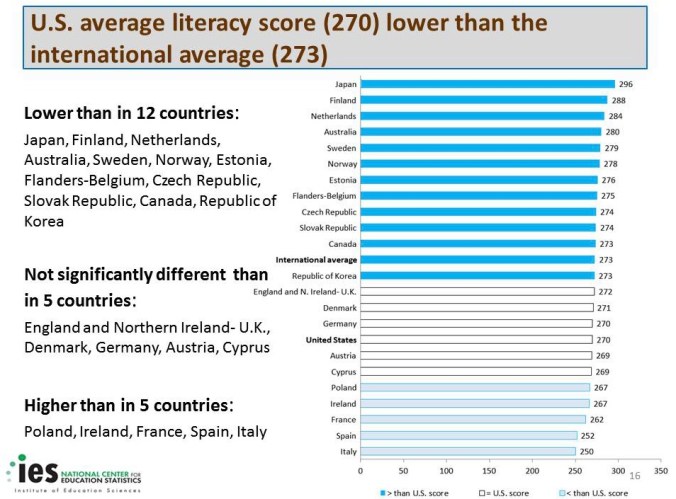
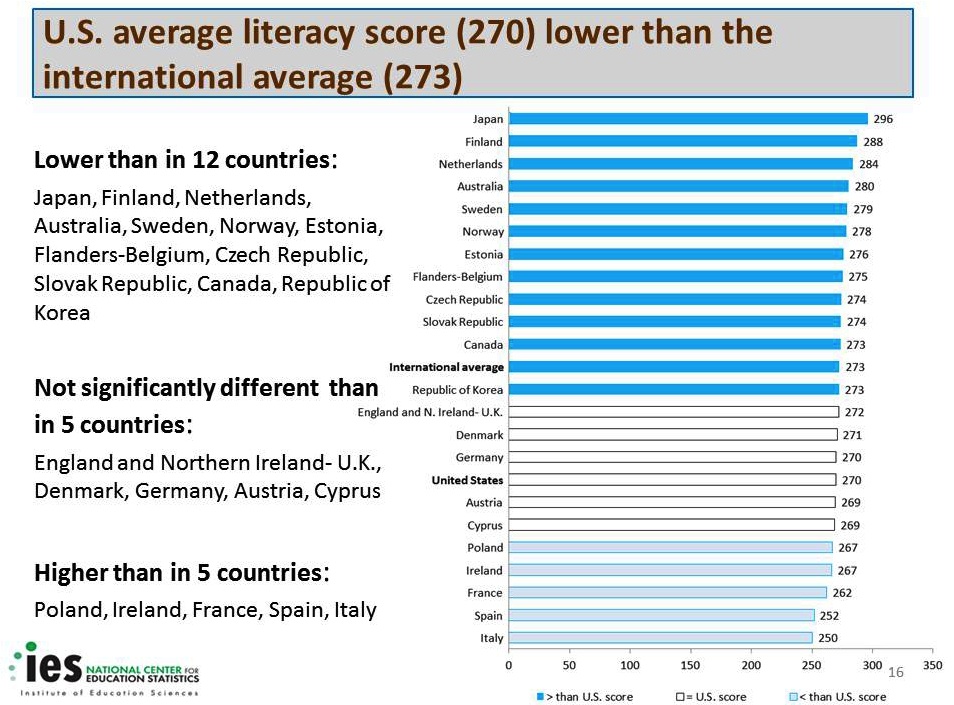
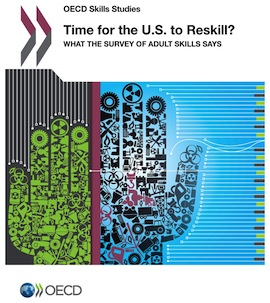
Last week, the Center for American Progress (CAP) and the Organization for Economic Cooperation and Development (OECD) co-hosted an event at CAP that basically served as the coming out party for a special U.S.-focused OECD report on the findings of the international Survey of Adult Skills, a product of the Programme for the International Assessment of Adult Competencies (PIAAC). As I’ve noted in previous posts, the findings for the U.S. are not encouraging. Here’s a chart from that report showing the relatively poor state of U.S. literacy skills:
After the OECD’s main presentation, Assistant Secretary for Vocational and Adult Education (OVAE) Brenda Dann-Messier outlined some specific actions that her office is taking in response to the report. You can view the entire event (including her complete speech) in the video at the end of this post, but I wanted to highlight the action steps, which were as follows:
(1) Her office will be developing a new national plan, to be released at the end of April, aimed at improving “the foundational skills” of low skilled adults.
(2) The plan will be informed in part by a series of five regional “engagement sessions” around the country, beginning with a session here in D.C. on Wednesday. (These “engagement sessions” may sound familiar.) OVAE will be working with the Department of Commerce to ensure that representatives from the workforce development, human resources, business, and labor communities “are actively engaged in these regional sessions.” OVAE also plans to gather “additional input” in each region from adult learners and teachers in local adult education and workforce training programs.
(3) Just like on Jeopardy, there’s a take-home edition: OVAE has put together a toolkit for people who want to host their own engagement sessions or roundtables. Feedback from these sessions will be collected and considered during the planning process. (OVAE also plans to provide opportunities for individuals to submit comments as well.)
(4) OVAE has produced a new set of state fact sheets that profile the low-skilled adult population in each state. (There’s a national profile, too.) This announcement was a bit puzzling to me, as the Assistant Secretary emphasized (correctly) that these profiles are not based on PIAAC but on schooling and educational attainment data from the American Community Survey (ACS). As I mentioned in an earlier post, I think the PIAAC data really drives home the importance of not conflating skills with educational attainment.
(5) The final action step was a puzzler as well, if only due to lack of detail. The Assistant Secretary announced a new “awareness campaign” with an organization called Connect2Compete, in order to, in her words, “create access for the approximately three million low-skilled adults” identified in PIACC “who want to participate in adult education but can’t due to lack of space or other constraints.”
Through the “Everyone On” campaign, millions of low-income american families can acquire low-cost high-speed internet access and low-cost, high-end devices, such as tablets and laptops. We’re particular exited about the opportunity to work together to not only qualify our students for affordable access and devices, but also to help adult learners connect with everyday services, engage in their communities, apply for jobs, and access high-quality online learning opportunities 24/7, 365 days a year.
This resource sharing effort will help us expand the infrastructure for adult learning in our country so that many more low-skilled adults can access high quality learning anytime, rather than exclusively relying on the WIA infrastructure which has the capacity to serve less than 2 million low-skilled adults per year. (my emphasis)
It’s hard to know what to say about this until further details are revealed. The reference to not “exclusively relying” on WIA (aka the Workforce Investment Act) is curious. It’s also worth noting, for now, that eligibility for many of Connect2Compete’s programs are tied to having children who are eligible for the federal school lunch program. Many adults in need of adult education services, of course, are without children. I’m also curious about how much of this effort is simply increasing awareness of Connect2Compete’s services, or whether there are some specific new resources for adult learners that will be developed. Hopefully, whatever this is, it will leverage and expand the existing efforts to provide online learning opportunities for adults, like this one.
One thing this announcement definitely didn’t include: more funding. That, of course, it is beyond the power of the administration to provide new funds without Congressional approval (although sometimes they can fund new programs by shifting money around or finding savings somewhere). However, that does not mean the administration is prevented from proposing that Congress provide new funding for adult education, which is exactly what the President did for pre-K education in his budget last year. In fact, major new pre-K legislation, based in large part on the President’s request, was rolled out great fanfare on Capitol Hill the very day after the OECD report on adult skills was unveiled at CAP. The House version of the Pre-K bill includes an authorization of $27 billion dollars for pre-K. (Federal support for adult education is well under a billion dollars annually.) This doesn’t mean that Congress will actually ever pass these bills, let alone appropriate those kinds of dollars for pre-K, but the proposal is, at least, on the table.
Make no mistake: the reason adult learners suffer from a “lack of space or other constraints,” is because nothing even remotely close to sufficient funding is being invested in these things. The question for those concerned about adult skills is whether, in the absence of even a modest proposal to increase funding for adult education, the administration is seriously committed to addressing the problem.
Update 11/19/13: I made a small edit above clarifying the ability of the administration to fund new programs. While it’s true that the executive branch can’t appropriate entirely new funding, the administration sometimes had discretion within program categories to allocate or re-allocate funds in order to pay for new programs.
 Literacy & Policy