Influential Research Center Has Closed

The Boston Globe is reporting that Northeastern University has closed the Center for Labor Market Studies, following on the heels of the retirement of its founder, Andrew Sum. For those of you who unfamiliar with Sum, he is one of the first I know of to study in depth the impact of literacy proficiency in the labor market. A huge influence in the adult education policy world.

Some samplings of his work:

Long-Awaited PIAAC Response Report Resurfaces

In case you missed it, this morning the White House announced the latest round of TAACCCT grantees. If you read the entire release, you may have noticed this curious related announcement:

In addition, the Department of Education is releasing a new report on the importance of building foundational skills in a job-specific context.

Ø  Department of Education Report on Transform Adult Learning through Work. The Department of Education is releasing a new report with recommendations to transform adult learning in the United States. After months of public engagement with a variety of stakeholders around the country, the recommendations for public-private partnership include strategies that engage employers to support upskilling of more entry-level workers while on the job, encourage the use of assessments and innovative learning tools to improve access to targeted career guidance for youth and adults, and promote better alignment and coordination of public and private programs so that youth and adults experience seamless services. The report highlights unique opportunities for implementing these recommendations as a result of the changed legislative environment made possible by the passage of the Workforce Innovation and Opportunity Act in July 2014.

I confirmed today with Department staff that the report referenced above is the long-awaited PIAAC response report or action plan that was announced last fall and then previewed at last spring’s adult education state directors meeting  However, contrary to the White House statement, the report was not in fact released today. It is finished but still in the “awaiting clearance” stage. No one could give me a date for actual release but the expectation is that it will be out sometime this fall. I know a lot of us in the field were wondering about the status of this report—some were speculating it might not ever be released—so I thought it was worth mentioning. It lives!


Some New(ish) Federal Adult Education Data to Chew On

UPDATED 9/22/14: The first chart below was the wrong chart, although this didn’t make any difference in terms of the point I was trying to make about total enrollment.

While preparing for a panel discussion tomorrow, I was reviewing the latest National Reporting System data on adult learners served by Title II of the Workforce Investment Act (WIA)—now reauthorized as the Workforce Innovation and Opportunity Act (WIOA).

I haven’t had a chance to update the “Primer” page on this site in a while. One of the things I need to update is the “Participants by Program Type” table, which also includes the total number of adults served. We now have data for the 2012-13 program year. This may not be that new—I just hadn’t had a chance to look to see if had been updated. Anyway, the numbers are not good:
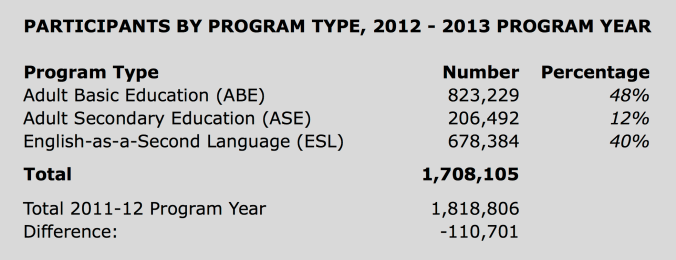
2013-14 NRS Enrollment Data

Source: Office of Career, Technical, and Adult Education, National Reporting System

You can see from this table that overall enrollment numbers are down once again, from 1.8 million to 1.7 million, a drop of almost 111,000 people. This is (or should be) really distressing, and again raises the question: will the new WIOA legislation do anything to stem the decline in adult education enrollment that has been occurring over the last several years? A lot of this decline has to do with funding, and the funding picture for WIOA is not good. (I realize that some of this enrollment could have been picked up by private, non-federally funded programs or via self-study, but I know of no data to support that. But I strongly suspect that enrollment in privately funded programs is not rising enough to offset the decline in WIA Title II enrollment.)

Here’s another interesting piece of data that is important to keep in mind when discussing the additional emphasis on employment skills in WIOA:
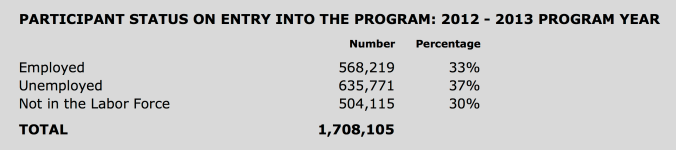
NRS Labor Market 2012-13

Source: Office of Career, Technical, and Adult Education, National Reporting System

As you can see from this table, during the most recent program year, 2012-13, almost a third of all adults participating in WIA Title II were not in the labor force. We need to know more about this population. Do we? Can anyone point me to a source? I don’t know, for example, how many of them are likely to be permanently out of the labor force. Or how many have simply given up (and of those who have given up, to what extent they identify skills issues as being the reason why). I know that during this same program year, about 60,000+ of adult learners were served over the age of 60, and presumably a lot of those folks are out of the workforce for good. Anyway, we likely need a lot of additional research here. In the meantime, it’s important to bear in mind that a significant number of people enrolling in a WIA-funded program are not part of the labor force.

Mr. Cranky’s Post of the Day

Earlier this week, when I was reviewing International Literacy Day blog posts and news items, a sentence from this post on the Global Partnership for Education’s Education for All Blog, by Aaron Benavot, caught my eye:

“One reason for slow progress in enabling adults to acquire basic literacy skills is inadequate education in their childhood.”

It says something, I think, about the degree to which early childhood education is seen as a silver bullet in conventional policy circles that a perfectly well-meaning person can make such a statement without noticing that it contains a fundamentally illogical premise. Until we gain the power of time travel, helping adults acquire basic literacy skills by going back in time and improving the education they received as children is not a realistic policy strategy.

Improving childhood literacy is a worthy and important goal, but it can only have an impact on adult literacy rates in the future, and only the relatively distant future, when those children are actually adults (15-20 years in the future). I think that is what Benavot is trying to say. But, to be clear, it does nothing to improve current adult literacy rates. Nothing. Assuming we also want to improve adult literacy right now, or in the relatively near future—and we should be—we need to invest resources in efforts that actually address adult education. Right now. Otherwise we are punting on the current generation of low-skilled adults in favor of a strategy that is solely focused on investing in future generations. Not, I think, what this post is actually suggesting, but I think it’s fair to point out that this sentence futzes up this point, and that many early childhood education advocates seem to do so as well.