Anthony Carnevale: Skills Mismatch Not the Whole Story

Whatever you think about the effectiveness of federal job training programs, Amy Goldstein’s story in Saturday’s Washington Post notes the basic problem with relying too heavily on job training to solve the country’s unemployment problem by itself.

Anthony Carnevale, the director of Georgetown University’s Center on Education and the Workforce, which has produced valuable research on the relationship between earnings and educational attainment—including the long-term value of a college education—acknowledges, according to Goldstein that “retraining can’t always overcome a scarcity of jobs.” She writes:

That skills mismatch, while real, is not the whole story, Carnevale says. At the moment, he points out, the country has 3 million to 4 million job openings. But if you add up the people who are unemployed, in part-time jobs because that’s all they could find or so discouraged that they’ve quit looking for work, he says, the country has more than 20 million people who could use a job. (my emphasis)

In other words, not enough jobs are out there, even if every single person who needed re-training received it. None of this means that re-training, investments in community colleges, and increasing access to higher education are bad policies, but it does suggest that there are other factors that need to addressed in order to fully address inequality and economic opportunity.

Interestingly, the Post comes back today with a story on the skills mismatch in some areas of the manufacturing sector.
Some High Demand Jobs of the Future Will Not Require College

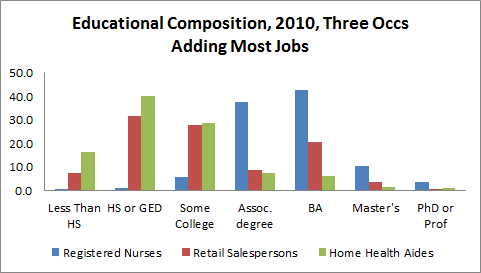
Jared Bernstein takes a look at the latest BLS tables and makes an interesting observation: of the first three occupations expected to add the most jobs in the near future, two of them (retail sales and home health aides) are in industries that generally do not require advanced education:

Educational Composition - top three fastest growing occupations

Source: Jared Bernstein, Citing BLS Employment Projections

Bernstein is not suggesting that skills and education do not matter. As he notes, it’s hard to say now what the skill demands for a food prep worker or cashier will be ten years down the road. More importantly, he has previously made the case that it’s better for the worker and society overall when people within these occupational categories have more skills and training.

But even if there are more job opportunities for those with lower education levels than some would have you believe, the quality of those jobs isn’t great. Where I live, in Washington, D.C., many of retail jobs, for example, pay the minimum wage or just slightly better, and don’t offer much in the way of advancement, and/or have lousy benefits. The median wage for workers in low-income families in D.C. is just a little over $9.00 an hour (this comes from a 2010 report, but I doubt it’s gone up much), which is too low to lift a family out of poverty even working full-time.

So I understand why college access is an attractive anti-poverty policy lever: (1) the jobs for those without college often do not pay enough to lift people out of poverty, and (2) those living in poverty have often been denied access to a decent education, perhaps over multiple generations.

But if we expect there to be a continued demand for employees in industries that do not generally require a college degree, what else could be done to lift wages and improve working conditions in these high-growth, low-skill industries—rather than just asking workers to get a degree in order to escape them?

Unemployment Benefits Extension Should be Approved Friday – and Without GED or High School Diploma Requirement

Full text of the bill, now titled  “The Middle Class Tax Relief and Job Creation Act of 2012” is posted here.

It is reported that the bill will get to the floor of the House on Friday. It is expected that the Senate will also approve the bill the same day, before going on recess for a week.

In the compromise bill, unemployment benefits eligibility will not require a high school diploma or a GED, or some kind of proof that you are in a class and making progress toward one for the other. As reported, a much more limited authority to require drug tests did get in, as did a modified version of the state waiver proposal. I haven’t had a chance to study that. Hopefully someone else will offer an analysis later today.

High School Diploma, GED Requirement Apparently Dropped in Unemployment Benefits Extension Compromise

(updated below)

According to press reports, the House-Senate committee charged with coming up with a compromise measure to extend the payroll tax reduction and unemployment benefits reached a tentative agreement last night. In the deal, Republicans have apparently dropped their proposal to require unemployed workers who lack a high school diploma or GED from collecting unemployment benefits until they acquire one or the other (or are enrolled in a class to acquire one). From a New York Times story on the deal this morning:

Democrats, elated after winning the Republican tax concession after months of clashes, said they had also been able to beat back new conditions that Republicans had wanted on jobless pay, like requiring beneficiaries to seek high school equivalency degrees…

From the Boston Globe:

Republicans also were expected to drop a proposal requiring unemployed people to enroll in GED classes to obtain benefits, and a GOP proposal allowing states to employ drug tests as a condition of receiving unemployment benefits would be scrapped as well. But Republicans won a provision requiring jobless people to be more diligent in job searches as a condition of receiving benefits.

It will be interesting to look at the final conference report to see what that last sentence means.

Also, it’s not entirelly clear to me what has happened with the drug testing requirement. The Globe report above says its been dropped, but an earlier report in Roll Call quoted a Republican aide saying that the deal included language allowing states “to drug screen workers seeking a job that requires a drug test or who lost a job due to a failed drug test.”

Politico, reaffirming that the high school diploma/GED requirement has been dropped, but suggests that the deal might have an extremely watered version of the drug testing requirement:

The deal would drop language called for by Republicans allowing states to drug test potential recipients of jobless benefits and requiring the unemployed to be in a GED program if they have not finished high school. Republicans said the deal’s language on drug testing will reaffirm existing law.

Update (6:00 PM): Roll Call reported this afternoon that House Republican leaders emerged from a Conference meeting this morning “tempering expectations” that a majority of their Conference will accept the deal. Democrats were also reportedly “quick to note that a deal is not yet final.”

Meanwhile, the Washington Post‘s Greg Sargent was forwarded talking points that House Republicans have been circulating about the deal, which includes the following:

“Those receiving unemployment benefits must be searching for a job, and every state will be allowed to drug screen workers seeking a job that requires a drug test or who lost a job due to a failed drug test.”