Nebraska City’s 2010 Anti-Immigrant Ordinance Comically Off Target, and Irritating to Business

The City of Fremont, Nebraska is providing a good case study on how anti-immigration efforts can backfire. Despite the fact that, according to this article, no one in Fremont has any idea how many of its 1,259 non-citizens are illegal immigrants, (or if there are any at all) anti-immigrant petitioners managed to get a referendum passed in 2010 that requires companies to verify the citizenship status of the people they hire, while forcing renters to swear to landlords that they are legal residents and pay a $5 fee for the pleasure.

But the law doesn’t really do much of anything other than irritate the local business community and antagonize the city’s Hispanic residents. A federal judge threw out part  of it, (because it was in conflict with federal law), making the rental verification piece utterly toothless (the city isn’t allowed to revoke the rental permits if applicants actually turn out to be illegal immigrants); and the hiring verification piece won’t have any effect beyond the city limits of Fremont, which is where most of the immigrant population in the area actually lives and works.

Meanwhile, business owners hate the new rules:

“I’ve spoken to a few businesses owners about it, and … they definitely feel this is just another burden for them,” [mayoral candidate] Paden said. “I don’t feel that it should be up to the businesses to police these matters. We have federal agencies that should be handling that. All this ordinance is now is another hoop to jump through.”

Ron Tillery, with the Fremont Area Chamber of Commerce, questioned Tuesday how effective the ordinance will be. Most of Fremont’s businesses already comply with the E-Verify requirements, he said, and the new housing permits seem to serve little purpose in the wake of the judge’s ruling. He said the city will incur costs to process the rental permits but won’t be allowed to act on the information and deny any permits.

The article also notes that the City Council president, mayor, city attorney and city administrator have all resigned within the last year, suggesting that the fallout from the ordinance is to blame.

So if the law is largely toothless, opposed by the business community, and poison to political leaders in town, what is the point of it?

Petition organizer Jerry Hart said he knows the ordinance won’t eliminate illegal immigration, but he hopes it will inspire other cities and states to act.

“Our goal when we started was just to get the issue to a vote of the people,” Hart said. “The people of Fremont let it be known that they don’t want illegal immigrants in their community.” (my emphasis)

A local grocery owner says, according the article, that the ordinance “is not about illegal (immigrants). It’s about race. The people behind it don’t want Hispanics here.”
Dean Baker Thinks Unfilled Jobs More Due to “Incompetent Managers” Than Skills Gap

Today I noticed that Dean Baker of the Center for Economic and Policy Research, who knows a lot more about this stuff than I do, shared my skepticism about this Washington Post article on the alleged skills gap in the manufacturing sector. Actually his response was a lot stronger than mine:

The Washington Post told readers that the manufacturing industry is suffering from incompetent managers and therefore is not hiring as many workers as it should. According to the Post, managers don’t realize that it is necessary to raise wages to attract more workers and instead are whining that they can’t get the workers they need to fill vacancies.

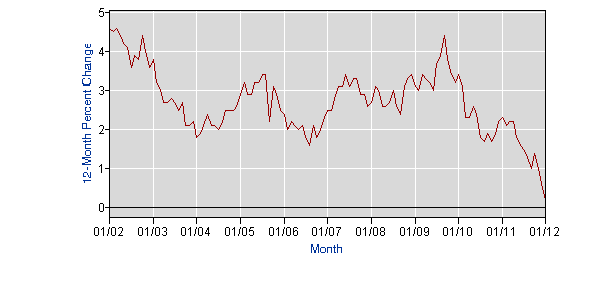
Baker produced a chart showing how far hourly wages for non-supervisory workers in the manufacturing sector has fallen in recent years, and it’s kind of astounding:

Chart showing decline in manufacturing wages

Source: Dean Baker, CEPR, using Bureau of Labor Statistics data.

Disinvesting in Libraries: Anti-Stimulus

Yesterday, the Lompoc Record (Lompoc, Calif.) published a story about a new round of budget cuts facing the Lompoc Public Library system. (Similar cuts taking place all over California, and in other states.)

Budget cuts have already left a “shovel ready” children’s library expansion project in limbo as the Lompoc library recently lost $1.05 million in construction funding. They now need $2.04 million to get the project underway, and “there’s no timeline for construction.”

Meanwhile, Lompoc Public Library board member Maria Aguiniga notes that the cuts to library services “are affecting some of the most vulnerable in the community.”

“I think that some of us are fortunate to have computer and Internet in our household,” Aguiniga said. “We think everyone has the same access and that is not the case. People go into the library to seek employment, to type up resumes and to do research.”

In other words, the Lompoc Public Library has been forced to (1) indefinitely delay an initiative that is immediately stimulative to the economy (construction of a new children’s library), and (2) reduce services that provide a long-term benefit to the economy by providing resources for people to improve their skills and look for work.

Multiply this by a few thousand communities where similar cuts and funding gaps exist, and it’s not hard to imagine how library cutbacks can act as a drag on overall economic growth, especially in states where cuts have been the most severe.

In the District of Columbia, where I live, public library budget cuts haven’t been quite as bad as they have been in states like California, particularly in terms of new construction: several beautiful brand new or revamped branch libraries have opened in D.C. neighborhoods over the last few years. But many of those branches have been forced to reduce their hours, and funds for new materials has been dramatically reduced because of overall budget cuts to the system.

Skilled Factory Workers or Cheap Skilled Factory Workers?

As I wrote earlier, the Washington Post published a story today on the alleged skills gap in the manufacturing sector in Michigan and other parts of the country. If you make your way all the way to the end of the story, after reading various employers lament the fact that the workers they laid off in 2009 now can’t work any of the newfangled machines that these companies installed during the recession, you get to this interesting paragraph:

The shortage of skilled workers has also pushed up wages, though executives said raising them too far could push more work to overseas plants(my emphasis)

In other words, if you are one of those laid off workers who does invest time in the re-training required to get your job back, don’t expect a big return on that investment in the form of higher pay, or we will ship your job overseas.

The article closes with an anecdote that again raises the question as to whether at least some employers who complain about the lack of skilled workers are actually complaining about a lack of cheap skilled workers:

A Michigan company that makes camshafts for cars, as well as farm and mining equipment, has had ads out for at least six months for CNC machine operators and programmers. The pay runs from $15 to $21 an hour, a relatively good wage in this part of the country.

“The problem is as soon as we get someone in, one of our other guys will jump ship,” said Tyson De Jonge, engineering manager at Engine Power Components. “They get better offers.” (my emphasis)

The author of the piece accepts the company’s claim that they are paying a “relatively good wage” even though the evidence seems to contradict this assertion. It sounds like these folks are “jumping ship” because someone is offering them better pay somewhere else.