Is the Potential Elimination of Adult Education in Los Angeles Our Wisconsin Moment?

latimes-march14

Photo of the front page of the March 14th edition of the Los Angeles Times, from the Save Adult Ed! Web site.

About a year ago, Steven Greenhouse of the New York Times described the effort by Governor Walker of Wisconsin to slash the collective bargaining rights of his state’s public employees as a potential “watershed for public-sector unions, perhaps signaling the beginning of a decline in their power — both at the bargaining table and in politics.”

The situation in Wisconsin galvanized the labor movement and resulted in a massive protest that engaged people from around the country. I’ve been thinking about those protests the last couple of months as I’ve been following the school budget situation in Los Angeles, where the school board has decided to completely shut down adult education unless new revenue or teacher pay cuts are accepted. Eliminating adult education in L.A. would cut off adult education services to well over 300,000 people.

There are a lot of differences between the crisis in L.A. what was happening in Wisconsin a year ago in many, many fundamental ways. For one thing, the effort to dismantle public sector unions in Wisconsin was connected to an organized, long-standing national political agenda, and to my knowledge there is no political party with a specific agenda to dismantle adult education. Secondly, adult education ever had the political clout or recognition that organized labor has. But I do think an argument can be made that the attempt to shut down adult education in L.A. is a similar “watershed” moment for the field, both because of the scale of the protests (500 people at the rally yesterday), and, possibly, the ramifications. If adult education services at this scale, and with such visible, active support, can simply be dropped—if the city and the school board, in other words, gets away with doing this—does this send a message to policymakers across the country that they can get away with it too? Granted, adult education has never been in a very secure position in most states; as noted by CLASP, several states have been cutting funding for adult education dramatically the last few years, and Arizona dropped state funding altogether in 2010.

But eliminating a program of this size is, I believe, unprecedented (by comparison, according to CLASP, Arizona’s 2010 cut dropped services for 40,000 people). For this reason, it feels like a dangerous line in the sand that the adult education field should not allow to be crossed, similar to the way in which labor leaders realized that the fight in Wisconsin last year had ramifications that went well beyond Wisconsin state borders.

Here is a video of the guy with the megaphone above. He was living under a bridge before he learned English:

LAUSD Board Approves Budget Proposal They Say Could Allow Adult Education to Continue (Updated)

march-13-rally-saveadulted-lausd-headquarters(UPDATED BELOW)

Last month, the Los Angeles Unified School District (LAUSD) Board held off on a proposal to completely eliminate the LAUSD’s adult education program, which would have left over 300,000 adult students without adult education services in Los Angeles.

According the L.A. Weekly, the Board instead asked Superintendent John Deasy and the unions to work together on a plan to balance the budget that would not require eliminating adult education and other programs, like pre-K services, also slated for elimination. According to the Weekly, Deasy started that ball rolling at the meeting by specifically pitching a parcel tax proposal just before the Board voted on the matter—one that “he and Board President Monica Garcia mentioned at every opportunity throughout the meeting.” Moreover, the Superintendent implored those speaking against the program eliminations to support such a tax proposal. (Some suggested at the time that the proposal to zero out adult education might, in fact, have been “orchestrated by district officials to galvanize support” for the tax increase.)

Today, as reported in the Contra Costa Times, the Board met and approved the plan the Superintendent came up with, which not only includes the parcel tax proposal (specifically, putting a $298 parcel tax on the November ballot to raise $255 million a year for the next five years), but also would require request LAUSD labor unions to accept a one-year pay cut across the board (!), which they estimate will save another $220 million. If both of these things are approved, Deasy says LAUSD will be able to continue adult education (although my guess from that language is that this does not necessarily mean that the budget for adult education services might not be reduced) and other services that have been threatened with elimination.

UPDATE, 3/14: A different story appearing in the same paper says that the vote was for “a worst-case budget that would gut popular programs like Adult and Early-Childhood Education for 2012-13, although a recent infusion of state money allowed officials to hold out hope of restoring some programs by fall.” That seems to be consistent with this post, although I still don’t understand what exactly has been cut and when those cuts would go in to effect or potentially be restored. I think the bottom line is that the proposal appears to do something short of eliminating adult education completely while leaving it’s budgetary future more than a little murky.

UPDATE 2, 3/14: More stories out today that clarify this a bit better. Basically, I’ve got this right, but the way I characterized it originally is a bit more hopeful-sounding than it should have been.

According to  in The Huffington Post, (citing the  Daily News) Deasy’s plan is a worst-case scenario plan that does in fact eliminate adult education and other programs—which is more or less just like the old plan, but with two differences:

1. Deasy was able to make a $180-million readjustment to the deficit projection as a result of, according to the Los Angeles Times, “a variety of unexpected good news, including the restoration of projected cuts to transportation, higher-than-expected state lottery revenue and a decrease in projected benefits expenditures.” As a result, the district was able to maintain some programs in the plan as it now stands, such as career and technical training for high school students.

2. Adult Education and several other programs, on the other hand, are still eliminated in this plan. The difference is that they could still be restored if the parcel tax increase is approved by the voters and/or the unions accept the across-the-board pay cut he has proposed.

In other words, the plan doesn’t assume that the revenue/savings ideas will go forward. It’s a worst-case plan that leaves some hope for adult education restoration, but no promises.

In order to pass, parcel taxes need the approval of two-thirds of voters. LAUSD’s last parcel tax measure in 2010 was defeated with 52 percent of the vote. I have no idea how likely it is that the unions will accept the pay cut proposal and too tired to find out. But I can guess it will not be (has not been?) warmly received.

Some adult education advocates in Los Angeles have strong opinions about the financial mess that LAUSD and how to resolve them that go to more fundamental issues of fairness and economic justice. In fact, for those interested, there is a lot more to read about the situation in L.A. here and here. (The second link is to a Web site set up by L.A. adult education advocates.)

(In addition to the updates above, the headline has been re-written to better reflect the tenuous nature of the possibility that adult education will be restored.)

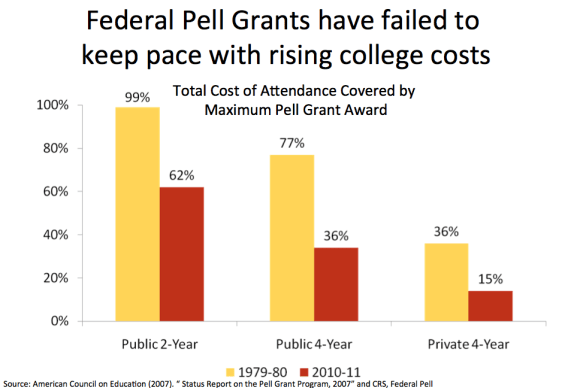
Great Chart Showing How Pell Grants Have Failed To Keep Pace with Rising College Costs

Paul Krugman, in response to the Thomas Edsall piece I wrote about below, was especially struck by this chart, (which comes from an Education Week webinar held last summer), showing the declining value of Pell grants compared with college costs:

pell-edweekchart

The “Reservoir of Resentment” Over College Access

Thomas Edsall wrote an excellent piece for the New York Times yesterday that is packed with data (and charts) showing how the high price of college access today, combined with a dramatic rise in recent years in the college premium—the difference in annual earnings of a high school graduate and a college graduate—is contributing to growing increasing income inequality and reinforcing class stratification in the U.S.

Edsell believes this problem presents a political challenge—or opportunity—for candidates running for office in 2012:

Politically, the lack of access to a four-year college education is a crucial problem for one of the key battleground constituencies of 2012: whites without college degrees. Several issues that can be mined by enterprising politicians cluster around this debilitating lack of access — in fact they help cause it — including the enormous debt loads carried by students and recent graduates, as well as the emergence of for-profit colleges saddling low-income students with loans for programs they cannot complete. The data show that a disproportionately large percentage of young adults from working-class families who, according to their test scores and grade point averages, are equipped to earn a B.A., are either not going to college, or failing to finish — relegating them to a life of stagnant or declining wages. There is a reservoir of resentment over this fate waiting to be tapped by either party.

The question is whether candidates will attempt to simply exploit that resentment without actually addressing the underlying problem—as some already have—or actually try to do something about it.