Great Collection of School Library Posters from the 1960s, Back When People Cared About School Libraries

RETRO POSTER - Interested in Sports?A Flickr user recently uploaded a collection of 1960s library posters discovered “while digging through old library stuff.”

I love the poster here in particular. Who doesn’t enjoy a good book about track? (I’m sure there must be one, actually. By the way, a great collection of boxing writing was published just last year, “At The Fights: American Writers on Boxing,” edited by the late George Kimball.)

Most of the posters in this collection, like the one here, are promoting school libraries. Today, school libraries are under threat. Here in Washington, the city recently eliminated funding for school librarian positions in D.C. Public Schools with fewer than 300 students. And those with more than that 300 students, while they will still receive funding for the position, they’re not compelled to fill it.

New Community College Completion Study Emphasizes Student Perspectives – Will Adult Education Policymakers Join the Trend?

Education Week’s College Bound Blog reported today on a new report published by Public Agenda, WestEd and the Bill & Melinda Gates Foundation’s Postsecondary Success Initiative that looks at barriers to college completion, called Completion by Design Student Voices on the Higher Education Pathway. The researchers gathered the bulk of their data for this report via focus groups with community college students themselves. The students’ responses are worth reading (in particular, from an adult education perspective, it was interesting to read that “most students believed that the student success and developmental education courses intended to bring them up to speed were not offered in a way that helped them succeed”), but it was also interesting to me to learn that, apparently, soliciting student views on the issue in the first place is unusual—and that doing so might be an emerging trend:

Policymakers are realizing that listening to students may be part of the answer to improving educational attainment. Other initiatives have focused on high school student voices and attitudes of students about paying for the cost of college.

Could this trend one day work its way into a prominent place in adult education research? In 2009, in testimony provided to what was then called the House Committee on Education and Labor’s Higher Education, Lifelong Learning, and Competitiveness Subcommittee, Mary Finsterbusch, Executive Director of VALUE, a national nonprofit organization governed and operated by current and former adult literacy students, argued that the perspectives of adult literacy and basic education students are often overlooked:

One of VALUE’s core beliefs is that most successful for-profit companies rely on consumer input and feedback to improve their products and services; the adult literacy system should do this too. Adult learners should be part of the planning, delivery, and supervision of adult education services and research at every level. As recipients of adult education services, adult learners have a unique, important, and all-too-often overlooked perspective regarding what does and does not work.

The consumer, the adult learner, isn’t asked for input or feedback about adult literacy policies and programs in any systematic way. Low-literate adults are sometimes viewed as ignorant – at best, people to be pitied and taken care of; at worst, people to be looked down on and dismissed.

On May 29th I was invited to attend a briefing on a new National Research Council (NRC) report,  Improving Adult Literacy Instruction: Options for PracticeThis report essentially distills and summarizes the latest research (or, in some cases, the lack of sufficient research) that informs (or should inform) adult literacy teaching practices. There were several hundreds attendees at the briefing asking questions and providing feedback; by my count, there was just one person there who self-identified as an adult learner—Marty Finsterbusch.

What Would Sequestration Mean for Adult Education?

(Updated Below)

In less than six months, more than 200,000 adults across the country may be facing the possibility of losing adult education services sometime in 2013, and as many as 730 adult education jobs in community colleges, community-based organizations, and public schools could be eliminated. (But see update below.)

These numbers come from an analysis just released by the National Education Association (NEA) on the potential consequences of sequestration on public education. Sequestration is the term used to describe the automatic federal budget cuts that are scheduled to kick in on January 1st, 2013, unless Congress passes some kind of legislation to defer, alter or avert it. Right now these cuts are required by a law that this same Congress passed just last summer—the Budget Control Act (BCA)—which raised the federal debt ceiling in return for an immediate federal budget cut of $900 billion and a commitment to come up with a plan (which could include spending cuts and/or tax increases) to reduce the federal budget deficit by another $1.2 trillion by 2021. The plan was supposed to come from a so-called  Congressional “super committee”—if they failed (and they did), automatic budget cuts were required in both defense and non-defense discretionary spending, beginning on January 1st of 2013, with across-the-board cuts to virtually every federal discretionary program (a few are exempted).

The NEA’s analysis of the impact this would have on adult education includes not only a national estimate, but state-by-state estimates as well. (NEA actually provides two estimates for the country and for each state. The Congressional Budget Office has estimated that nonexempt programs would be reduced by 7.8 pecent in 2013; an analysis conducted by the Center on Budget and Policy Priorities indicates that nonexempt, nondefense discretionary programs and nonexempt mandatory programs would be reduced by 8.4 percent and 8 percent, respectively.)

I asked the author of this analysis, Tom Zembar, about his methodology and he did point out that it’s impossible to know exactly how states and providers would actually react and readjust services once the cuts go into effect, but the point of the analysis was to help people understand the potential consequences of the cut in each state. I’ve included a reproduction of the first page of the adult education analysis below; click on the link to go to the full report. This page, and the state-by-state table that follows, are towards the end.NEA: Impact of Sequestration on Adult Education
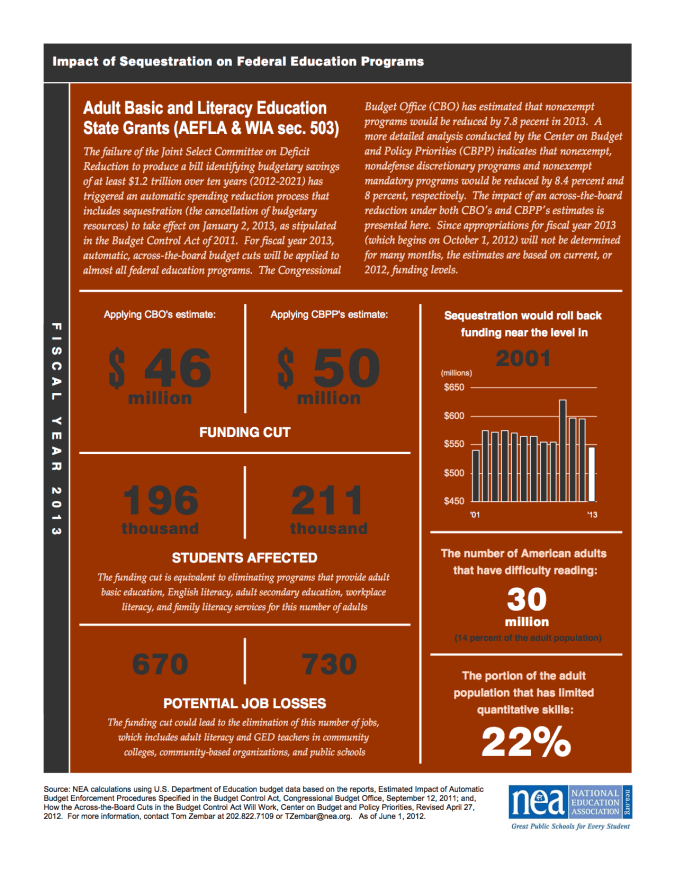
UPDATE 8/1/12: A couple of clarifying points:

(1) First, in my lead, for the sake of being dramatic, I strongly created the impression that FY2013 funds will be cut instantaneously on January 1st. I should have pointed out that Adult Education under WIA Title II is a forward-funded program, meaning that funds don’t become available for obligation until July 1st of the fiscal year in which they are appropriated. On the other hand, since states start their budget process over the winter based on the amounts they expect to receive from federal programs later in July, I believe the impact of sequestration would start to work its way into proposed state budgets for adult education pretty quickly,  even if the actual federal reductions might not be felt until later in the year.

(2) Which brings me to my second clarifying point: no one can know with certainty what states are actually going to do once they get their sequestered numbers. I assume that any reduction in the Title II state grants resulting from sequestration would trigger an equivalent reduction in the state’s match and maintenance of effort obligations—but I don’t know exactly how that will work. In any case, a state could, conceivably, respond to the reduction in the federal grant by raising their state’s investment in adult education to offset the cut. I think that’s doubtful, at least on a widespread basis. It seem more likely to me that the NEA estimates above—which, for simplicity’s sake, don’t factor in potential state reductions, but just focus on the student service cuts and job losses resulting from the federal cutprobably underestimate the actual reduction in both services and jobs in most states if sequestration moves forward.

UPDATE 11/15/12: I’ve re-worded the opening paragraph for the reasons noted in the update above.

CEPR: People Living Below the Income Poverty Line Today are Better Educated than Ever

Last April,  the Center for Economic and Policy Research (CEPR) published Low Wage Workers Are Older and Better Educated than Ever, an issue brief showing that the average low-wage worker today is both older and much better educated than the average low-wage worker was in the past.

Yesterday, Shawn Fremstad noted on CEPR’s blog that, in addition, the number of middle-aged workers living below the poverty line with at least some college or a Bachelor’s Degree has nearly doubled between 1979 and 2010. In addition, the number of middle-aged workers living below the poverty line without a high school diploma has dropped by nearly 50% during that same period. Fremstad looks at this data nd concludes:

Increasing educational attainment by itself is not at all sufficient to reduce inequality and income poverty — we need stronger labor market institutions, particularly ones that increase workers bargaining power to address these issues.