(Important Updates Below)
Less than a month ago, Democrats were talking about the possibility of embracing some kind of tax deduction cap as part of a potential fiscal cliff-avoiding deficit reduction agreement, an idea that President Obama had himself been floating for some time, although it’s never gone anywhere with Congress. (Specifically, the President has proposed was capping itemized deductions, including the one for charitable contributions, at 28% for individuals earning more than $200,000 a year and married couples earning more than $250,000 a year.)
But Friday, Jason Furman and Gene Sperling, two of President Barack Obama’s top economic advisers, posted an article to the White House blog that is critical of placing a cap on itemized deductions—in this case, a proposal to place a fixed $25,000 cap on deductions. They argue that such a cap would not raise the revenue proponents claim, and would have too much of an adverse impact on middle-class families and on charitable donations.
Some have raised issues with their analysis, but I wonder if that matters—it seems to me that what’s most important about their post is not the numbers, but the political message that it’s sending.
Clearly, something has changed since just after election, when Democrats were talking about deduction limits being part of a bipartisan solution to deficit reduction. Interestingly, Furman and Sperling make no reference to the President’s earlier 28% cap proposal—which would obviously work differently—but I don’t get the feeling that this proposal is coming back either. I think that what’s changed is that the administration is digging in its heals on raising tax rates, and so they’ve decided to scrap the idea of raising revenue by capping deductions as a potential compromise.
Which is another way of saying that, politically, it seems increasingly unlikely that the charitable tax deduction is in any danger. Capping or getting rid of it has never been a popular idea anyway, and now it appears the administration is taking it off the table in their push to force Republicans to accept tax rate increases as part of a deal. (But see important update below—turns out that the 28% cap is not off the table, as the White House has since released a more detailed cirtique of dollar caps that includes a renewed endorsement of the President’s 28% cap proposal.)
I’m really interested in knowing whether anyone else thinks I’m reading this correctly. I’ve seen a few comments about the Sperling/Furman post, but haven’t seen any discussion as to whether this is a complete abandonment of the idea of any kind of deduction cap being part of the deficit deal.
UPDATE 12/4/12: An article yesterday in InvestmentNews discusses the difference between a dollar cap on deductions (which is what Sperling and Furman were analyzing) and the percentage cap that the President had proposed earlier. Since I noted above that a percentage cap would work differently but didn’t explain how, I thought I would pass it along:
Especially for higher-dollar donors, the dollar cap would be much, much worse than a percentage cap of 28%,” said Evan Liddiard, tax policy expert at Urban Swirski & Associates LLC, who advises on charities. “We should be focused on all kinds of caps, but particularly dollar caps because they will have the most devastating impact on the nonprofit community.”
With a dollar cap on deductions, it’s expected that Americans would first use up their allotted tax savings with items such as their mortgage interest and state taxes, and that there would be none or just a small amount left for giving tax-efficiently to charities, said Steve Taylor, senior vice president for public policy at United Way Worldwide.
“Wherever you draw that line, you effectively eliminate the charitable deduction for some class of donors,” Mr. Taylor said.
To compare the impact of the two proposals, Mr. Liddiard looked at how a married couple with two children earning $400,000 and contributing $40,000 to charity would be hit. The 28% cap would provide $4,500 less in tax savings for that family, which under today’s law can deduct 31%.
That same family would lose about five times that amount in tax benefits under the $25,000 cap (assuming that the family qualified for a total of $91,000 in deductions for charity, mortgage interest, and state and local taxes). The $66,000 spent beyond that cap would translate to about $22,000 less in tax savings, Mr. Liddiard said. (my emphasis)
For a family making $3 million and donating $300,000, the 28% cap would take away $42,000 of their tax savings, assuming that they could take the maximum 35% deduction. The $25,000 cap would wipe out more$200,000 of their tax benefits, assuming that they claimed a total of about $600,000 in deductions.
However, the article also quotes Howard Gleckman, a resident fellow at the Tax Policy Center, who points out that the two approaches are “difficult to compare,” because everyone’s tax situation is different.
I still think that the White House Blog post represents a pull-back on the whole idea of capping deductions further. Again, the article never once mentions the President’s earlier proposal.
UPDATE 12/7/12: As noted above, after not talking about for a while, The White House is again pitching the President’s 28% cap proposal, (during a series of calls with nonprofit leaders today, along with in a new report from the National Economic Council), so the idea of a percentage cap, at least is definitely not off the table. The report makes a more detailed argument as to why a dollar cap is be a bad idea, while making a reinvigorated pitch for the President’s 28% deduction cap.
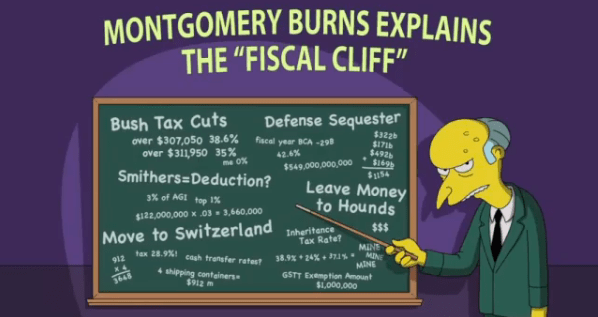 Still reeling from the Romney election loss, Montgomery Burns takes a few moments to explain the looming fiscal cliff:
 Literacy & Policy