Obama Administration: SKILLS Act Fails to Meet the Needs of Adults With “Literacy and English Language Needs”

(Updated below)
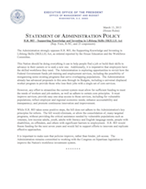
STATEMENT OF ADMINISTRATION POLICYIn case you missed it, here is the Obama administration’s official response (known as a “Statement of Administration Policy”) to the SKILLS Act. The Republican-led bill to reauthorize the Workforce Investment Act recently passed in the House, but is likely dead-on-arrival in the Senate.

The administration says the SKILLS Act “would eliminate, or allow the consolidation of, many targeted programs, without providing the critical assistance needed by vulnerable populations,” including “adults with literacy and English language needs.” (my emphasis)

UPDATE: Acting Secretary of Labor Seth Harris also released a statement last week that was critical of the SKILLS Act. He doesn’t mention adult literacy specifically.

Could Immigration Reform Draw Greater Attention to the Legal Needs of Low-Income Immigrants?

Kirk Semple, writing for the New York Times’ City Room blog, reports that a federal appellate judge in New York is proposing an “immigrant justice corps” program that would recruit and train young lawyers to assist illegal immigrants navigate the pathway to legal residency status and citizenship—under the assumption that the immigration reform legislation anticipated sometime this year will provide one. Most expect it will.

The judge, Robert A. Katzmann, envisions something that would look a lot like AmeriCorps VISTA and the Peace Corps. According to Semple, the program would recruit 50 young immigration lawyers every two months for two-year periods of service. Like the programs modeled on Teach for America I wrote about a couple of weeks ago, it would give graduating law students an opportunity for work in what is a tight job market right now for lawyers. Katzmann estimates that he would need $5 million to support the program for a year. Authorizing a few million dollars of federal money in the immigration reform bill itself to provide legal assistance to those trying to meet the requirements of the law should be a no-brainer, but in the current budget-cutting climate, that may not be possible.

As Semple notes, Judge Katzmann has been a longstanding critic of the quality of the legal representation provided to immigrants, and was the leader of a group in New York group that proposed a plan last year to create a network of legal service providers to represent low-income immigrants in the New York City region.

One of the biggest problems facing immigrants in any legal proceeding is lack of English proficiency. I’ve seen firsthand defendants brought before judges in criminal courtrooms, for example, who don’t read or speak English and have no experience navigating the U.S. legal system. Last year, I noted on this blog that the National Center on Access to Justice (NCAJ) at the Cardozza School of Law had concluded that many courts “have little or no way to communicate with the growing number of Americans who have only limited proficiency in English.” As a result, “innocent people have been sent to prison, children have been sent to foster care unnecessarily, and women have found it impossible to get court orders to protect them from domestic violence.” As I argued in that post, this is a problem not just for non-native English speakers but for native English speakers with low levels of literacy as well.

I agree with Judge Katzmann that the problem of inadequate legal representation for immigrants (especially low-income immigrants) will acquire even greater urgency once an immigration reform bill is passed, but the problem isn’t limited to immigration status issues. Perhaps his proposal will draw greater attention to the need to address language access and low literacy in our justice system generally.

SKILLS Act Approved by the House – Now It’s Off to Die in the Senate

If you follow this legislation closely, you already know this, but in case you missed it: the House of Representatives, to no one’s surprise, approved the House Republicans’ Workforce Investment Act (WIA) reauthorization bill, H.R. 803 (known as the SKILLS Act) on Friday, pretty much along party lines. Only two Democrats voted in favor: Rep. Matheson (UT) and Rep. Barrow (GA).

Fourteen Republicans voted against:

Paul Cook (CA)
Gary Miller (CA)
Paul Broun Jr. (GA)
Thomas Massie (KY)
Justin Amash (MI)
Walter Jones Jr. (NC)
Frank LoBiondo (NJ)
Jon Runyan (NJ)
Christopher Gibson (NY)
Michael Grimm (NY)
Peter King (NY)
Michael Turner (OH)
Jim Bridenstine (OK)
David McKinley (WV)

Rep. Tierney (D-MA) offered the Democrats’ substitute bill, H.R. 798, as an amendment, but again, not surprisingly, it didn’t pass.

Interestingly, the two Democratic House members vying for John Kerry’s former Senate seat, Edward Markey and Stephen Lynch, both sat out the vote.

The bill will now go on to find a nice hole to crawl into in the Senate. The Senate Health, Education, Labor, and Pensions (HELP) Committee is reportedly working on a bipartisan WIA reauthorization bill, and thus it is extremely unlikely that the SKILLS Act, having received virtually no Democratic support in the House, will ever see the light of day on the Senate floor.

It was a bit frustrating (for me, anyway) to see this bill introduced at this time, since it’s going nowhere in the Senate. Because WIA is so critical to adult education funding, adult education advocates couldn’t ignore it, but I fear that it served as a distraction from immigration reform, where I think there is better opportunity right now to generate some new awareness and support in Congress for adult education.