Addressing Adult Literacy: “A Key Step to Ensuring That All Young People Become Literate”

From Reaching Full Literacy in Pakistan by 2025, a report commissioned by Pakistan Tehreek-e-Insaf Party Chairman Imran Khan released this week:

While it is tempting to argue that the priority is to ensure that no child leaving primary education is illiterate, the evidence from both Pakistan and elsewhere is that adult illiteracy has a direct effect on the performance of the young. In effect, addressing adult illiteracy is a key step to ensuring that all young people become literate, especially as adult illiteracy is one reason why children drop out of school early. (my emphasis)

They Write Letters

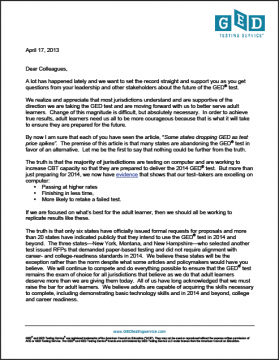
GED Testing Service LetterThe GED Testing Service released a letter yesterday in response to a recent, widely circulated Associated Press story about the changes coming to the GED exam in 2014. I’ve written a lot about the controversy over the new exam—you can search the archives if you are interested.

The letter asks the adult education community to be “more courageous” when making decisions about the new test, “because that is what it will take to ensure [adult learners] are prepared for the future.”

It goes on to say that the alternative exams from McGraw Hill and ETS now competing with the GED in the high school equivalency testing market fail to measure college and career readiness, and that the revamped GED will be the only test “truly capable of measuring depth of knowledge and the skills that employers and colleges now expect.” Choosing one of the competing assessments “will just leave your adult learners behind.”

Other highlights:

  • “We believe adults are capable of acquiring the skills necessary to compete, including demonstrating basic technology skills and college and career readiness in 2014 and beyond.”
  • “It’s important that we have substantive conversations about all the issues and changes that we need to make, instead of settling for a cheaper, less effective test. It’s past time that the media and policymakers acknowledge the role that your staff and adult educators play in economic development in your jurisdiction and that you need resources to do the job right.”

So there you have it: those state officials who have chosen one of the alternative assessments are gutless cheapskates who don’t think their learners can actually acquire  the skills to compete. Let the substantive discussion begin!

Senate Immigration Bill Introduced (Updated)

(Updated Below)

Here is the full text of the immigration reform bill introduced by the Senate “Gang of Eight” yesterday: S. 744, the “Border Security, Economic Opportunity, and Immigration Modernization Act.”

Pretty consistent with what I had been hearing:

  • Establishes “Office of Citizenship and New Americans” at USCIS.
  • Creates a “United States Citizenship Foundation” to fund the Office of Citizenship and New Americans,  the purpose of which is seems to include expanding citizenship instruction.
  • Seems to partially punt, though, on the adult English language instruction issue somewhat by creating a “Task Force on New Americans” to look at this issue, among others.

Seems to me that the big question is whether USCIS will coordinate with the existing adult ESL system or create something parallel… not clear from my quick skim. I’m eager to hear what others think after giving it a more thorough read. Take my comments above with a grain of salt — I may have missed something.

UPDATE (4:30 PM): Something I missed on the first go-round: In addition to the above, there is also another grant program allowed under Title II. Under Section 2106, up to $50 million from the Comprehensive Immigration Reform Trust Fund can be used for grants, and the list of permissible uses of those grants includes civics and civics-based English as a second language instruction.

The Comprehensive Immigration Reform Trust Fund would be set up as the depository of the funds collected via various existing and new fines/fees. It’s important to note that the  grant program coming out of the Trust would be allowable, but not mandatory, and there’s really no way to tell how realistic it is that as much as $50 million would be available for it, let alone how much might actually end up in the hands of programs that offer ESL instruction. A lot of activities under this legislation would be funded through the Trust.

A comprehensive analysis of the potential funding opportunities will take some time. It will also take some time to better understand how well/whether the provisions related to English language instruction leverage the existing federal funding for adult education.

Nonetheless, I still feel that there is something of a punt here on some of the integration pieces—to be sorted out and clarified via the “Task Force on New Americans.”

Again, though, this is a very preliminary look at a very long (844 page) bill.

Sorry also about the typos in the original post.
Outline of Senate Immigration Reform Bill

The American Immigration Lawyers Association has posted a 17-page outline of the Senate Immigration reform bill, which apparently will be called the “Border Security, Economic Opportunity, and Immigration Modernization Act of 2013.”

The outline does not provide much clarification regarding the English language requirement discussed in the principles statement released by the “Gang of Eight” Senators last January. In that document, they listed learning English and civics as one of the requirements that undocumented immigrants currently residing in the U.S. would need to meet in order to earn the opportunity to apply for lawful permanent residency. The section in the bill outline on “Legalization and Legal Immigration” reaffirms this requirement (see second to last paragraph below) without providing any additional details:

Legalization and Legal Immigration

I. Adjustment of Status to Registered Provisional Immigrant Status

  • Individuals in unlawful status may apply to adjust their status to the legal status of Registered Provisional Immigrant Status.
  • Eligibility Criteria:
    • Residence in the United States prior to December 31, 2011 and maintenance of 
continuous physical presence since then.
    • Paid a $500 penalty fee (except for DREAM Act eligible students), and assessed taxes, per adult applicant in addition to all applicable fees required to pay for the cost of processing the application.
    • Ineligible if:
      • Convicted of an aggravated felony;
      • Convicted of a felony;
      • Convicted of 3 or more misdemeanors;
      • Convicted of an offense under foreign law;
      • Unlawfully Voted; and
      • Inadmissible for Criminal, National Security, Public Health, or other morality grounds.
  • Spouses and children of people in RPI status can be petitioned for as derivatives of the principal applicant (but must be in the United States at the time).
  • Immigrants in RPI status can work for any employer and travel outside of the United States
  • Individuals outside of the United States who were previously here before December 31, 2011 and were deported for non-criminal reasons can apply to re-enter the United States in RPI status if they are the spouse, of or parent of a child who is, United States citizen or lawful permanent resident; or are a childhood arrival who is eligible for the DREAM Act.
  • The Application period will be for 1 year with the possibility of extension by the Secretary for an additional 1 year.
  • Individuals with removal orders will be permitted to apply as will aliens currently in removal proceedings.
  • RPI status shall last for a 6-year term that is renewable if the immigrant does not commit any acts that would render the alien deportable. Another $500 penalty fee is applicable at this time.
  • The Secretary may collect a processing fee from individuals who register for RPI status in an amount that is sufficient to recover all of the costs of implementing the registration program.
  • An individual who has been granted RPI status is not eligible for any Federal means-tested public benefit (as such term is defined in section 403 of the Personal Responsibility and Work Opportunity Reconciliation Act of 1996 (8 U.S.C. 1613)).
  • A noncitizen granted registered provisional immigrant status under this section shall be considered lawfully present in the United States for all purposes, while such noncitizen remains in such status, except that the noncitizen
    • is not entitled to the premium assistance tax credit authorized under section 36B of the Internal Revenue Code of 1986; and
    • shall be subject to the rules applicable to individuals not lawfully present that are set forth in section 1402(e) of the Patient Protection and Affordable Care Act (42 U.S.C. 18071).
  • After 10 years, aliens in RPI status may adjust to Lawful Permanent Resident Status through the same Merit Based System everyone else must use to earn a green card (described below) if the following things have occurred:
    • The alien maintained continuous physical presence
    • They paid all taxes owed during the period that they are in status as an RPI
    • They worked in the United States regularly;
    • And demonstrated knowledge of Civics and English (my emphasis)
    • All people currently waiting for family and employment green cards as of the date of enactment have had their priority date become current.
    • A $1,000 penalty fee is rendered
  • People in DREAM Act Status and the Agricultural Program can get their green cards in 5 years and DREAM Act kids will be eligible for citizenship immediately after they get their green cards.

Source: American Immigration lawyers Association