To Boldly Rule…

According to The National Law Journal, U.S. District Judge Otis Wright impressively weaved Star Trek references throughout his ruling Monday on a sleazy copyright enforcement case:

Wright riddled Monday’s ruling with Star Trek references, including an epigram quoting Spock from the 1982 film Star Trek II: The Wrath of Khan: “The needs of the many outweigh the needs of the few.” He wrote that, “though Plaintiffs boldly probe the outskirts of law, the only enterprise they resemble is RICO. The federal agency eleven decks up is familiar with their prime directive and will gladly refit them for their next voyage.”

“Plaintiffs have outmaneuvered the legal system,” Wright concluded. “They’ve discovered the nexus of antiquated copyright laws, paralyzing social stigma, and unaffordable defense costs. And they exploit this anomaly by accusing individuals of illegally downloading a single pornographic video. Then they offer to settle — for a sum calculated to be just below the cost of a bare-bones defense. For these individuals, resistance is futile; most reluctantly pay rather than have their names associated with illegally downloading porn.”

According to the judge, it was after the Plaintiffs “engaged their cloak of shell companies and fraud that the Court went to battlestations.” He also referred to one of the lawyers involved as “just a redshirt.” Ouch.

See: Judge Lashes Out at ‘Fraud’ in Porn Infringement Claims.
Business Models

Offering fee-based services for those who can afford it, in order to generate income to support free ESL/literacy services for those who can’t, makes a lot of sense—especially contracts with other organizations and businesses for custom-designed services. This  isn’t a new idea, but it’s probably something more organizations that provide community-based literacy instruction ought to be looking at. I just can’t see a scenario in the near future in which government funding (federal, state, or local) for adult literacy or ESL is likely to substantially increase, and growth in foundation and charitable giving in general  is likely to continue to be pretty flat. At the same time, immigration reform appears to have at least a reasonable chance of passage in the near future, and if it does, that will  likely  open up even more opportunities for fee-based English language instruction and translation services.

Septima Clark

Septima Clark

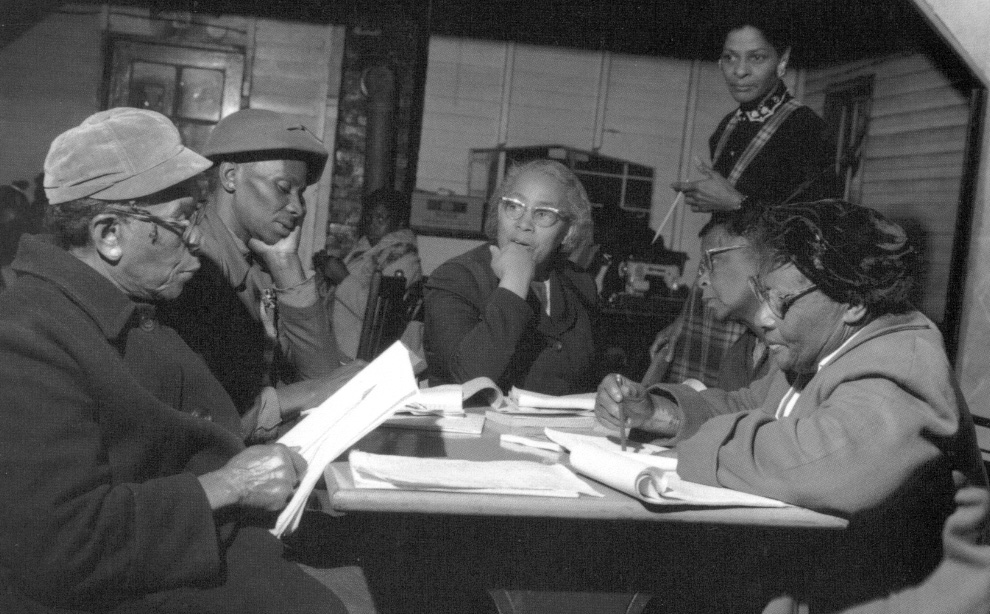
Septima Clark (center). Date/source of photo unknown.

Septima Poinsette Clark was born on this day 115 years ago. Without question one of most important figures in the American Civil Rights movement, the story of her role in  advancing adult literacy in the U.S.—and in drawing attention to the connections between education, poverty, and political power—should be mandatory reading for anyone interested or involved in adult literacy or education—especially the “education is the civil rights movement of our time” folks who seem to believe that the relationship between civil rights and education began sometime around the year Teach for America was founded.

Clark is best known for her role in developing the Citizenship Schools of the 1950s and 60s, where thousands of disenfranchised African Americans across the southern U.S. learned to read and write in order to pass the literacy tests required by southern states to register to vote. But while voting was the focus, the schools also emphasized the role of literacy as an instrument of empowerment more broadly.

And unlike today, this was at a time—not that long ago—when teaching reading in such a context was truly dangerous. Classes often had to be taught in back rooms of stores and other hidden places. Teaching people how to read helped countless Black Southerners push for the right to vote, but beyond that, it developed leaders across the country that would help push the civil rights movement long after 1964.

Clark wrote two autobiographies during her lifetime: Echo in My Soul and Ready from Within: Septima Clark & the Civil Rights Movement, A First Person Narrative. A  collection of her papers is archived here, although none of it seems to be accessible online. But there is a great online “scrapbook” of  images, newspaper clippings, and correspondence related to her life at the Lowcountry Digital Library site.

A Little Bit of News About WIA Reauthorization in the Senate

The (very) little I know about any work going on in the Senate on a Workforce Investment Act (WIA) reauthorization bill this session is mostly on background, but what I do know is pretty consistent with what was reported by Neil Bomberg for the National League of Cities (NLC) a couple of weeks ago.

Unlike the House bill passed earlier this year, we know the Senate bill will be a bipartisan effort, and leads on it are Senators Patty Murray (D-WA) and Johnny Isakson (R-GA). According to NLC’s sources, Senators Murray and Isakson “are using last year’s Senate draft bill as the starting point for this year’s bill.” (I believe that is supposed to read “last session,” as the only recent Senate draft bill I’m aware of was released in 2011.) Although not perfect, most of my colleagues in adult education seemed to be reasonably happy with that older draft bill, while the recent House bill was universally panned.

There’s no timeline for the introduction and consideration of a Senate bill. NLC notes that it is unlikely that it would be introduced before June.