New York Times on the School-to-Prison Pipeline

The New York Times published a good editorial earlier this week on the school-to-prison pipeline issue:

[B]y criminalizing routine disciplinary problems, they have damaged the lives of many children by making them more likely to drop out and entangling them, sometimes permanently, in the criminal justice system. The policies are also discriminatory: black and Hispanic children are shipped off to court more frequently than white students who commit similar infractions.

According to the Times, the New York City School-Justice Partnership Task Force  has found that “the overwhelming majority of school-related suspensions, summonses and arrests are for minor misbehavior, behavior that occurs on a daily basis in most schools.”
Why the Senate Needs to Win Over House Conservatives on Immigration Reform

 makes a good point in the National Journal today:

[A]ny comprehensive measure agreed to in the House will be substantially to the right of the Senate bill. This would reflect the conservative membership of the House majority, they argue. But if such a bill passed the lower chamber, it could threaten to shatter the delicate coalition assembled by Senate negotiators, who won the support of both labor and business groups with an emphasis on compromise and middle ground. (my emphasis)

New Migration Policy Institute Brief Offers Demographic, Socioeconomic Data on Unauthorized Immigrants in the U.S.

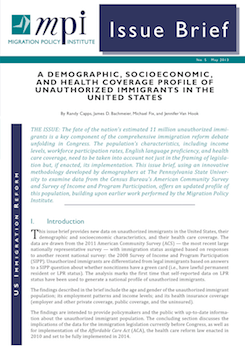
MPI BriefThe Migration Policy Institute (MPI) has just published a new brief, A Demographic, Socioeconomic, and Health Coverage Profile of Unauthorized Immigrants in the United States, which provides all kinds of useful and interesting  data about unauthorized immigrants currently living in the U.S.

The final section of the brief lays out some of the policy implications of the data they have compiled, both in terms of immigration reform and implementation of the Affordable Care Act. For example, under the immigration reform bill that is currently under consideration in the Senate, unauthorized immigrants who are granted registered provisional status (which would permit them to reside and work here legally) would be ineligible for Medicaid or most other federal benefits. MPI’s data suggests that 71% of unauthorized immigrants (47% of children) are uninsured, and the vast majority of them have incomes that fall below the federal poverty level. So it appear that many RPI status holders would struggle to obtain medical insurance under the Senate bill.

Department of Education Releases Fact Sheet on English Literacy Education in the Adult Basic Grant Program

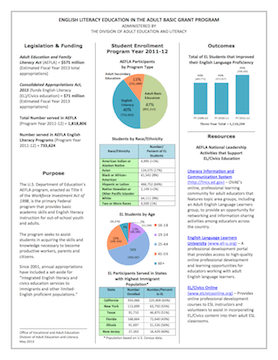
English Literacy Education in the Adult Basic Grant ProgramThe Office of Vocational and Adult Education at the Department of Education recently released a one-page fact sheet on English literacy education in the Adult Education and Family Literacy Act (AEFLA) grant program administered by the Division of Adult Education And Literacy. It includes useful statistics on student enrollment, outcomes, and demographics.

I don’t know this for a fact, but I have to assume this was put together as a resource for folks on the Hill working on immigration reform (English language acquisition is an issue in the pending legislation, since the pathway to citizenship will require undocumented immigrants to demonstrate some level of English proficiency).