What’s in the FY 2015 Federal Spending Bill for Adult Education

Members of the House and Senate reached an agreement late yesterday on a nearly $1.1 trillion FY 2015 spending bill that will fund most of the federal government through September 30, 2015. The one exception: funding for the Department of Homeland Security is funded only through February. This is supposedly going to give Republicans some leverage in the next Congress to block President Obama’s recent executive order on immigration.

Here is how adult education made out:

Total amount for WIOA Title II adult education is $582,667,000. State grants were funded at $568,955,000. (This is the money that is sub granted to programs for direct services.) The FY 2014 figure for state grants  was $563,955,000, thus this is a $5 million increase. National Leadership funding (basically funding that goes to the U.S. Department of Education to manage the WIOA Title II program and provide assistance, research etc.) was level-funded at $13,712,000 (but note that this line item did get a slight bump up in FY 2014).

There is also some report language on the National Leadership funding:
Career Pathways Report Language

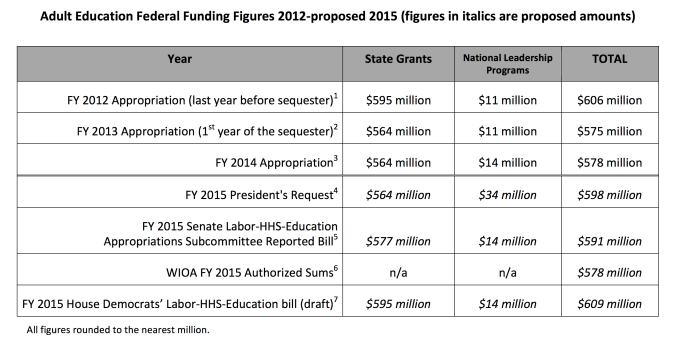
No one is going to complain about an increase—whatever the amount—and in the current fiscal environment, even a relatively small $5 million increase should arguably be viewed as a victory. But as far as I can tell, nearly every adult education or WIOA advocacy group that spoke out about the FY 2015 budget advocated for a larger increase, and with ample justification. A $30 million increase was needed to bring state grant funding back to the pre-sequestration level of $595 million. This was what the House Democrats’ proposed Labor-HHS-Education bill included. The National Coalition for LIteracy advocated for the House Democrats’ proposal, noting that it would not only have restored state adult education grants to the pre-sequester level, it would have also maintained the slight bump up in national leadership programs that was included in the Fiscal Year (FY) 2014 Consolidated Appropriations Act. For those interested, I have a post here that summarizes the different proposals for adult education funding under WIOA that were released over the course of the last year.

For what it’s worth, the total amount for WIOA Title II adult education contained in this bill—$582,667,000—is actually above the funding level authorized under WIOA for FY 2015, which simply carried over the FY 2014 funding level of $577,667,000. But as noted by myself and others, the WIOA authorized amounts are not even close to what is needed to meet the need for adult education in this country.

The new spending bill also includes a provision “reinstating” ability-to-benefit (ATB) financial aid eligibility for students without high school diplomas enrolled in career pathway programs at community colleges. Note that this is in fact a partial reinstatement of ATB, since the older provision didn’t restrict eligibility to those enrolled in career pathway programs. Regardless of whether you think such a restriction is a good or bad idea, I think it’s important to remember that this is not a full restoration of ATB.

The House and Senate are expected to try to quickly pass the bill this week.

Here is the source for all the FY 2015 information above.
Immigration Reality Check

I realize most of the debate over the President’s immigration plan unveiled last week is going to focus on the the issue as to whether the President has the legal authority to unilaterally suspend deportation on the scale that he is proposing. But it’s also important to remember why something needs to be done. We have a huge and growing backlog in immigration cases in this country, and desperately need better guidelines for prosecutors to use in deciding whether to pursue deportation. From an article in the National Law Journal:

There were 421,972 cases pending in the nations 58 immigration courts as of the end of October — an increase of more than 22 percent from around the same time period in 2013, according to data released this week by the Transactional Records Access Clearinghouse.

… [T]he backlog of cases in immigration courts has been on the rise since the 2006 fiscal year, when there were 168,827 pending cases. In June 2011, John Morton, head of U.S. Immigration and Customs Enforcement (ICE) at the time, issued a memorandum explaining that the agency lacked resources to go after every violation; instead, he said, the government should “prioritize its efforts.”

…Philip Wolgin, a senior policy analyst on the Center for American Progress’ immigration policy team, said the Morton memo didn’t work as planned. The language was “vague,” he said, and didn’t have clear enough directives about when prosecutors should stop pursuing low-priority matters.

“…The biggest problem is when ICE is indiscriminate about who it puts into removal proceedings,” [Peter Asaad, an immigration lawyer and managing director of Immigration Solutions Group in Washington] said. “The whole point here is to make it less indiscriminate.”

This is also important to keep in mind when certain members of Congress talk about using the appropriations process to block the President’s order. Congress doesn’t provide enough funding to deal with the immigration case backlog we already have, so any effort by Congress to block the President by starving the agencies responsible for enforcement is only going to make the problem worse.

Summary of Fiscal Year 2015 Funding Proposals for Adult Education

The National Coalition for Literacy (NCL) recently sent a sent a letter to members of Congress urging them to approve an FY 2015 omnibus appropriations bill before the end of the calendar year, including an increase in funding for adult education to at least the $609 million level proposed in the Labor-HHS-Education bill released by Representative Rosa DeLauro in September. (Full disclosure: I am the current President of NCL.)

While working with NCL members to put together our recommendation, I needed to pull together all the recent proposals for federal adult education funding for FY 2015, including the President’s original budget request, the Senate Labor-HHS-Education Appropriations Subcommittee Reported Bill, the House Democrats’ Labor-HHS-Education bill, as well as the figures authorized by the new WIOA legislation. Rather than just file that away, I thought I would share it here, in case it might be useful to others.

Adult Education Recent Federal Funding

Note that the House Democrats’ proposal is probably the high-water mark for potential adult education funding in FY 2015. It’s also worth noting that there is increasing concern that an omnibus bill will be blocked by Tea Party Republicans upset with President Obama’s imminent executive action on immigration. It’s really unclear to me what is going to happen with the FY 2015 federal budget. If I had to guess, I’d put my money on a short-term Continuing Resolution (CR) that punts the decision into January and the newly elected Congress.


Election Thought of the Day

Thinking about the impact of the elections on adult education policy, I wonder if the results of some of the governer’s races are more significant for adult education (and workforce policy generally), than the shift in power in the Senate. While most education-related legislation languished without much progress during the last Congress, the current crew did manage to successfully dispose of the most important piece of legislation for our field, the Workforce Investment and Opportunity Act (WIOA), passing it by a wide margin this summer. The action is really now at the state level, where governors hold sway over WIOA’s implmentation.

What will party switches in the governor’s offices in Illinois, Pennsylvania, Massachusetts, and Maryland, for example, mean for WIOA implementation in those states?