Additional Notes on the FY 2015 Spending Bill

Although not without considerable last-minute drama, Congress did manage to pass a spending bill before leaving town this week. Dubbed the “Consolidated and Further Continuing Appropriations Act of 2015,” the legislation will fund most of the government though the remainder of the fiscal year ending September 30th, 2015. (The exception: The Department of Homeland Security, which was funded only through February, which provides Republicans in the next Congress with some leverage to block President Obama’s executive order on immigration.)

There was never any serious doubt that the small adult education increase was in any jeopardy during the last-minute negotiations, and despite the drama, it would have been hugely surprising if the bill itself failed to pass before Congress adjourned.

As I mentioned in an earlier post, the Act also includes a partial reinstatement of Pell Grant and other federal student aid eligibility for “ability-to-benefit” (ATB) students who lack a high school diploma.

A couple of additional notes on the legislation now that the has been enacted:

First, I’ve updated my earlier table of recent actual and proposed federal funding amounts for adult education under WIA and its successor, WIOA.
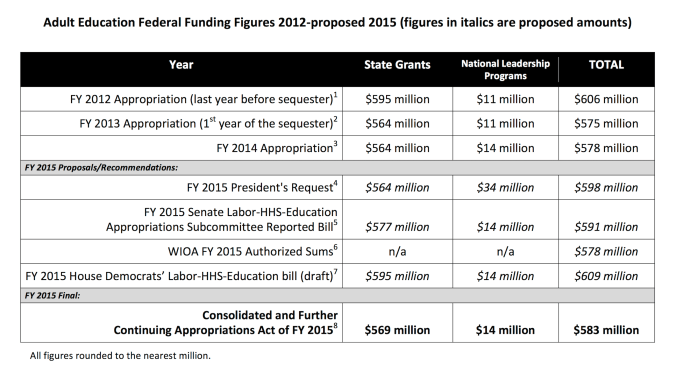
Adult Education Recent Federal Funding - Updated

As you can see above, while any increase in federal funding can be characterized as something of a win right now, the $5 million increase in state grants under WIOA for adult education is far short of where funding for this line item was in FY 2012. A better measure of our success in advocating for more federal funding in recent years, in my opinion, is to look at how we stacked up against other programs—particularly education programs—over the last two years of sequester relief under Ryan -Murray, when there was an opportunity to restore funds lost to the sequester. Some programs have received nearly a full restoration, some have fared worse. I don’t have time to do that analysis myself. But that’s where I suggest looking in order to begin to assess the field’s advocacy efforts during the “sequester era.”

A couple of notes about ATB (and thanks to my colleagues who follow Pell closely for their insights): The reinstatement of ATB eligibility goes into effect immediately. In order to qualify, students have to be enrolled in career pathway programs and prove their ability to benefit from higher education, either by passing an exam or successfully completing six credit hours.

I also dug up the language in the bill that defines an “eligible career pathways program” (it’s on page 376-377). To be considered such a program for purposes of ATB eligibility, it must be a program that:

(A) concurrently enrolls participants in connected adult education and eligible postsecondary programs;

(B) provides counseling and supportive services to identify and attain academic and career goals;

(C) provides structured course sequences that—
(i) are articulated and contextualized; and
(ii) allow students to advance to higher levels of education and employment;

(D) provides opportunities for acceleration to attain recognized postsecondary credentials, including degrees, industry relevant certifications, and certificates of completion of apprenticeship programs;

(E) is organized to meet the needs of adults;

(F) is aligned with the education and skill needs of the regional economy; and

(G) has been developed and implemented in collaboration with partners in business, workforce development, and economic development.

I’m still not entirely sure how students and financial aid folks go about establishing that a program qualifies under those rules, however. It seems to me that some of these elements are open to debate. (How does one demonstrate definitively that a program is “aligned with the education and skill needs of the regional economy,” for example?) But financial aid is not an area of expertise for me. If anyone has a better understanding of this, I’d love to hear from you in the comments.

Also, note that the size of the Pell grant that ATB students will be eligible for varies based on their enrollment date. Those who enroll in a program before July 1st, 2015, will be eligible for the maximum Pell Grant award (which is currently estimated to be going up to $5,830), while those enrolling after that date will be limited to only the maximum discretionary Pell Grant award of $4,860.

One last item that is important to many adult education students and programs: the Act also extended authority and funding for the TANF block grant through September 30th, 2015. TANF has been due for reauthorization since 2010, by the way, and is one of those non-WIOA piece of legislation I advise adult education advocates to follow and weigh in on in the months ahead.

Breaking News: Many People in Prison Eventually Leave Prison

From a Seattle Times investigative piece on what appears to be a a pretty impressive prison labor scam in Washington:

While lawmakers have pushed to increase the number of inmate workers, they’ve limited the educational opportunities that could help offenders find work outside of prison.

As part of a “get tough on crime” effort, the Washington Legislature in 1995 passed a law prohibiting state money from being used for higher education in prisons. Some taxpayers had griped that inmates were getting college courses for free.

Rep. Larry Springer, a Democrat from Kirkland who serves as deputy majority leader, views the CI jobs as “basic skill” work that may only help former inmates find very low-paying jobs. The better use of tax dollars would be for higher education for higher-skilled jobs. (my emphasis)

The fact that people in prison are often serving sentences that eventually lead to release does seems to escape policymakers sometimes. I’m not sure I understand what the argument is for blocking prisoners’ access to things that are likely to decrease the likelihood that they will commit crimes again once released. But I’m all ears if you have one.

Perhaps the answer has something to do with the fact that most people leaving prison aren’t headed for the communities where those policymakers live.

Does a High School Diploma Add Labor Market Value to the GED?

Interesting reporting here, deep inside a story on D.C. Schools Chancellor Kaya Henderson’s strategies to improve the D.C. graduation rates, on the debate over whether GED passers in the District of Columbia should be awarded a high school diploma, instead of the high school equivalency credential that is currently awarded:

During a meeting with OSSE officials this month, some board members had questions about the proposal to give a diploma, rather than a credential, to students who pass the GED. As of early December, 374 D.C. residents had taken the GED this year.In the District, you must be 18 to take the test, and many test-takers are older. But the shift could have a significant effect on graduation rates at alternative schools that offer GED preparation classes, such as Ballou STAY, which reported a 4 percent four-year graduation rate in 2013.

Currently, 13 states, including Maryland, award diplomas to those who pass the GED. City officials maintain that those who pass the test are demonstrating the same cognitive skills and abilities as a high school graduate, and a diploma could give them a better chance at getting a job or pursuing higher education.The GED was revised this year to align with Common Core academic standards, and the threshold for passing the test is based on how a sample of high school graduating seniors perform on it.

“I think it’s a valid approach, but I don’t think it’s the same” as actually attending and finishing high school, Laura Slover, an outgoing board member from Ward 3, said during a State Board meeting this month. She recommended that if GED recipients receive a diploma, they should be reported separately.

Some research shows that although GED test-takers can demonstrate comparable cognitive skills, they are less likely to demonstrate life skills such as perseverance that students develop by reporting to school day in and day out.

Great reporting by the Post‘s Michael Alison Chandler. A helpful primer on the issue not just in D.C. but in other states where this discussion is also taking place.

I’m not close to the local D.C. adult education scene anymore, so no special insights here, but I would just add a couple of quick thoughts:

  • Does the fact that the neighboring state of Maryland does award a high school diploma to GED graduates put D.C. GED recipients at a competitive disadvantage? I have no idea, but it’s sort of implied above.
  • There is much enthusiasm in the adult education policy world over initiatives that provide high school or high school equivalency faster for those who have dropped out of school, and in my limited anecdotal experience, not a lot of discussion about the quality and value of such initiatives for students over the long-term. If your system tends to use the number of diplomas or credentials awarded as the primary metric for assessing such initiatives, that’s not surprising.
  • I get that for someone who dropped out of school, earning a diploma quickly may be attractive, and thus encourage more dropouts to return to school, but I would think dual enrollment opportunities that offer opportunities for earning college credit while working toward that diploma (or equivalent) would do the same, and potentially have more lasting value. In any case, evidence that either really works as a motivating factor would be helpful.

Are We Too Quick to Accept PIAAC Findings at Face Value?

Ralf St. Clair comments on last week’s PIAAC research conference:

At this meeting, lots of findings were discussed, but very little time was spent on methodology. The papers written by presenters were not available in advance (and mostly not at the meeting). One of the problems with PIAAC data is that it is not complete…

In many cases such data gaps are tackled through synthetic data, where the existing data is used to estimate what the missing data should be. One of the problems with this, of course, is that the missing data is essentially assumed to fit with what we have, and unexpected results will never arise.

Without understanding the details of how these types are issues are tackled it is difficult to assess the implications of some of the correlations found, which are often quite weak. Would they exist at all if we had the missing data? Would they run in different directions? What sorts of assumptions are being made throughout the research process that generates the results?

Yet throughout the meeting the findings were accepted at face value and the issues of the data set never fully discussed, even though it was a room full of people who could understand and even work out how to deal with them. As in so much of the activity that surrounds international surveys, the will to believe overwhelms the skepticism we must bring to these exercises. (my emphasis)

I would just add that critical scrutiny is particularly important with PIAAC since it appears that the adult education field (in the U.S. at least, can’t speak for other countries) has decided to embrace PIAAC as our primary foundational data source for policy decisions going forward.

I recommend reading the entire post.