(updated below)
As the House-Senate Conference Committee renews their discussion this week on the payroll tax cut and unemployment insurance extension, here are four things I’ll be watching for regarding the proposal to ban unemployed workers without a high school diploma or GED from collecting unemployment benefits:
We Are Providing Help, Not Taking Away Benefits
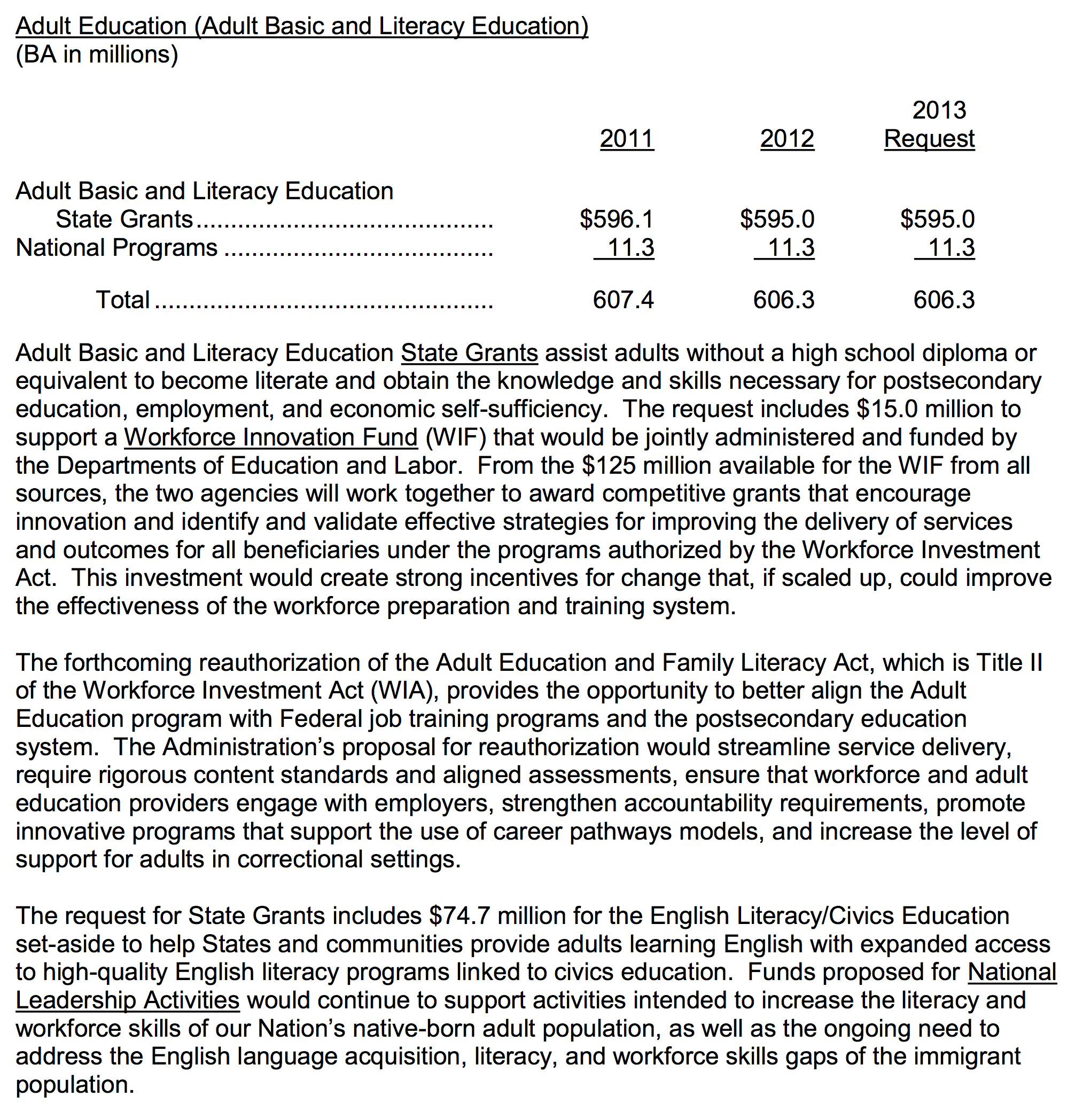
As I noted yesterday, proponents have routinely suggested that their proposal is designed to provide “resources” or “tools” of some kind to help those without diplomas or GEDs attain those credentials and get back to work. However, there is no additional education or training funding in the House proposal, just a restriction that would prevent those without such credentials from receiving the benefits they have earned.
General Agreement That a GED or High School Diploma is the Only Option
During the conference committee discussion last week, both sides in the argument seemed to more-or-less agree that for those out of work and without a high school diploma, obtaining that diploma or a GED was bascially the only option available to them. But as the National Coalition for Literacy pointed out in their letter to conference committee members:
[T]he new restriction mistakenly assumes that attainment of a high-school diploma or GED is the most efficient and effective strategy towards reemployment. In fact, industry-recognized credentials and certificates may be a better pathway to a good job. Attainment of such credentials does not necessarily require a GED.
In other words, for many unemployed workers, enrollment in an industry credential program may be the most efficient and logical way to obtain the education and training they need to re-enter the workforce. Some unemployed workers without a high school diploma might, in fact, struggle with the range of academic skills needed to obtain a GED, but have sufficient skills and experience on the job to obtain such a credential. It just doesn’t make any sense to shoehorn people into just one education option.
This is actually just one example of an even more fundamental problem with what the House has proposed: it reflects a simplistic and fundamentally mistaken understanding of the range of adult education needs in this country, as well as the range of options that are required to to address each individual’s needs. As noted above, an unemployed worker may find themselves in a situation where pursuing an industry-recognized credential may be a quicker path to re-employment than obtaining a GED. Others may view the GED as their best option, but due to the lack of decent quality, available classes nearby, they choose to study on their own—not in a class. Others may have literacy skills at such a low level that they sign up for a one-on-one tutoring at a library literacy program—again, not a class, and also not direct preparation for a diploma or a GED.
The drafters of the House proposal, however, appear to be completely unaware of the range of adult education needs, credentials avaialble, and types of instruction practiced in the field. The House proposal is, instead, quite restrictive: you can only remain eligible for benefits if you are enrolled and making satisfactory progress in a class, and only a class that will lead you to the acquisition of a high school diploma or a GED, (or another high-school equivalency credential recognized by the state).
The Impact on Older Workers
From the beginning, opponents to this proposal have used the example of older workers to illustrate the unfairness of this proposal.
Robert Greenstein of the Center for Budget and Policy Priorities (CBPP) made this point in a blog article last month:
The proposal would deny UI benefits to hundreds of thousands of workers — many of them middle-aged — who have worked hard, played by the rules, and effectively paid UI taxes for years and who then were laid off due to no fault of their own. (my emphasis)
At last week’s conference commitee meeting (thanks to the National Coalition for Literacy for the excerpts from the transcript), the older worker issue was a major part of Sen. Jack Reed’s (D-RI) argument against the proposal:
This provision would disproportionately affect older workers. It’s been estimated that 35 percent of the UI beneficiaries without a high school education are over the age of 50. So you would have a significant number of people who have worked literally for 30 years, who might have more skills, even technical certificates and company training awards than anyone else, and then to ask them to get a GED before they can collect on their unemployment I think is a huge burden.
While I understand the argument that throwing this new requirement at older workers is particularly unfair, the proposal is really unfair to anyone at any age who has been working and effectively paying into their state’s unemployment insurance fund (employers make the contributions on their behalf)—whether it’s been 30 years or just a few. While I don’t think this is being considered, carving out an exception for older workers as a compromise would be arbitrary (how do we define older worker?) and unfair. As Timothy Noah as pointed out, “it’s unfair to impose conditions on drawing from an unemployment insurance fund that don’t exist when you’re paying into it.”
Well, OK… But There’s a Waiver!
When proponents exhaust their other arguments, I’ve noticed that they then turn to a provision in the House bill that would allow the new requirement to be waived for an individual “to the extent that the State agency charged with the administration of the State law deems such requirements to be unduly burdensome.” However, as CBPP and others have pointed out, the waiver language is extremely weak. There is no standard for determining whether such a burden exists. It is not clear from the language whether the burden being referred to is the burden on the individual applying for benefits or on the state in administrating the provision for that individual. Most importantly, it is only an option to waive the requirement; nothing in that paragraph would require a state to make a determination of whether such a burden exists, or actually waive the requirement if it finds one.
It still seems likely to me from what I’m reading and hearing that the Senate will prevail and this provision will be tossed from the final bill, but I do think it’s worth paying attention to the waiver argument, in particular, and whether any opponents to the House proposal find this language sufficient enough to let the provision through.
UPDATE (10:40 AM): Politico and the Washington Post have both published updates this morning on the state of House-Senate conference committee negotiations. Both of which are worth reading for those interested in a big picture take on these negotiations (more is at stake than the GED/high school diploma requirement, obviously). Both articles claim that the House proposal would require recipients of unemployment benefits simply “to pursue a GED,” which is not what the House proposal actually proposes. This might seem like a picky, technical point, but it’s important in light of the second point I make above. The House proposal requires those without a high school diploma or GED to enroll themselves in a class in pursuit of one of these credentials, not merely to “pursue it.” If pursuit of a GED was sufficient, then self-studiers would presumably still qualify.
Also, the New York Times published an editorial yesterday in which they characterize the high school diploma/GED requirement as a “punitive measure designed to stigmatize the desperate.”
 Literacy & Policy