Sequester Cuts Begin to Affect Availability of Adult Education

From The Salem News (Missouri):

Those who want to study for the General Educational Development certificate will no longer be able to do it in Salem.

Salem’s Adult Education and Literacy program will be forced to close its doors Friday because state funding has been denied.

AEL Community Liaison Jackie Hobaugh said the program will end after about 30 years here. The nearest alternative class site is in Houston in neighboring Texas County.

The grant from the Department of Elementary and Secondary Education was denied because of the federal sequester, according to Hobaugh. Seven sites, including those in Dent, Phelps, Maries and Crawford counties, were targeted for closure.

Local phone service has already been disconnected.

“The DESE grant is our only source of funding,” she said. “These classes are needed now more than ever. At a critical time in our local communities, a way for individuals to pull out of poverty and move to self-sustainability is being eliminated. This should not be allowed to happen.”  (my emphasis)

Houston, Missouri is about 40 miles from Salem. For those of you in D.C., like me, this would be like being told that your GED class was closing, and then being referred to a program in Baltimore.

Something to remember as programs close is that they don’t just reappear overnight when/if funding is restored. Facilities are re-purposed, teachers move on, etc. The sequester isn’t just about cutting services in the present, but also, in some cases, will result in the permanent loss of infrastructure needed for the future.

Self-Promotion Sunday

The Committee for Education Funding, a coalition of (mostly) national educational groups, released their annual response to the President’s 2014 budget proposal released on May 29th. (It was delayed due to the fact that the President’s budget was delayed.) This book is delivered to every member of Congress.

The section on the Adult Education and Family Literacy Act (AEFLA), which I wrote (hence the self-promotion) on behalf of the National Coalition for Literacy, is on page 133 at this link (or you can just click here for the AEFLA section alone). It’s really more of a revision/edit of last year’s section. This year we also included a short anecdote, contributed by another NCL member, to start things off, which hopefully provides readers with a sense of what this funding actually means to people.

Anyway, I wanted to mention it here because I figured that some of you may find a quick summary of adult literacy funding under AEFLA (i.e. Title II of WIA) to be useful in your own advocacy efforts.

It also gives me a chance to recommend the CEF book, which really serves as much more than just a response to the President’s budget—it includes a history of education funding over the last ten years for nearly every federal education program, and includes lots of charts and graphs making the case for the federal investment in education.

Final Estimated Federal Funding for Adult Education for Fiscal Year 2013

(Updated Below)

On April 30th, the Department of Education released funding tables (by program and by state) for FY 2012 and FY 2013 appropriations, and FY 2014 estimates. As a result, we now know the final estimated total allocation for WIA Title II (or AEFLA) Adult Basic and Literacy Education State Grants for FY 2013: $563,954,515. This includes $70,811,239 for English Literacy and Civics Education State Grants. That’s a cut of about $31 million dollars of federal support for adult literacy in comparison with FY 2012. (But it’s worse than that when you adjust for inflation—see below.)

Fiscal years 2012 and 2013 are based on currently enacted appropriation bills, and the amounts listed for FY 2013 include the effect of the sequester and an across-the-board cut in the final appropriation. FY 14 estimates are based on the president’s proposed budget, and barring a miracle, those estimates are well over what we’ll actually see in the final FY 2014 appropriation.

These tables also include the estimated state allocations. I’ve pulled those out for you here:

State AEFLA Allocation rev05-13-13State Allocations: Adult Basic and Literacy Education State Grants: FY 2012 Appropriations, FY 2013 Appropriations, and FY 2014 estimates
State AEFLA ELCivics Allocation rev05-13-13State Allocations: English Literacy and Civics Education State Grants (Excluded from Adult Basic and Literacy Education State Grants): FY 2012 Appropriations, FY 2013 Appropriations, and FY 2014 estimates

These tables were updated yesterday, but no changes were made to the WIA Title II grants, at least as far as I can tell.

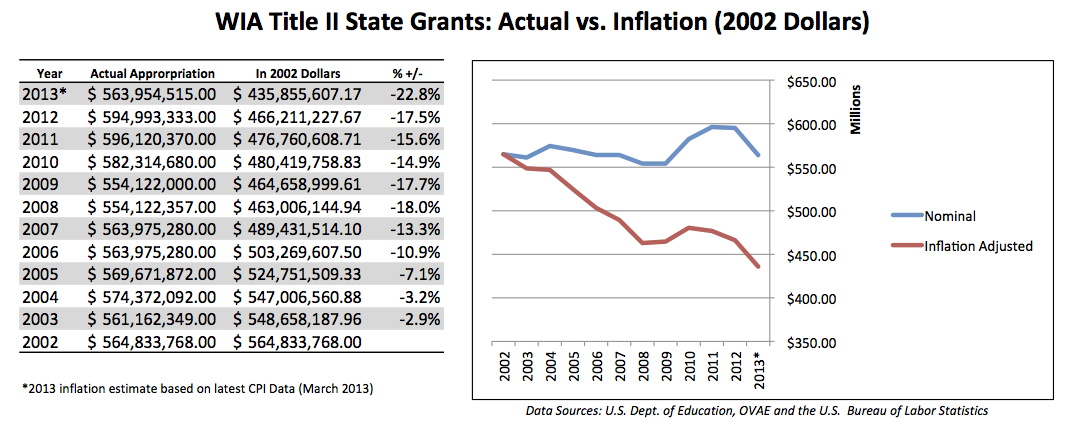
As I mentioned above, federal funding for adult education is even more grim once you adjust for inflation. Based on these figures, I took a stab at estimating the buying power of $563,954,515 in 2002 dollars. I used that figure because the last time I saw this calculated, 2002 was used as the baseline. I plan to follow up at some point with a longer post on calculating the effect of inflation, and the effect of using different baselines (and maybe even different methods, too) but for now this seemed like a good place to start. (For FY 2010, I did not include the one-time adjustment made by the Department of Education to make up for several years of underpayment to some states—that anomaly wasn’t carried over and shouldn’t be interpreted as growth, so I left it out.) (Note: this chart was updated 02/18/14.)

AEFLA Grants to States 2002-13 Graph

Using the most recent CPI (March), I calculate that $563,954,515 equals about $435,855,607 in 2002 dollars. Again, that’s a rough estimate, using the March CPI (for the other years I can use an annual average), but it’s close enough. The main takeaway here is that pre-sequestration the field was receiving somewhat stable, more-or-less flat, funding (that’s the blue line)—even, arguably, with the 2013 cut—but once you adjust for inflation (the red line)  you can see that the field has actually lost about 23% in real dollars in comparison with the appropriation of 2002.

Finally, don’t forget that other federal programs that are vital to adult education programs (Community Development Block Grants, CNCS/AmeriCorps, grants from USCIS, etc.) were also subject to sequestration cuts.

That’s a lot to chew on. Take a look and let me know if you have any comments or corrections.

UPDATE 2/18/14: This table has been updated to reflect the final 2013 CPI numbers.

Adult Education in the President’s Proposed FY 2014 Budget

Just had time to take a quick look. More detail (lots more detail, in fact) here.

The short version: The Adult Basic and Literacy Education State Grant program under Title II of the Workforce Investment Act (WIA) was level funded once again at $594 million (including the usual $74.7 million set-aside for English Literacy/Civics Education. However, the President does propose a $3 million increase for Adult Education National Leadership Activities. This proposed increase would be used to “support the expansion of the Department’s reentry education model demonstration initiative” and “help develop evidence of effectiveness in a variety of institutional contexts and build on the Department’s recent Promoting Reentry Success through Continuity of Educational Opportunities competition.”

Of course, there are other federal programs of interest to adult education programs. The only one I’ve had a chance to look at so far is the Corporation for National and Community Service (CNCS). The President’s budget requests $1.061 billion for the CNCS and its programs, an increase of $12.2 million over the 2012 funding level.