The Administration’s proposed spending plan for 2012, which was released on Monday, was sort of a mixed bag for adult literacy. It included a small increase in the state block grants to local adult literacy and basic education programs; it proposed the creation of a Workforce Innovation Fund (WIF) (this was also proposed last year) a competitive grant programs for new, innovative adult education and job training projects; and called for reauthorization of the Workforce Investment Act (WIA), the largest source of federal funding for adult literacy (via Title II). But it also cuts some programs outside the education budget that have provided some funding for many adult literacy programs in recent years.
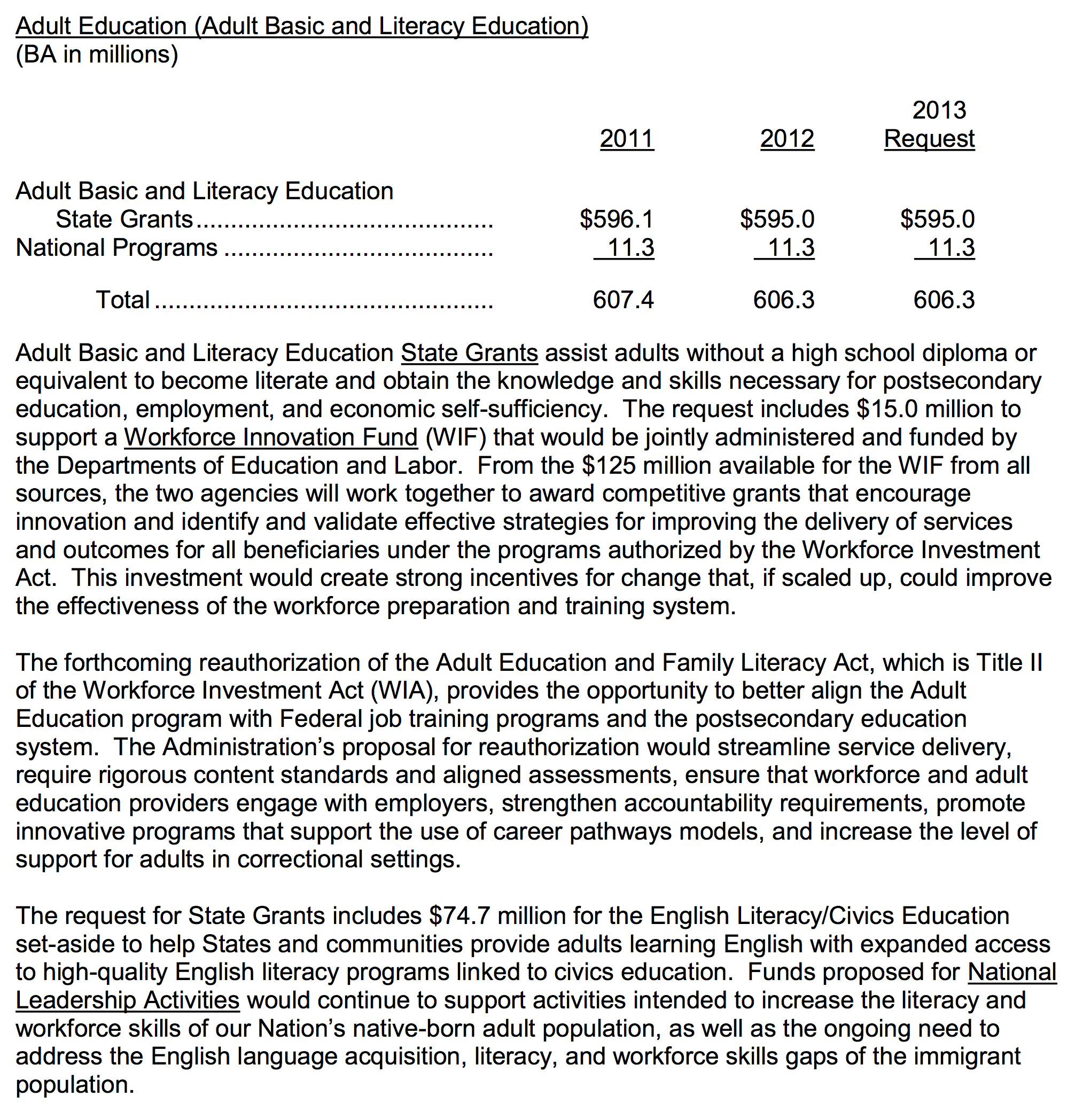
The proposed budget includes $635 million for state grants to local literacy programs, an increase of $6.8 million over the 2010 appropriation and the adjusted 2011 Continuing Resolution. But $50.8 million from this line item will be used to support the WIF, which will also include $30 million in funding from the Rehabilitation Services and Disability Research account, and almost $298 million from the Department of Labor.
This leaves $584.2 million for formula-based state grant money for adult literacy programs (of which $75,00,000 is set-aside for English literacy and civics education grants, also managed at the state level), a figure that is still short of what is needed.
Especially when you take into account that state budgets for adult literacy have been cut significantly over the last several years, and I expect that funding for adult literacy will continue to be on the chopping block as states grapple with their own budget challenges over the next year.
At a Department of Education briefing on the budget held February 14th, Department of Education officials told me that eligible grantees for the WIF would include programs, consortia of programs, and/or states. So it appears that this money will eventually get out to programs in the field. Essentially what they’ve done is take away some of the funds that would normally go to states via formula funding and made it competitive. Some states could end up doing better under this scheme. But it appears that there is definitely a chance here that some states will end up with less federal funding.
In addition, the proposal wants to more than double the amount of money going to the Office of Vocational and Adult Education at the Department of Education by providing an additional 12 million dollars for national leadership funds to evaluate the impact of college bridge programs and build technology infrastructure.
Again, during a period where states are cutting funding, some may raise concerns about the fact that the bulk of the President’s proposed increase for adult literacy stays (at least initially) at the Department of Education, and not out to the states that need the help now.
What concerns me more, though, is the proposed cuts to the community development block grant program and the community service block grant program. Many adult literacy programs have supported instructional services in part through these programs. And finally, the President’s budget also does not include funding for Even Start, the program that integrates adult literacy and early childhood literacy instruction.
But there are a few other positive things in the proposal: first, during a conference call briefing on the education budget held February 16th, administration officials noted that the 21st Century Community Learning Centers program, which has been increased by $100 million dollars, support partnerships with adult education programs. Adult Education projects could also receive funding through a proposed public-private financing program called “Pay for Success,” an innovation that is designed to encourage private investors to support education projects that would receive public funding only once the projects have met performance targets and generated successful outcomes.
Finally, it was encouraging to see the administration’s ongoing support for the Corporation for National and Community Service (CNCS). CNCS engages more than five million Americans in service through Senior Corps, AmeriCorps, and Learn and Serve America. Many AmeriCorps members serve as instructors and in other capacities at adult literacy programs across the country. The President’s FY 2012 budget requests $1.26 billion for CNCS, a $109 million increase over current funding levels.
 Literacy & Policy