Crazy Idea of the Day

(updated below)

LA Weekly‘s News Blog, the Informer, posted a story today on the Los Angeles adult education funding crisis that included this great little tidbit:

There has been speculation that “zeroing out” the programs was a highly risky strategic move on the school district’s part to attract grants from either the state or federal government.

Is there any way that this speculation could possibly be true? I don’t understand a scenario in which zeroing out adult education would attract federal or state money from some other source.

UPDATE (2/15/12)LA Weekly‘s report today on the LAUSD Board of Education’s decision to postpone their vote on this cut suggests that the proposal to zero out adult education might have been “political theater orchestrated by district officials to galvanize support for a $270-a-year parcel tax proposed by LAUSD for the November ballot.”

What Can We Learn from California’s Adult Education Funding Crisis?

While the President’s proposed FY 2013 budget will continue to be the focus of attention in Washington this week, the most urgent adult education funding battles over the next year are more likely to occur at the state and district level, I think—most notably. Today, for example, the Los Angeles Unified School District Board has scheduled a vote on a proposal to cut most of the $200 million in state money earmarked for adult education in the district.

Is the adult education funding crisis in California unique, or could it happen elsewhere? State funding for adult education has, in fact, been cut in other states in recent years—but California appears to be the most dramatic example, due in large part to a provision in the California Budget Act (CBA) that allows school districts in the state to shift dollars away from adult education to make up for shortfalls in district budgets.

But while the CBA (and the state’s overall position as an economic basket case) makes California unique in some ways, the situation also provides us with a case study in how adult education funding can become vulnerable. The article I cited yesterday in the Contra Costa Times provides a summary of the factors that contributed to the crisis in Los Angeles:

For the last five years, the cash-strapped state government has provided the district with just part of the money it is supposed to receive and has extended IOUs for the rest. This year, for instance, Los Angeles Unified got just $3,338 of the $6,506 it had been promised to educate each student, according to district officials.

Los Angeles Unified, meanwhile, must fulfill its labor contracts — roughly 90 percent of its costs are personnel-related — while coping with the expiration of state and federal grants and stimulus money. Lower birthrates and the exodus to charter schools has reduced district enrollment, resulting in less state funding and making it more difficult to serve the remaining students.

Here then, are some of the conditions to be on the lookout for in your state or district that may lead to adult education funding cut proposals:

  • Lower State Tax Revenue. (Or, at least, lower than expected tax revenue.)
  • Expiration of Federal Stimulus Funding. This is happening everywhere, so go ahead and check this one off on your list.
  • Locked-in Contractual Obligations. Labor contracts, mostly, although there could be other long-term contracts that districts can’t get out of or re-negotiate. (Note that in the story above, 90% of LAUSD costs are labor related.)
  • Reduced Enrollment Due to Lower Birthrates or Population Shifts.
  • Reduced Enrollment Due to Charter School Expansion.

There could be other factors, of course—and they are going to vary depending on how state adult education funding is disbursed (in some areas, for example, school districts are not involved in adult education at all, so school district formula funding based on enrollment is not going to be an issue). The point is, while I realize that California is in some ways a unique situation, I still think it’s useful for adult education advocates to be thinking about the factors that have led to adult education cuts here and in other states and districts across the country, and to be on the lookout for them in your state or district.
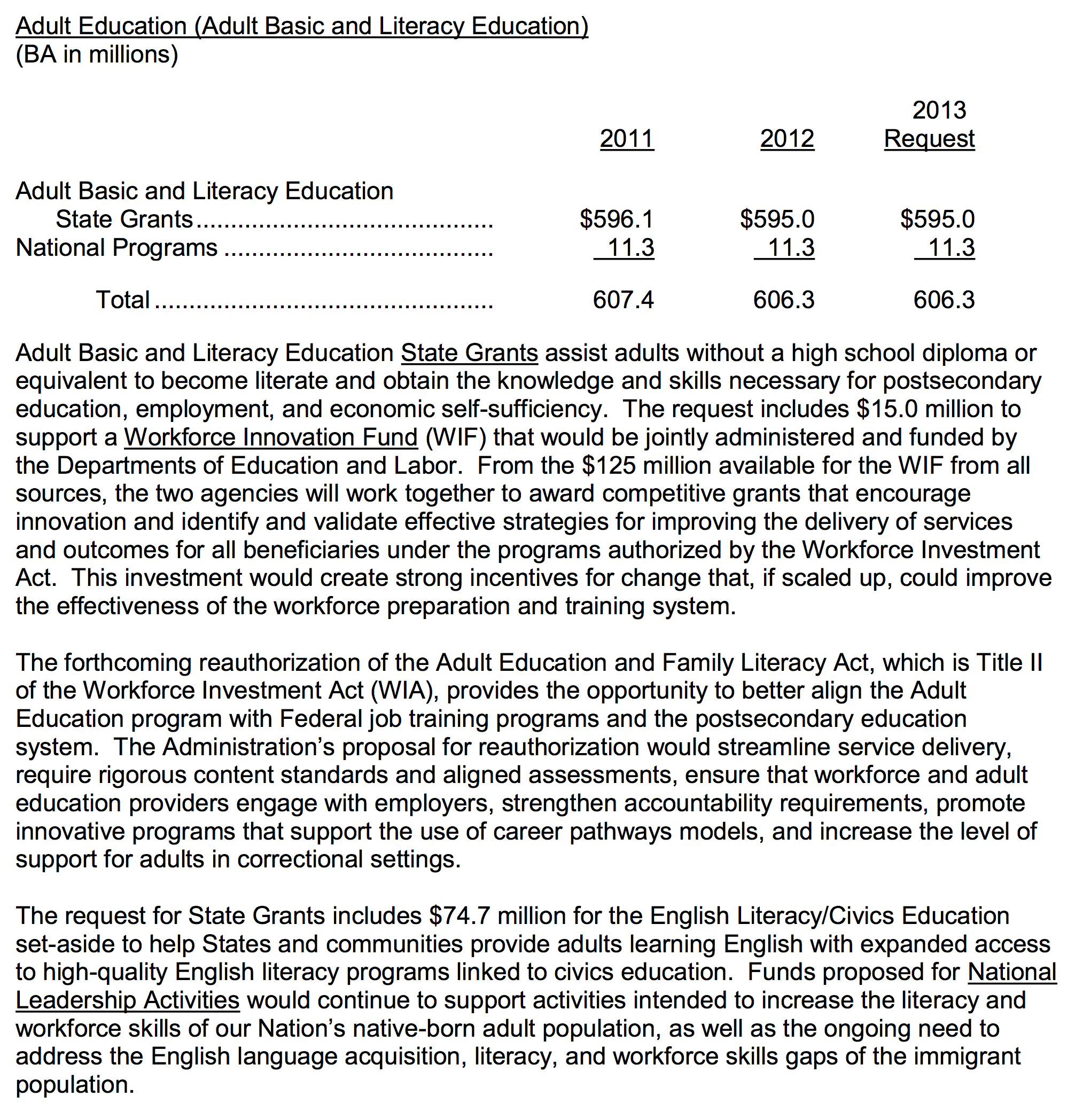
The President’s Proposed FY 2013 Budget for Adult Education

Yesterday the President unveiled his budget proposal for fiscal year 2013. To no one’s surprise, the President proposed level funding for adult education. This doesn’t mean that this will be the actual federal budget for adult education in 2013—most people who follow the budget process agree that there is no chance the President’s proposed budget will be adopted by Congress. As Derek Thompson notes at The Atlantic, “[T]he vast majority of its provisions are dead-on-arrival.” Still, it’s a good sign that a reduction in adult education spending is not being proposed here. As we know from last year’s FY 2011 budget debate, Congress is likely to go along with almost any proposed reductions in non-military spending. (It’s also important to remember that there are other smaller sources of federal funding for adult education services in other parts of the budget, which I haven’t looked at yet.)

Anyway, for those who are interested, here is the section on adult education from the Department of Education’s summary document:

Los Angeles School Board Votes Tomorrow on a Cut that Could Deprive Thousands of Children the Support They Need to Succeed in School

Tomorrow the Los Angeles Unified School District Board may vote in favor of a budget cut that could result in thousands of children being deprived of the support they need to succeed in school. As permitted by California state law, the board is set to vote Tuesday on a proposal to cut most of the $200 million in state money earmarked for adult education in order to address the district’s $557 million deficit.

As I noted last December, school districts all over California have been shifting dollars away from adult education to shore up K-12 budgets for the last several years because of a provision in the California Budget Act (CBA) which allows school districts to do this when budgets are tight. Los Angeles is the highest profile example to date.

The choice here is not about decimating the adult education system in Los Angeles so that the status quo in K-12 education can be preserved. It’s about choosing a course of action that would be disastrous for many K-12 students as well. As noted in this article on the impact of the cut on one particular adult community school in the district, the loss of adult education impacts not just the adults but the educational success of the children of those adults who are parents or caregivers.

Administrators and faculty at South Gate Community Adult School believe that cutting adult education will affect students at the K-12 campuses, and especially in areas with a high immigrant population. In those communities, parents are learning skills at the adult schools that allow them to help their children academically.

“This morning, we had role play, where a parent was at a conference with their child’s math teacher,” said John Liddle, teacher of English as a second language at South Gate Community Adult School. Using such situations to learn English interest immigrant parents, who want to understand their children’s school experience in the United States. “We use topics that are of high interest to [adult] students, such as health, jobs and parenting,” he said.

Dario Aleman, 41, was a medical doctor in Cuba before arriving in the United States in May 2010. Learning English is very important to him since he hopes to become fluent and renew his medical license. However, the adult classes also help him as a parent, since he can better prepare and help his 6-year-old son.

“If you prepare adults, the adults will then prepare their children,” said Aleman, who is also taking computer skills classes. “We want our children to be excellent [students] in the future.”

It gets worse: According to the article above, adult schools in the District served about 100,000 K-12 students with “catchup” classes so that they could graduate on time from high school.

The scope of the cuts has been so great in California that, arguably, the CBA is the worst piece of legislation for adult education in the entire U.S. over the last several years. If the LAUSD goes through with this cut, I don’t think it will be arguable anymore. Even worse, as research continues to emerge linking the education success of parents and caregivers to children’s success in school, the negative impact on school success generally may be felt in California for a generation.