Long-Awaited PIAAC Response Report Resurfaces

In case you missed it, this morning the White House announced the latest round of TAACCCT grantees. If you read the entire release, you may have noticed this curious related announcement:

In addition, the Department of Education is releasing a new report on the importance of building foundational skills in a job-specific context.

Ø  Department of Education Report on Transform Adult Learning through Work. The Department of Education is releasing a new report with recommendations to transform adult learning in the United States. After months of public engagement with a variety of stakeholders around the country, the recommendations for public-private partnership include strategies that engage employers to support upskilling of more entry-level workers while on the job, encourage the use of assessments and innovative learning tools to improve access to targeted career guidance for youth and adults, and promote better alignment and coordination of public and private programs so that youth and adults experience seamless services. The report highlights unique opportunities for implementing these recommendations as a result of the changed legislative environment made possible by the passage of the Workforce Innovation and Opportunity Act in July 2014.

I confirmed today with Department staff that the report referenced above is the long-awaited PIAAC response report or action plan that was announced last fall and then previewed at last spring’s adult education state directors meeting  However, contrary to the White House statement, the report was not in fact released today. It is finished but still in the “awaiting clearance” stage. No one could give me a date for actual release but the expectation is that it will be out sometime this fall. I know a lot of us in the field were wondering about the status of this report—some were speculating it might not ever be released—so I thought it was worth mentioning. It lives!


Some New(ish) Federal Adult Education Data to Chew On

UPDATED 9/22/14: The first chart below was the wrong chart, although this didn’t make any difference in terms of the point I was trying to make about total enrollment.

While preparing for a panel discussion tomorrow, I was reviewing the latest National Reporting System data on adult learners served by Title II of the Workforce Investment Act (WIA)—now reauthorized as the Workforce Innovation and Opportunity Act (WIOA).

I haven’t had a chance to update the “Primer” page on this site in a while. One of the things I need to update is the “Participants by Program Type” table, which also includes the total number of adults served. We now have data for the 2012-13 program year. This may not be that new—I just hadn’t had a chance to look to see if had been updated. Anyway, the numbers are not good:

2013-14 NRS Enrollment Data

Source: Office of Career, Technical, and Adult Education, National Reporting System

You can see from this table that overall enrollment numbers are down once again, from 1.8 million to 1.7 million, a drop of almost 111,000 people. This is (or should be) really distressing, and again raises the question: will the new WIOA legislation do anything to stem the decline in adult education enrollment that has been occurring over the last several years? A lot of this decline has to do with funding, and the funding picture for WIOA is not good. (I realize that some of this enrollment could have been picked up by private, non-federally funded programs or via self-study, but I know of no data to support that. But I strongly suspect that enrollment in privately funded programs is not rising enough to offset the decline in WIA Title II enrollment.)

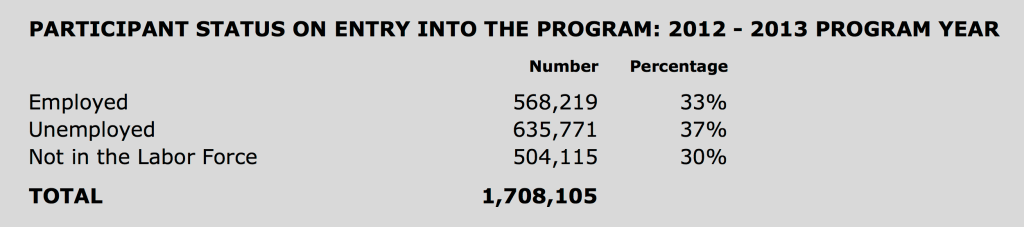
Here’s another interesting piece of data that is important to keep in mind when discussing the additional emphasis on employment skills in WIOA:

NRS Labor Market 2012-13

Source: Office of Career, Technical, and Adult Education, National Reporting System

As you can see from this table, during the most recent program year, 2012-13, almost a third of all adults participating in WIA Title II were not in the labor force. We need to know more about this population. Do we? Can anyone point me to a source? I don’t know, for example, how many of them are likely to be permanently out of the labor force. Or how many have simply given up (and of those who have given up, to what extent they identify skills issues as being the reason why). I know that during this same program year, about 60,000+ of adult learners were served over the age of 60, and presumably a lot of those folks are out of the workforce for good. Anyway, we likely need a lot of additional research here. In the meantime, it’s important to bear in mind that a significant number of people enrolling in a WIA-funded program are not part of the labor force.

Literacy for Work – Why Novels Count Too

Yesterday a major report was released examining the impact of illiteracy and innumeracy in the U.K. I was reading some of the responses to that report last night, and I came across a really smart blog post by Brian Creese of the U.K.’s National Research and Development Centre for Adult Literacy and Numeracy. His post included a superb description of how literacy skills are actually used in the workplace, while simultaneously arguing that reading for pleasure is a critically important component of literacy development:

The use of literacy and numeracy skills in the workplace is complex; different jobs, and the various elements within them, involve a range of literacy and numeracy practices, with workers often learning the specific skills they need for their job from peers and co-workers. Employees consistently report that they have adequate skills to do their jobs. What we see in the workplace is that we often work with others in ways that maximize our strengths and allow us to learn from them. We also see how workplaces can be adapted to remove the demand for literacy and numeracy or to scaffold its use.

Despite the policy focus on the workplace, we have continued to work with emergent adult readers on reading for pleasure. Those less confident with their reading may get great joy from reading novels, biographies or other texts in supportive, collaborative environments. They use adult experience and expertise to develop reading confidence, skills and practices gradually and communally – and in doing so are more able to tackle some of life’s other challenges, such as job interviews or finding better heating deals. (My emphasis)

This read to me like a gentle push back against rigidly contextualizing adult literacy instruction, at least insofar as it suggests a practical benefit from developing a habit of reading for pleasure, regardless of context.

Invitation to Comment on Implementation of Title II of WIOA

(Updated Below)

The U.S. Department of Education’s Office of Career, Technical, and Adult Education (OCTAE) is providing the public with an opportunity to kvetch and complain —I mean, submit comments and recommendations—regarding the implementation of the new Workforce Innovation and Opportunity Act (WIOA), signed by President Obama in July. Specifically, the new version of the Adult Education and Family Literacy Act (AEFLA) in Title II.

According to OCTAE, “your input can help us identify issues and concerns that we need to address in order to fulfill the expectations of WIOA, particularly as we develop draft regulations for public comment.” They’ve listed a few specific issues they are interested in hearing about, but you can comment on anything you like. In fact, I usually think it’s best not to necessarily let OCTAE be the one to frame the discussion about their activities.

It is a pretty good list, though:

  1. In issuing definitions of performance indicators under Section 116, what should be considered in regulation or guidance when applying these indicators to adult education participants? How can the use of “measurable skill gain” best support services to low-skilled and limited English proficient individuals?
  2. WIOA emphasizes the importance of connecting job seekers and workers with the needs of employers and the regional economy. States will be required to report on their effectiveness in serving employers. What factors should OCTAE consider when defining how adult education and literacy programs may effectively serve employers?
  3. WIOA requires states to implement adult education content standards that are aligned to their standards under Title I of the Elementary and Secondary Education Act of 1965. What are the timeline and implementation issues that should be considered in supporting this requirement?
  4. AEFLA adds new activities to adult education and literacy services, including integrated education and training and workforce preparation. What should be considered in regulation or guidance on these new activities?

Someone representing local programs asked me earlier today if I thought it was worth their while to submit comments now, or to wait to respond to the draft regulations. I think it’s definitely worth submitting comments now. Comments on the draft regulations will also be important, but just like with legislation, it’s best to let drafters know what your biggest questions/concerns are *before* anything is drafted. It’s been my experience that the further you are along a bureaucratic process, the harder it is to change things. Once drafted, whatever is in those regulations will likely set the parameters of the discussion/debate more narrowly—it may be harder, for example, to add something that’s missing at that stage.

Another way to think of it is this: if folks at the local level don’t submit comments, then we are all relying on the comments submitted by the big national policy shops—who surely will be weighing in heavily on this. While I’m not suggesting that they won’t necessarily submit good recommendations, those groups typically don’t have to worry about actually implementing any of their proposals. It’s the folks on the ground who are going to have to live with the policies and regulations that are produced. So I’d strongly encourage local folks to get into the discussion early and often.

Not a ton of time though: comments are due by Friday, August 29th – roughly between the time almost everyone is on vacation and when they come back.

Again, here is the link to the invitation:

Invitation to Comment on Implementation of Title II and Title IV of the Workforce Innovation and Opportunity Act | Office of Career, Technical, and Adult Education.

UPDATE 8/13/14 2:30pm: Added the due date. Made title shorter.