More on the Federal FY 2014 Appropriations and Adult Education

A week ago I mentioned that the final FY 2014 federal appropriations bill passed by Congress in January didn’t include an increase to the line item that is the primary federal funding source for adult education programs in the U.S.: the state grant program that is authorized by AELFA, otherwise known as Title II of the Workforce Investment Act.

Over the weekend I planned to post something about the President’s FY 2015 budget proposal but I realized that I never actually completely summarized what was in the FY 2014 appropriations package. By now, most federal budget analysts have moved on to the President’s proposal, but before I do that, let’s finish up with a few more points about how things shook out for adult education in FY 2014. I think it’s important in order to properly assess what the President has proposed for FY 2015.

First, by way of background, remember that the Bipartisan Budget Act, which passed in December, eliminated sequestration for FY 2014 and 2015 and set funding levels for each year at $1.012 trillion and $1.014 trillion respectively. That’s going to be important to keep in mind for the discussion below, and also when analyzing the FY 2015 budget proposed later on. The BBA provided $63 billion toward sequester replacement: $45 billion for FY 2014 and $18 billion for FY 2015. In other words, for FY 2014, Congress had $45 billion dollars to restore to discretionary programs that had been cut by sequestration in FY 2013.

However, while the bill did in fact boost funding for some programs compared to what these programs would have received under sequestration, Congress did not restore any of the AEFLA state grant funds lost to sequestration in FY 2013. That left the final appropriation for state grants at exactly the same level as Fy 2013, which was $31,038,000 less than the amount requested by President Obama ($594,993,000) in his FY 2014 budget. And, as you may recall, the Senate Labor-HHS-Education Appropriations Subcommittee had originally recommended $593,803 in their appropriations bill last spring, which was close to the President’s request. (All of which is also going to be worth keeping in mind when evaluating the President’s FY 2015 request for adult education.)

The bill did include, however, a $3,000,000 restoration for National Leadership Activities, a 28.0% increase above the FY 2013 sequestered amount. As noted in this post, these funds are used by the Office of Career, Technical, and Adult Education (OCTAE) for a variety of national projects: standards development, curriculum material, and research—but not, generally speaking, to support local program services.

Some other interesting provisions related to adult education accompanied the bill (page numbers below refer to the bill as originally introduced):

  • It renamed the Office of Vocational and Adult Education to the Office of Career, Technical, and Adult Education. (Page 79)
  • It “urges” the Department of Education to strengthen adult education programs by “increas[ing] the focus on adults with the lowest literacy and numeracy skills.” Authorizers also want the Department to “work with national adult literacy organizations to identify and promote new capacity building initiatives on adult learner leadership and advisory roles in local programs and assist in evaluating program effectiveness.” (Page 74) (Again, this language will be interesting to revisit when looking at the President’s FY 2015 request.)
  • It sets aside $3,000,000 from the National Leadership Activities line item to support new awards for prisoner re-entry education models as described in Senate Report 113-71. (1)

A lot of folks in the education community were disappointed that more programs weren’t fully restored to their pre sequestered levels. Part of the reason was due to the fact that in the end there wasn’t as much money to work with after all, after certain programs had to be prioritized for a variety of reason I won’t into here.

But one of them is important to keep in mind for future years: millions had to be added on the discretionary side for nonprofit (NFP) student loan servicers, because the BBA eliminated it as a mandatory funding programNext year, the NFP loan servicer amount will grow to $300-400 million, which will contain appropriators even further.

Recall from above that the BBA provided just another $18 billion for sequester replacement in FY 2015. So even without that the additional NFP loan servicer expense, there would be little reason to expect much upward movement in any of the education programs that didn’t see all of their pre-sequester level budgets restored in FY 2014 (or any of it, as in the case of adult education state grants). As we’ll see, the President’s FY 2015 budget proposal stays under that cap, and even if Congress rejects some of what he has proposed (well, not if—they most certainly will not go along with everything he’s requested), Congress will be similarly constrained.

(1) From Senate Report 113-71: “National Leadership Activities.—The Committee recommends $14,302,000 for national leadership activities, including $3,000,000 to support new awards for prisoner reentry education models that build on the success of the Promoting Reentry Success through Continuity of Education Opportunities [PRSCEO] competition. PRSCEO was funded in fiscal year 2013 with funds transferred from the Department of Justice under an interagency agreement.

The Committee recommendation will support projects that develop evidence of reentry education’s effectiveness and align with the model described in ‘‘A Reentry Education Model: Supporting Education and Career Advancement for Low-Skill Individuals in Corrections,’’ published by the Department in August 2012.”

Adult Education Funding in 2014: Why an increase Isn’t an Increase

(Updated Below)

I was talking to someone last Friday who was a bit confused by this post—specifically, by what I’m counting when measuring the federal investment in adult education—and I thought a followup post might be helpful to others who might be confused as well.

Again, to start with, I’m looking at WIA Title II/AEFLA only. That is by far the biggest source of adult basic education/literacy funding in the federal budget. (In fact, I’m pretty sure it’s the only line item you’ll see in the federal budget where adult literacy is mentioned.)

The U.S. Department of Education produces a lot of different tables and charts related to the programs that they fund. Sometimes it takes a little work to figure these out—and that work is made much harder if you are not familiar with the programs in question.

For example, this set of tables, last updated on January 23rd of this year, is the latest Department compilation of funding levels for each program it funds, based on the Consolidated Appropriations Act of 2014 (where one will find the final appropriation amounts set by Congress for FY 2014).

The question posed to me last week was why my chart shows I’ve been claiming no change in WIA Title II funding from FY 2013 to FY 2014. Apparently the Department of Education claims there was an increase of about $3 million. Which is technically true if you look at the entire subtotal for adult education (see chart below), but that’s not the number you want to look at when trying to figure out how much the federal government is investing adult education programs. My chart is looking specifically at the line item for adult education state grants, which is where all the money for local programs actually comes from. The other line item that makes up the aggregate subtotal for WIA Title II/AEFLA funding is national leadership activities—money used by the Office of Career, Technical, and Adult Education (OCTAE) for a variety of national projects: standards development, curriculum material, research, etc. It’s conceivable that some of this money may find it’s way into the hands of local programs (for a demonstration project, for example), but it is not by definition money that is used to support local program services. So for the purposes of tracking federal adult education funding that actual goes to programs, I track the state grant program, which is where that money comes from.

You can see in the Department’s chart below that, yes, the total line time for adult education did in fact rise by $3 million, from $574,667,000 in FY 2013 to $577,667,000 in FY 2014. But the key number is in the second to last column, under the line item “Adult basic and literacy education State grants,” which as you can see shows an increase of exactly zero between FY 2013 and FY 2014. The increase in funding for adult education in FY 2014 was entirely allocated to OCTAE for national leadership activities.

(Click on the graphic to see it full size.)

adult-ed_overview_budget_budget14_14action_pdf

One other possible source of confusion: in the tables above, the Department simply lists “Adult basic and literacy education State grants” without noting that a certain percentage is set aside specifically for states to fund ESL/civics programs. Which makes sense, as this is not a separate program but a set-aside. Sometimes, however, the Department breaks that out in their tables. for example, in their “State History Tables by Program tables. here, there are two tables you need to look for in order to get the total for the state grant program for each year: “Adult Basic and Literacy Education State Grants” and the table that follows, “English Literacy and Civics Education State Grants (Excluded from Adult Basic and Literacy Education State Grants)”

You have to add up the totals in each of those tables to get the aggregate total for state grants for that year.

UPDATE 3/10/14: Ugh. I hate having to make a clarifying correction to a post that was in part meant as a clarification to begin with. In the 5th paragraph above, I mistakenly implied that my inflation chart included the FY 2014 appropriation. It doesn’t. It stops at 2013. The question referenced the chart in relation to a point I had made somewhere else (Twitter?) about the FY 2014 appropriation not including an increase for AEFLA state grants.

None of that has anything to do with the substance of my post, but it might have been confusing to anyone you clicked on the link to the chart looking for the FY 2014 appropriation. More on the FY 2014 appropriation here.

Free College for All Not Exactly Free College For All

This is a pretty good analysis of the bill recently passed by the Mississippi legislature that would pay community college tuition for Mississippi high school graduates who are not covered by other sources of financial aid. The basic problem is that while it sounds great, (free college for all), it doesn’t really target the people who need the help the most. Most important, I think, is the fact that “recent high school graduates” are actually a minority of the students served by such institutions—most are older adults.

But I also agree that despite the flaws, it’s probably a positive sign that ideas like this are on the table (Tennessee and Oregon have similar proposals in the works). How do we get adult learners into the mix?

Second Chance Act Reauthorization Adds Support for Adult Education

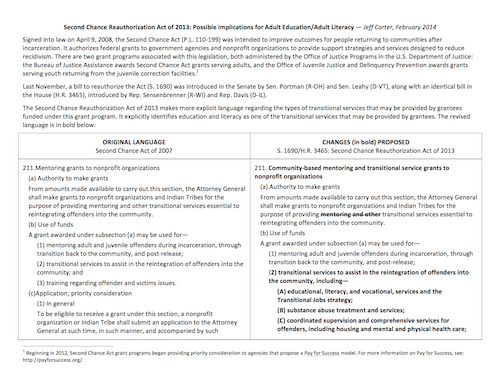
Looking for a small federal policy win for adult literacy? Then I invite you to take a look at The Second Chance Reauthorization Act of 2013, a bipartisan (!) bill recently introduced in both the House and the Senate containing language that appears to open up a Department of Justice grant program to adult education/literacy providers by making it explicit that such services qualify.

Signed into law on April 9, 2008, the Second Chance Act (P.L. 110-199) authorizes federal grants to government agencies and nonprofit organizations that provide support strategies and services designed to reduce recidivism. There are two grant programs associated with this legislation, both administered by the Office of Justice Programs in the U.S. Department of Justice: the Bureau of Justice Assistance awards Second Chance Act grants serving adults, and the Office of Juvenile Justice and Delinquency Prevention awards grants serving youth returning from the juvenile correction facilities.

Last November, a bill to reauthorize the Act (S. 1690) was introduced in the Senate by Sen. Portman (R-OH) and Sen. Leahy (D-VT), along with an identical bill in the House (H.R. 3465), introduced by Rep. Sensenbrenner (R-WI) and Rep. Davis (D-IL).

The reauthorization bill(s) offer more explicit language regarding the types of transitional services that may be provided by grantees funded under this grant program. It explicitly identifies education and literacy as one of the transitional services that may be provided by grantees. I know zippo about how/why this language got in there, but if the bill passes with this provision intact, it seems to me it presents an interesting opportunity for adult education providers.

The document below (click on it for a PDF) highlights the pertinent section. The new language is in bold.

Second Chance Reauthorization Act of 2013