Australia Looks to Import Skilled Workers from U.S. to Fill Vacancies in Skilled Labor

According to the The Information Daily, Australia believes there are enough skilled workers in the U.S. to fill vacancies in their booming mining and gas industries:

Chris Evans, minister for Skills, Science and Research, expects the demand for skilled construction workers to peak over the next three to five years and said his government was looking towards the US to fill the gaps.

To do that, Australia is considering a change to their immigration policy which will enable U.S. workers in licensed occupations, such as electricians and plumbers, to have their skills assessed before they arrive for work in Australia. Under the current system, these workers are required to have their skills assessed when they arrive—a process that often takes several months.

The Daily adds, “[t]he announcement will come as a welcome relief to the US, with high unemployment rates at 8.3% despite some recent improvements.”

American industries report that they are unable to find skilled workers to fill vacancies for skilled labor here in the U.S., yet Australian government officials are so confident that skilled labor is abundant here that they are adopting policies to encourage those workers to emigrate half-way around the world for a job.
House Republicans Introduce Their Workforce Investment Act Reauthorization Bill

Yesterday House Republicans introduced their Workforce Investment Act (WIA) reauthorization bill, H.R. 4297, The Workforce Investment Improvement Act of 2012. This bill more or less pulls together the three separate WIA bills introduced earlier this year by Reps. Virginia Foxx (NC), Rep. Buck McKeon (CA), and Rep. Joe Heck (NV). I learned this morning at a meeting that there is one significant change in this bill from Rep. Foxx’s earlier bill, the Streamlining Workforce Development Programs Act. In the older bill, the provision that allowed states to consolidate different job training programs into one unified plan included Perkins grant funds as one of the programs that could be consolidated. In the new bill, language was added that removes Perkins as a candidate for consolidation. (h/t NASDCTEc)

House Democrats Workforce Investment Act Reauthorization Bill – What’s in it for Adult Literacy?

Here is what they say it will do, anyway:

Developing a 21st Century Delivery System for Adult Education Literacy and Workplace Skills Services:

  • Expands access to adult education, literacy services, and workplace skills training.
  • Expands access to postsecondary education and credentials to achieve and maintain economic self-sufficiency for adult learners.
  • Supports integrated adult education and training.
  • Provides support for English-literacy services and integrated English-literacy and civics education programs for adult learners.
  • Authorizes increased investments in technology (such as online education) and digital literacy, providing needed training and education resources to rural and urban areas.
  • Enhances support for research on innovative methods and policies that help accelerate progress for basic skills students, improving the likelihood that they will receive postsecondary credentials.

The full text of the bill, announced by House Democrats and released today, is available here, via the National Skills Coalition.

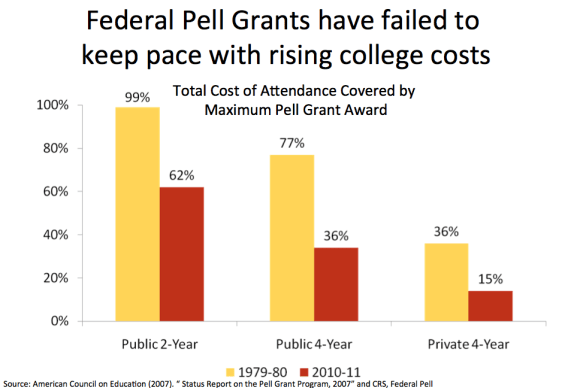
Great Chart Showing How Pell Grants Have Failed To Keep Pace with Rising College Costs

Paul Krugman, in response to the Thomas Edsall piece I wrote about below, was especially struck by this chart, (which comes from an Education Week webinar held last summer), showing the declining value of Pell grants compared with college costs:

pell-edweekchart