White House Claims House Republican Budget Would Eliminate Training and Employment Services for 3,500 D.C. Residents Over the Next Two Years

The White House Office of Management and Budget has released a couple of charts showing what they believe to be the impact of House Budget Committee Chairman Paul Ryan’s budget plan, released last month.

Basically, they’ve taken the cuts and, using existing allocation formulas, spread them out proportionately across employment and training programs and, for education, across four major educational programs: Pell Grants, work study, special education, and Head Start. Unfortunately, the analysis of education program cuts does not include the District of Columbia, which is strange, since I can imagine more people in the District are impacted by the programs they highlighted than those living, in say, Wyoming.

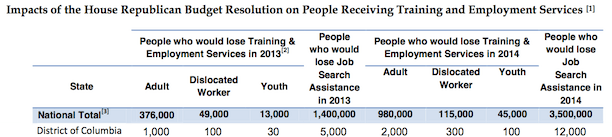
However, they do include D.C. in their analysis of employment and training programs. The projected decrease in participants in these programs was derived by applying the percentage reduction in funding for each state to the national projected reduction in the number of participants served. Here is the breakout nationally, and for the District:

D.C. Chart: Ryan Budget Impact on Job Training

Source: White House

As you can see, they estimate about 1,130 District residents across three categories (adults, dislocated workers, and youth) will lose employment and training services in 2013, and about 2,400 in 2014, for a total of 3,530 over two years. In addition, they estimate 17,000 people will lose access to job search assistance.

Here are links to both charts, which are a bit hard to find on the White House site:

AFL-CIO, NEA, and Other Organizations Oppose H.R. 4297

I don’t think this will come as a big shock to anyone who follows this issue: labor unions don’t particularly care for H.R. 4297, the House Republican’s proposal to update/revise the Workforce Investment Act (WIA).

In a blog post last week, just before a House Committee on Education and the Workforce hearing on the bill, the AFL-CIO characterized it as an attempt to “hand over the nation’s publicly-administered job training and workforce development system to the corporate sector.”

In addition, in a letter sent to members of the Committee last week, labor organizations echoed the concerns about program consolidation raised by workforce development advocates like the National Skills Coalition (see NSC’s Executive Director’s testimony from the hearing last week) and from the National Coalition for Literacy.* The letter, signed by 11 union organizations, including the AFL-CIO, the National Education Association, and SEIU, argues that consolidation would “eliminate the targeting of resources to workers and communities where the needs are greatest” and “make programs more vulnerable to funding cuts and pit one group of workers against another in competition for limited resources.” They go on to argue that “[s]uch consolidation of funding streams will undermine the accountability of the entire WIA system, enabling states to manipulate their resources in a manner that will result in the neglect of populations with the greatest needs.”

The bulk of the letter, however, is focused on the changes the bill would make to the composition of state and local workforce investment boards. According to their letter, H.R. 4297 would impose a new requirement that two-thirds of those board members be selected from the business sector, and it eliminates the mandate that the boards include at least two worker representatives nominated by unions and labor federations. The bill also eliminates the requirement that labor organizations have an opportunity to comment on state and local plans. The letter calls for unions to “be fully represented on WIA boards so that the workers are heard in the decisions that profoundly affect their careers.”

The board composition issue is interesting from an adult literacy perspective. As many of you reading this likely already know, WIA is made up of several different titles. Title I is concerned with the federal job training system (and hence the place where the language around workforce investment board composition is found), and Title I issues tend to dominate discussions about reauthorization. Title II, meanwhile, also known as “Adult Education and Family Literacy Act,” is focused entirely on adult and family literacy, and is typically less controversial (or even discussed). Back in 1998, when WIA was originally authorized, the goal of the law was to create an integrated employment, adult education, and vocational rehabilitation system. Those who advocated for the inclusion of the Adult Education and Family Literacy Act in WIA argued  that this would encourage more coordination between job training programs and adult education programs. I’ll leave it to others to discuss the degree to which the law has been successful in that regard.

But getting back to the board composition issue: I think it’s safe to say that even if all of the “unified plan” program consolidation language (see my earlier post about this) was taken out of the bill—which would make adult education advocates much happier with it—labor groups would still be strongly opposed to it over the board composition issue, and that makes the prospects for a bipartisan bill much less likely.

In addition—and here is my point, finally—whatever your position is on the composition of workforce investment boards, the wrangling over labor union participation is largely irrelevant to the adult and family literacy programs covered under Title II.

I understand—from both a strategic point of view and as a matter of policy—why the inclusion of adult and family literacy in WIA made sense back in 1998. My point is simply to note that every WIA reauthorization proposal seems to spark big, fundamental disagreements over issues in Title I, and even when our field is handed a bill we can support, we can still be held hostage, legislatively, to those Title I disagreements. Sometimes it feels like being trapped in the back seat of a car while the folks in the front seat argue about how to get it started again.

*The usual disclaimer here: I am a member of NCL’s board of Directors and participate in the development of NCL’s policy positions—but the opinions in this blog are my own.

How Would Adult Education Funding Fare under H.R. 4297?

(Updated below)

The National Skills Coalition has posted helpful summaries of each title of H.R. 4297, the Republican Workforce Investment Act (WIA) reauthorization bill recently introduced in the House, which they call “The Workforce Investment Improvement Act of 2012.”

H.R. 4297 doesn’t tinker much with Title II, (the Adult Education and Family Literacy Act, which, under this bill—and this is most innocuous example of the tinkering I’m talking about—would be rechristened Adult Education and Family Literacy Education Act), yet I think an argument could be made that if passed into law, H.R. 4297 would likely lead to a dramatic drop in both federal and state funding for the programs funded under Title II—especially for those serving people at the lowest levels of literacy.

Why? The answer lies primarily in the dramatic and far-reaching changes the House Republicans are proposing in Title I.

First, section 127 of Title I would authorize states to consolidate all the job training funds under Title I, the adult literacy funds under Title II, and a bunch of other federal programs (TANF, Trade Adjustment Assistance, Community Services Block Grants, and others), into one big Workforce Investment Fund. (See section 127, pp. 138‐140.) Under these unified plans, “[s]tates may treat any funds consolidated into the Workforce Investment Fund as if they were original funds allotted to the state for that purpose.” That suggests, for example, that states could use the Title II funds for purposes other than adult education/literacy, and completely ignore the requirements under Title II to serve adults with low basic skills.

We already know that adult basic education funding is vulnerable when it’s not protected from attempted raids by other sectors with a stronger political base. A case in point is California, where school districts are responsible for adult education. Since 2009, after the passage of the California Budget Act (CBA), school districts have been allowed to take money from one funding category and move it into another. This allows California school districts to use funding originally intended for adult education to fill gaps in its K-12 budget. This has been happening all over California for the last few years— the most dramatic example being Los Angeles, where the Los Angeles Unified School District (LAUSD) Board is still considering the possible elimination of the LAUSD’s adult education program, which would leave well over 300,000 adult students without adult education services.

Section 127 of H.R. 4297 doesn’t just leave federal adult education money unprotected—it practically encourages states to grab that money and use it for other purposes. But the whole point of having this funding segregated from job training funding was to ensure that states would address the needs of those with very low literacy skills. Under this bill, they won’t have to. (And it’s not as if there are states out there being forced to use WIA money on adult literacy when there is no need. There is no state in the country that does not have a significant number of individuals in need of adult basic education services. Most have waiting lists.)

Advocates for every program funded under WIA can probably make an argument as to why their program should be firewalled from Section 127 consolidation, but I think adult literacy has an especially good case. It’s a separate title under WIA for a logical reason. Adult literacy has always been at best an awkward fit under the current law, since adult and family literacy programs are not always directly focused on employment-related outcomes, but on academic goals. The original authors of the act hoped that by including the Adult Education and Family Literacy Act under WIA it would encourage more coordination between job training and adult education, but in order to best support the specific purposes of adult education, they wisely put adult education in its own separate title.

But even if the bill was modified so that Title II was eliminated from the list of programs eligible for consolidation under section 127, there is a change in Title II that I believe would result in a significant reduction in state funding for adult education. Specifically, the bill eliminates the current maintenance of effort provisions mandated by section 241. (See section 241, p. 171.)

Under current law, states must contribute a certain minimal level of non-federal state or local funding to adult education programs funded under Title II, (i.e. “match” funding); in addition, under the maintenance of effort requirement under section 241 , a state may only receive an allotment of federal adult education funds if the state/local non-federal funding effort meets certain previous levels. (If you’re a glutton for punishment, you can read about how all this is calculated here.) If a state reduces that contribution by more than 10% any given year, it’s supposed to trigger an automatic pro rata reduction in the federal allocation to the state.

In other words, under current law, states can’t make dramatic cuts to local funding for adult education without the possibility of a reduction in federal adult education funding coming to their state. Now, as a practical matter, I don’t know how often—or whether—that trigger has ever been pulled. It appears to me that the Department of Education works hard with states to work out arrangements so that a reduction in federal funding is not triggered.

However, I do know that a couple of years ago, here in the District of Columbia, local government officials, looking for cost-savings in the city budget during a challenging revenue year, analyzed their federal grants and stripped down the local funding contribution to the minimum required to maintain their federal match and/or maintenance of effort contribution(s). I think it’s reasonable to assume that the cut the administration proposed to local adult education spending that year (which was later rescinded by the D.C. Council) would have been much greater if that maintenance of effort rule had not been there.

Even if the maintenance of effort requirement is actually be relatively easy for states to negotiate, I believe it does exert at least some pressure on states to maintain at least some minimal funding base for adult education. Thus the elimination of this requirement would further erode an already shaky state/local funding landscape for adult literacy.

I haven’t had the time to study the legislation that thoroughly, so I’d love to hear from others in the comments section about what they think of it. Those were the funding issues that jumped out at me—I know there are other issues with the bill that others have and will point out.

Meanwhile, a hearing on H.R. 4297 is scheduled for tomorrow at 10am.

UPDATE 4/19/12: The National Coalition for Literacy has issued an action alert on the consolidation issue.

UPDATE 4/23/12: One clarification regarding my contention above that H.R. 4297 doesn’t tinker that much with Title II itself. Just to be clear, that is not to say there aren’t any other significant changes to Title II in the Republican bill than those I discussed. Most notably, H.R. 4297 eliminates authorization for the National Institute for Literacy (NIFL). But I’d still characterize that as relatively minor in terms of impact. That’s because in spite of the fact that NIFL remains an authorized program under current law, it closed down several years ago after Congress (with the support of the President) de-funded it. Also, the point of my article was to highlight the changes that would impact funding for programs, and NIFL is largely irrelevant to that discussion.

UPDATE 5/1/12: I received an e-mail from CLASP today with links to their analyses of both this bill and H.R. 4227, the Democratic alternative:
The Biggest Differences Between the House Republican and Democratic WIA Bills

(Updated Below)

This April 4th story from The Hill highlights the critical issues that stand in the way of a bipartisan Workforce Investment Act (WIA) reauthorization bill in the House. Both Democrats and Republicans on the House Education and Workforce Committee recently offered their own bills, (H.R. 4227 and H.R. 4297, respectively), and it’s unclear right now whether Democrats will attempt to offer amendments to the Republican bill, or how this will play out. (According to The Hill, The Senate will not take up the Republican bill as it now stands.)

The key issues? The Republican bill would consolidate all of the different WIA funding streams and convert them into a block grant program for states, and would not increase overall funding. Democrats are against block granting, and they would boost WIA funding by $8 billion. The third big issue has to do with the makeup of job training boards:

Aside from the fight over funding levels, the two parties are expected to differ over language dealing with business representation in local boards that distribute WIA funds.

Appointed by governors, state and local workforce investment boards allocate funds to various education and training programs within a state. Under current law, 50 percent of the board has to be business representatives.

Republicans want to increase business representation to two-thirds on these boards and leave the remaining one-third of the board up to the discretion of governors. Under this change, Republican governors could potentially decide to stack the whole board with business leaders.

In contrast, Democrats want to ensure the presence of labor organizations and community college representatives on these boards. The Service Employees International Union (SEIU) has also lobbied against this Republican provision.

There are plenty of other differences between the two bills, but I think you can make a good case that these are the three most significant areas of disagreement.

For adult literacy advocates, it’s worth noting that the Democrats’ bill increases funding for Title II (Adult Education and Literacy) to $1.1 billion, almost double the current appropriation (which hovers around $600 million). (See page 243 of H.R. 4227.)

UPDATE 4/11/12: Thanks to the person who alerted me to a similar post based on The Hill’s coverage of WIA on another blog, posted about two hours after this post. For the record, I don’t see much similarities between the two posts, and the author did not lift anything from this blog without crediting me. If anyone should be concerned, it’s the editors at The Hill, because several passages from The Hill’s story were copied pretty much verbatim for that post without attribution. (A link to The Hill’s coverage is provided at the end of the post, but the story is never quoted, nor is the The Hill credited as a source for their information.)

But thanks for the heads-up, and the words of support—that was a nice surprise.