High School Diploma, GED Requirement Apparently Dropped in Unemployment Benefits Extension Compromise

(updated below)

According to press reports, the House-Senate committee charged with coming up with a compromise measure to extend the payroll tax reduction and unemployment benefits reached a tentative agreement last night. In the deal, Republicans have apparently dropped their proposal to require unemployed workers who lack a high school diploma or GED from collecting unemployment benefits until they acquire one or the other (or are enrolled in a class to acquire one). From a New York Times story on the deal this morning:

Democrats, elated after winning the Republican tax concession after months of clashes, said they had also been able to beat back new conditions that Republicans had wanted on jobless pay, like requiring beneficiaries to seek high school equivalency degrees…

From the Boston Globe:

Republicans also were expected to drop a proposal requiring unemployed people to enroll in GED classes to obtain benefits, and a GOP proposal allowing states to employ drug tests as a condition of receiving unemployment benefits would be scrapped as well. But Republicans won a provision requiring jobless people to be more diligent in job searches as a condition of receiving benefits.

It will be interesting to look at the final conference report to see what that last sentence means.

Also, it’s not entirelly clear to me what has happened with the drug testing requirement. The Globe report above says its been dropped, but an earlier report in Roll Call quoted a Republican aide saying that the deal included language allowing states “to drug screen workers seeking a job that requires a drug test or who lost a job due to a failed drug test.”
Politico, reaffirming that the high school diploma/GED requirement has been dropped, but suggests that the deal might have an extremely watered version of the drug testing requirement:

The deal would drop language called for by Republicans allowing states to drug test potential recipients of jobless benefits and requiring the unemployed to be in a GED program if they have not finished high school. Republicans said the deal’s language on drug testing will reaffirm existing law.

Update (6:00 PM): Roll Call reported this afternoon that House Republican leaders emerged from a Conference meeting this morning “tempering expectations” that a majority of their Conference will accept the deal. Democrats were also reportedly “quick to note that a deal is not yet final.”

Meanwhile, the Washington Post‘s Greg Sargent was forwarded talking points that House Republicans have been circulating about the deal, which includes the following:

“Those receiving unemployment benefits must be searching for a job, and every state will be allowed to drug screen workers seeking a job that requires a drug test or who lost a job due to a failed drug test.”

Crazy Idea of the Day

(updated below)

LA Weekly‘s News Blog, the Informer, posted a story today on the Los Angeles adult education funding crisis that included this great little tidbit:

There has been speculation that “zeroing out” the programs was a highly risky strategic move on the school district’s part to attract grants from either the state or federal government.

Is there any way that this speculation could possibly be true? I don’t understand a scenario in which zeroing out adult education would attract federal or state money from some other source.

UPDATE (2/15/12)LA Weekly‘s report today on the LAUSD Board of Education’s decision to postpone their vote on this cut suggests that the proposal to zero out adult education might have been “political theater orchestrated by district officials to galvanize support for a $270-a-year parcel tax proposed by LAUSD for the November ballot.”

What Can We Learn from California’s Adult Education Funding Crisis?

While the President’s proposed FY 2013 budget will continue to be the focus of attention in Washington this week, the most urgent adult education funding battles over the next year are more likely to occur at the state and district level, I think—most notably. Today, for example, the Los Angeles Unified School District Board has scheduled a vote on a proposal to cut most of the $200 million in state money earmarked for adult education in the district.

Is the adult education funding crisis in California unique, or could it happen elsewhere? State funding for adult education has, in fact, been cut in other states in recent years—but California appears to be the most dramatic example, due in large part to a provision in the California Budget Act (CBA) that allows school districts in the state to shift dollars away from adult education to make up for shortfalls in district budgets.

But while the CBA (and the state’s overall position as an economic basket case) makes California unique in some ways, the situation also provides us with a case study in how adult education funding can become vulnerable. The article I cited yesterday in the Contra Costa Times provides a summary of the factors that contributed to the crisis in Los Angeles:

For the last five years, the cash-strapped state government has provided the district with just part of the money it is supposed to receive and has extended IOUs for the rest. This year, for instance, Los Angeles Unified got just $3,338 of the $6,506 it had been promised to educate each student, according to district officials.

Los Angeles Unified, meanwhile, must fulfill its labor contracts — roughly 90 percent of its costs are personnel-related — while coping with the expiration of state and federal grants and stimulus money. Lower birthrates and the exodus to charter schools has reduced district enrollment, resulting in less state funding and making it more difficult to serve the remaining students.

Here then, are some of the conditions to be on the lookout for in your state or district that may lead to adult education funding cut proposals:

  • Lower State Tax Revenue. (Or, at least, lower than expected tax revenue.)
  • Expiration of Federal Stimulus Funding. This is happening everywhere, so go ahead and check this one off on your list.
  • Locked-in Contractual Obligations. Labor contracts, mostly, although there could be other long-term contracts that districts can’t get out of or re-negotiate. (Note that in the story above, 90% of LAUSD costs are labor related.)
  • Reduced Enrollment Due to Lower Birthrates or Population Shifts.
  • Reduced Enrollment Due to Charter School Expansion.

There could be other factors, of course—and they are going to vary depending on how state adult education funding is disbursed (in some areas, for example, school districts are not involved in adult education at all, so school district formula funding based on enrollment is not going to be an issue). The point is, while I realize that California is in some ways a unique situation, I still think it’s useful for adult education advocates to be thinking about the factors that have led to adult education cuts here and in other states and districts across the country, and to be on the lookout for them in your state or district.

The President’s Proposed FY 2013 Budget for Adult Education

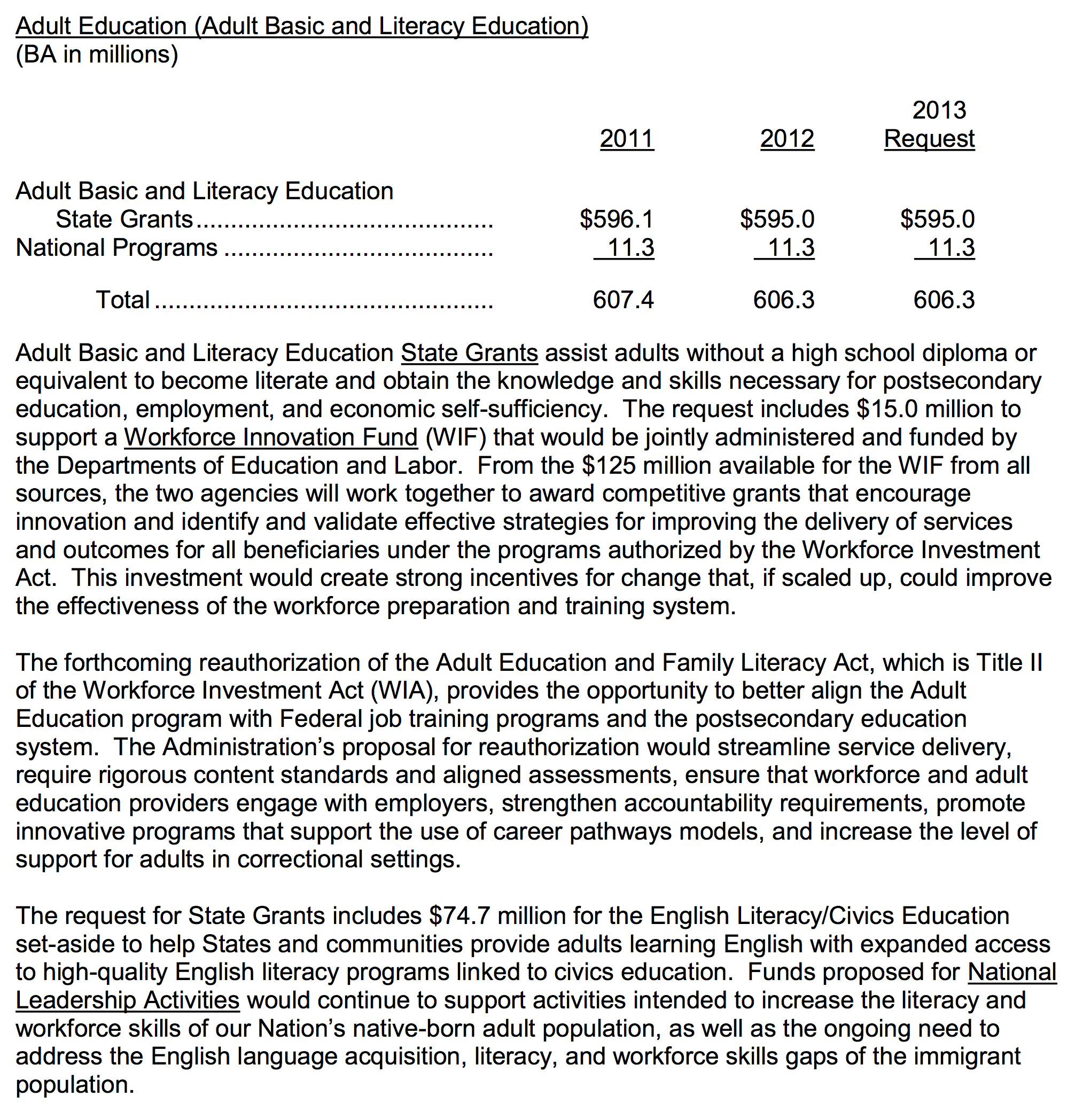
Yesterday the President unveiled his budget proposal for fiscal year 2013. To no one’s surprise, the President proposed level funding for adult education. This doesn’t mean that this will be the actual federal budget for adult education in 2013—most people who follow the budget process agree that there is no chance the President’s proposed budget will be adopted by Congress. As Derek Thompson notes at The Atlantic, “[T]he vast majority of its provisions are dead-on-arrival.” Still, it’s a good sign that a reduction in adult education spending is not being proposed here. As we know from last year’s FY 2011 budget debate, Congress is likely to go along with almost any proposed reductions in non-military spending. (It’s also important to remember that there are other smaller sources of federal funding for adult education services in other parts of the budget, which I haven’t looked at yet.)

Anyway, for those who are interested, here is the section on adult education from the Department of Education’s summary document: