What’s in the FY 2015 Federal Spending Bill for Adult Education

Members of the House and Senate reached an agreement late yesterday on a nearly $1.1 trillion FY 2015 spending bill that will fund most of the federal government through September 30, 2015. The one exception: funding for the Department of Homeland Security is funded only through February. This is supposedly going to give Republicans some leverage in the next Congress to block President Obama’s recent executive order on immigration.

Here is how adult education made out:

Total amount for WIOA Title II adult education is $582,667,000. State grants were funded at $568,955,000. (This is the money that is sub granted to programs for direct services.) The FY 2014 figure for state grants  was $563,955,000, thus this is a $5 million increase. National Leadership funding (basically funding that goes to the U.S. Department of Education to manage the WIOA Title II program and provide assistance, research etc.) was level-funded at $13,712,000 (but note that this line item did get a slight bump up in FY 2014).

There is also some report language on the National Leadership funding:
Career Pathways Report Language

No one is going to complain about an increase—whatever the amount—and in the current fiscal environment, even a relatively small $5 million increase should arguably be viewed as a victory. But as far as I can tell, nearly every adult education or WIOA advocacy group that spoke out about the FY 2015 budget advocated for a larger increase, and with ample justification. A $30 million increase was needed to bring state grant funding back to the pre-sequestration level of $595 million. This was what the House Democrats’ proposed Labor-HHS-Education bill included. The National Coalition for LIteracy advocated for the House Democrats’ proposal, noting that it would not only have restored state adult education grants to the pre-sequester level, it would have also maintained the slight bump up in national leadership programs that was included in the Fiscal Year (FY) 2014 Consolidated Appropriations Act. For those interested, I have a post here that summarizes the different proposals for adult education funding under WIOA that were released over the course of the last year.

For what it’s worth, the total amount for WIOA Title II adult education contained in this bill—$582,667,000—is actually above the funding level authorized under WIOA for FY 2015, which simply carried over the FY 2014 funding level of $577,667,000. But as noted by myself and others, the WIOA authorized amounts are not even close to what is needed to meet the need for adult education in this country.

The new spending bill also includes a provision “reinstating” ability-to-benefit (ATB) financial aid eligibility for students without high school diplomas enrolled in career pathway programs at community colleges. Note that this is in fact a partial reinstatement of ATB, since the older provision didn’t restrict eligibility to those enrolled in career pathway programs. Regardless of whether you think such a restriction is a good or bad idea, I think it’s important to remember that this is not a full restoration of ATB.

The House and Senate are expected to try to quickly pass the bill this week.

Here is the source for all the FY 2015 information above.

Election Thought of the Day

Thinking about the impact of the elections on adult education policy, I wonder if the results of some of the governer’s races are more significant for adult education (and workforce policy generally), than the shift in power in the Senate. While most education-related legislation languished without much progress during the last Congress, the current crew did manage to successfully dispose of the most important piece of legislation for our field, the Workforce Investment and Opportunity Act (WIOA), passing it by a wide margin this summer. The action is really now at the state level, where governors hold sway over WIOA’s implmentation.

What will party switches in the governor’s offices in Illinois, Pennsylvania, Massachusetts, and Maryland, for example, mean for WIOA implementation in those states?


Some New(ish) Federal Adult Education Data to Chew On

UPDATED 9/22/14: The first chart below was the wrong chart, although this didn’t make any difference in terms of the point I was trying to make about total enrollment.

While preparing for a panel discussion tomorrow, I was reviewing the latest National Reporting System data on adult learners served by Title II of the Workforce Investment Act (WIA)—now reauthorized as the Workforce Innovation and Opportunity Act (WIOA).

I haven’t had a chance to update the “Primer” page on this site in a while. One of the things I need to update is the “Participants by Program Type” table, which also includes the total number of adults served. We now have data for the 2012-13 program year. This may not be that new—I just hadn’t had a chance to look to see if had been updated. Anyway, the numbers are not good:

2013-14 NRS Enrollment Data

Source: Office of Career, Technical, and Adult Education, National Reporting System

You can see from this table that overall enrollment numbers are down once again, from 1.8 million to 1.7 million, a drop of almost 111,000 people. This is (or should be) really distressing, and again raises the question: will the new WIOA legislation do anything to stem the decline in adult education enrollment that has been occurring over the last several years? A lot of this decline has to do with funding, and the funding picture for WIOA is not good. (I realize that some of this enrollment could have been picked up by private, non-federally funded programs or via self-study, but I know of no data to support that. But I strongly suspect that enrollment in privately funded programs is not rising enough to offset the decline in WIA Title II enrollment.)

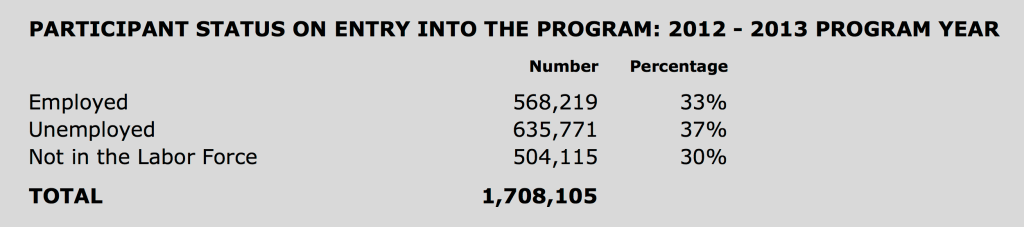
Here’s another interesting piece of data that is important to keep in mind when discussing the additional emphasis on employment skills in WIOA:

NRS Labor Market 2012-13

Source: Office of Career, Technical, and Adult Education, National Reporting System

As you can see from this table, during the most recent program year, 2012-13, almost a third of all adults participating in WIA Title II were not in the labor force. We need to know more about this population. Do we? Can anyone point me to a source? I don’t know, for example, how many of them are likely to be permanently out of the labor force. Or how many have simply given up (and of those who have given up, to what extent they identify skills issues as being the reason why). I know that during this same program year, about 60,000+ of adult learners were served over the age of 60, and presumably a lot of those folks are out of the workforce for good. Anyway, we likely need a lot of additional research here. In the meantime, it’s important to bear in mind that a significant number of people enrolling in a WIA-funded program are not part of the labor force.

The Real Problem With WIOA

I’m still confused over why the Workforce Innovation and Opportunity Act (WIOA) is already considered an abject failure because it didn’t do anything about the predatory lending practiced by institutions covered by an entirely different piece of legislation, but in the meantime, while watching this, I was pleased to see someone mention, even if somewhat obliquely (and then completely ignored by the host), the one clear aspect of WIOA (and its predecessor, the Workforce Investment Act) that really does work to the advantage of those schools that rip people off: the fact that there isn’t nearly enough funding in WIOA to provide quality training to people who are eligible for the program. If people had better options, maybe they wouldn’t be in a position to be taken advantage of by these terrible schools.

I’ve written about the completely inadequate funding levels for adult education in WIOA here. I’m not an expert by any stretch on the job training programs covered in WIOA, but I gather from what little I do know that the funding for these programs is inadequate as well. If people think that it’s the WIOA-funded one-stops that should be counseling people about higher ed student loans, then in their next breath it night be good to talk a little about whether one-stop staff capacity is sufficient—or sufficiently knowledgable—to do this, and if not, what kind of money it might take to  make that happen.

Again, I’m really interested in how workforce investment advocates might do more to stop the higher education scam artists that prey on the unemployed and unskilled, but most of the discussion over the last week or so hasn’t been very clear about the differences between higher eduction and WIOA, how they actually work together, and how they could work together better, given such a restrictive funding environment. Without such clarity, it’s hard to know which policy choices, if any, will make a difference. This is one area where your comments would be much appreciated!