Dean Baker Thinks Unfilled Jobs More Due to “Incompetent Managers” Than Skills Gap

Today I noticed that Dean Baker of the Center for Economic and Policy Research, who knows a lot more about this stuff than I do, shared my skepticism about this Washington Post article on the alleged skills gap in the manufacturing sector. Actually his response was a lot stronger than mine:

The Washington Post told readers that the manufacturing industry is suffering from incompetent managers and therefore is not hiring as many workers as it should. According to the Post, managers don’t realize that it is necessary to raise wages to attract more workers and instead are whining that they can’t get the workers they need to fill vacancies.

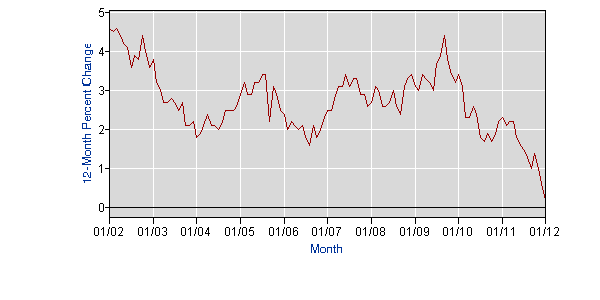
Baker produced a chart showing how far hourly wages for non-supervisory workers in the manufacturing sector has fallen in recent years, and it’s kind of astounding:

Chart showing decline in manufacturing wages

Source: Dean Baker, CEPR, using Bureau of Labor Statistics data.

Skilled Factory Workers or Cheap Skilled Factory Workers?

As I wrote earlier, the Washington Post published a story today on the alleged skills gap in the manufacturing sector in Michigan and other parts of the country. If you make your way all the way to the end of the story, after reading various employers lament the fact that the workers they laid off in 2009 now can’t work any of the newfangled machines that these companies installed during the recession, you get to this interesting paragraph:

The shortage of skilled workers has also pushed up wages, though executives said raising them too far could push more work to overseas plants(my emphasis)

In other words, if you are one of those laid off workers who does invest time in the re-training required to get your job back, don’t expect a big return on that investment in the form of higher pay, or we will ship your job overseas.

The article closes with an anecdote that again raises the question as to whether at least some employers who complain about the lack of skilled workers are actually complaining about a lack of cheap skilled workers:

A Michigan company that makes camshafts for cars, as well as farm and mining equipment, has had ads out for at least six months for CNC machine operators and programmers. The pay runs from $15 to $21 an hour, a relatively good wage in this part of the country.

“The problem is as soon as we get someone in, one of our other guys will jump ship,” said Tyson De Jonge, engineering manager at Engine Power Components. “They get better offers.” (my emphasis)

The author of the piece accepts the company’s claim that they are paying a “relatively good wage” even though the evidence seems to contradict this assertion. It sounds like these folks are “jumping ship” because someone is offering them better pay somewhere else.

Anthony Carnevale: Skills Mismatch Not the Whole Story

Whatever you think about the effectiveness of federal job training programs, Amy Goldstein’s story in Saturday’s Washington Post notes the basic problem with relying too heavily on job training to solve the country’s unemployment problem by itself.

Anthony Carnevale, the director of Georgetown University’s Center on Education and the Workforce, which has produced valuable research on the relationship between earnings and educational attainment—including the long-term value of a college education—acknowledges, according to Goldstein that “retraining can’t always overcome a scarcity of jobs.” She writes:

That skills mismatch, while real, is not the whole story, Carnevale says. At the moment, he points out, the country has 3 million to 4 million job openings. But if you add up the people who are unemployed, in part-time jobs because that’s all they could find or so discouraged that they’ve quit looking for work, he says, the country has more than 20 million people who could use a job. (my emphasis)

In other words, not enough jobs are out there, even if every single person who needed re-training received it. None of this means that re-training, investments in community colleges, and increasing access to higher education are bad policies, but it does suggest that there are other factors that need to addressed in order to fully address inequality and economic opportunity.

Interestingly, the Post comes back today with a story on the skills mismatch in some areas of the manufacturing sector.

Some High Demand Jobs of the Future Will Not Require College

Jared Bernstein takes a look at the latest BLS tables and makes an interesting observation: of the first three occupations expected to add the most jobs in the near future, two of them (retail sales and home health aides) are in industries that generally do not require advanced education:

Educational Composition - top three fastest growing occupations

Source: Jared Bernstein, Citing BLS Employment Projections

Bernstein is not suggesting that skills and education do not matter. As he notes, it’s hard to say now what the skill demands for a food prep worker or cashier will be ten years down the road. More importantly, he has previously made the case that it’s better for the worker and society overall when people within these occupational categories have more skills and training.

But even if there are more job opportunities for those with lower education levels than some would have you believe, the quality of those jobs isn’t great. Where I live, in Washington, D.C., many of retail jobs, for example, pay the minimum wage or just slightly better, and don’t offer much in the way of advancement, and/or have lousy benefits. The median wage for workers in low-income families in D.C. is just a little over $9.00 an hour (this comes from a 2010 report, but I doubt it’s gone up much), which is too low to lift a family out of poverty even working full-time.

So I understand why college access is an attractive anti-poverty policy lever: (1) the jobs for those without college often do not pay enough to lift people out of poverty, and (2) those living in poverty have often been denied access to a decent education, perhaps over multiple generations.

But if we expect there to be a continued demand for employees in industries that do not generally require a college degree, what else could be done to lift wages and improve working conditions in these high-growth, low-skill industries—rather than just asking workers to get a degree in order to escape them?