OMB Sequester Transparency Act Report Is Released

OMB has just released its report on sequestration, which they were required to do by the Sequestration Transparency Act passed by Congress earlier this summer. (The report is actually about a week late.)

To me, it’s mainly of interest because it provides us with OMB’s best estimate, at this time, as to what the percentage cut will be: 8.2% for nondefense discretionary spending, and 7.6% for nondefense mandatory programs. (Adult education falls under the category of nondefense discretionary spending.) This is based on an assumption that FY 2013 discretionary spending will be at FY 2012 levels (the Act mandated that they do this). For fairly tedious reasons I won’t go into here, that’s not what’s actually going to happen, and so the final percentage cut will actually be a bit different. But we are moving closer towards understanding precisely what the numbers will be.

Sequester Transparency Report Excerpt

The report does not break out Adult Education separately. I’m too tired to calculate precise numbers for adult education alone, but without looking anything up, I believe an 8.2% reduction from FY 2012 levels is going to be just shy of $50 million.

Again, bear in mind that there are several other federal programs other than Title II of WIA that fund adult education in the U.S., and all of the estimates I’ve seen only look at WIA Title II. It would be very difficult to figure out with much precision what the combined impact of the cuts to the other programs that fund adult education would be, since these programs do not exclusively fund adult education—and the extent to which they support adult education services may vary from year to year. The point is, any analysis of the impact of sequestration that looks only at WIA Title II is surely underestimating the actual impact that sequestration will have on this field.

I also think that the even bigger danger for adult education funding may lie in possible replacements for sequestration being bandied about, which could conceivably cut even more from nondefense discretionary programs in over to prevent cuts on the the defense side.

By the way, there are pages and pages in this report identifying certain categories of spending as “sequesterable” or not. As a fun weekend sequester-themed activity—and one that might also help get more people talking about the issue—try using the word “sequesterable” in conversation at some point. Here is an example to get you started: “Boy, I am really in a sequesterable mood at the moment—I think I will go and sit in the closet.”
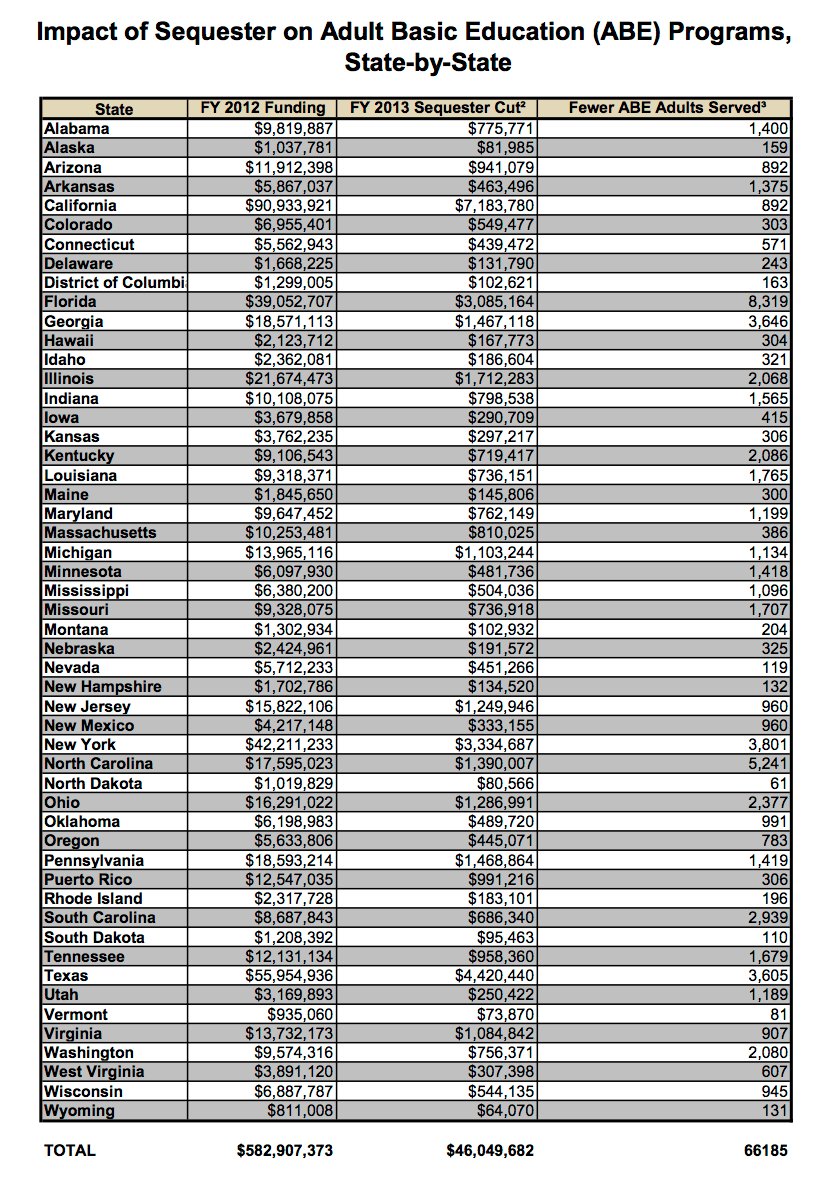
NSC Estimates that 66,000 Fewer Adult Learners Would Be Served Under Sequestration

A couple of weeks ago the National Skills Coalition released a report, “Disinvesting in the Skills of America’s Workforce,” which examined the potential impact of sequestration on key federal employment and training programs. The report estimates that Adult Basic Education (ABE) programs would serve 66,000 fewer learners if sequestration cuts go forward, as now required by law. Unlike the NEA numbers published earlier this year, NSC included not just the loss of federal dollars but also a proportional cut from required state matching funds. It includes a table that shows the impact on a state-by-state basis (click on the table to read the entire report):

NSC Sequester Analysis - Adult Education

NSC used a different methodology to calculate their estimates than the one used by the NEA for the tables they published a few months ago. The NSC’s estimate of 66,185 adult learners losing services is considerably lower than the NEA’s worst-case estimate, which was north of 200,000.

Either estimate likely understates the actual impact of sequestration on adult education because they do not include the impact of cuts to other non-defense discretionary programs that support adult education other than WIA Title II, such as Community Development Block Grants, community service programs, USCIS, and other programs. (Understandably—it would be challenging to come up with impact estimates across all of those other programs since they do not exclusively fund adult education programs.)

What Would Sequestration Mean for Adult Education?

(Updated Below)

In less than six months, more than 200,000 adults across the country may be facing the possibility of losing adult education services sometime in 2013, and as many as 730 adult education jobs in community colleges, community-based organizations, and public schools could be eliminated. (But see update below.)

These numbers come from an analysis just released by the National Education Association (NEA) on the potential consequences of sequestration on public education. Sequestration is the term used to describe the automatic federal budget cuts that are scheduled to kick in on January 1st, 2013, unless Congress passes some kind of legislation to defer, alter or avert it. Right now these cuts are required by a law that this same Congress passed just last summer—the Budget Control Act (BCA)—which raised the federal debt ceiling in return for an immediate federal budget cut of $900 billion and a commitment to come up with a plan (which could include spending cuts and/or tax increases) to reduce the federal budget deficit by another $1.2 trillion by 2021. The plan was supposed to come from a so-called  Congressional “super committee”—if they failed (and they did), automatic budget cuts were required in both defense and non-defense discretionary spending, beginning on January 1st of 2013, with across-the-board cuts to virtually every federal discretionary program (a few are exempted).

The NEA’s analysis of the impact this would have on adult education includes not only a national estimate, but state-by-state estimates as well. (NEA actually provides two estimates for the country and for each state. The Congressional Budget Office has estimated that nonexempt programs would be reduced by 7.8 pecent in 2013; an analysis conducted by the Center on Budget and Policy Priorities indicates that nonexempt, nondefense discretionary programs and nonexempt mandatory programs would be reduced by 8.4 percent and 8 percent, respectively.)

I asked the author of this analysis, Tom Zembar, about his methodology and he did point out that it’s impossible to know exactly how states and providers would actually react and readjust services once the cuts go into effect, but the point of the analysis was to help people understand the potential consequences of the cut in each state. I’ve included a reproduction of the first page of the adult education analysis below; click on the link to go to the full report. This page, and the state-by-state table that follows, are towards the end.NEA: Impact of Sequestration on Adult Education

UPDATE 8/1/12: A couple of clarifying points:

(1) First, in my lead, for the sake of being dramatic, I strongly created the impression that FY2013 funds will be cut instantaneously on January 1st. I should have pointed out that Adult Education under WIA Title II is a forward-funded program, meaning that funds don’t become available for obligation until July 1st of the fiscal year in which they are appropriated. On the other hand, since states start their budget process over the winter based on the amounts they expect to receive from federal programs later in July, I believe the impact of sequestration would start to work its way into proposed state budgets for adult education pretty quickly,  even if the actual federal reductions might not be felt until later in the year.

(2) Which brings me to my second clarifying point: no one can know with certainty what states are actually going to do once they get their sequestered numbers. I assume that any reduction in the Title II state grants resulting from sequestration would trigger an equivalent reduction in the state’s match and maintenance of effort obligations—but I don’t know exactly how that will work. In any case, a state could, conceivably, respond to the reduction in the federal grant by raising their state’s investment in adult education to offset the cut. I think that’s doubtful, at least on a widespread basis. It seem more likely to me that the NEA estimates above—which, for simplicity’s sake, don’t factor in potential state reductions, but just focus on the student service cuts and job losses resulting from the federal cutprobably underestimate the actual reduction in both services and jobs in most states if sequestration moves forward.

UPDATE 11/15/12: I’ve re-worded the opening paragraph for the reasons noted in the update above.