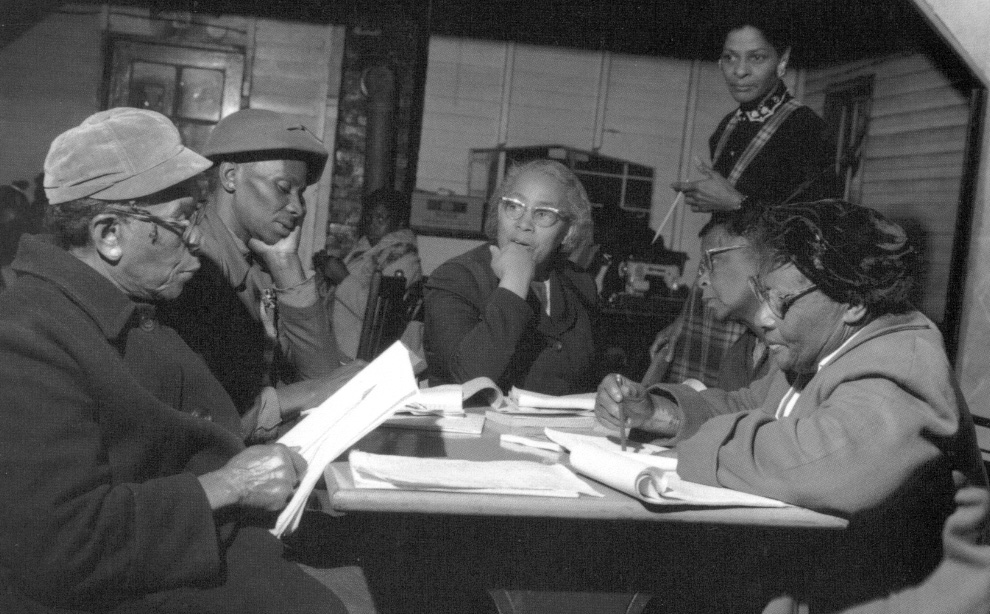
Septima Clark

Septima Clark

Septima Clark (center). Date/source of photo unknown.

Septima Poinsette Clark was born on this day 115 years ago. Without question one of most important figures in the American Civil Rights movement, the story of her role in  advancing adult literacy in the U.S.—and in drawing attention to the connections between education, poverty, and political power—should be mandatory reading for anyone interested or involved in adult literacy or education—especially the “education is the civil rights movement of our time” folks who seem to believe that the relationship between civil rights and education began sometime around the year Teach for America was founded.

Clark is best known for her role in developing the Citizenship Schools of the 1950s and 60s, where thousands of disenfranchised African Americans across the southern U.S. learned to read and write in order to pass the literacy tests required by southern states to register to vote. But while voting was the focus, the schools also emphasized the role of literacy as an instrument of empowerment more broadly.

And unlike today, this was at a time—not that long ago—when teaching reading in such a context was truly dangerous. Classes often had to be taught in back rooms of stores and other hidden places. Teaching people how to read helped countless Black Southerners push for the right to vote, but beyond that, it developed leaders across the country that would help push the civil rights movement long after 1964.

Clark wrote two autobiographies during her lifetime: Echo in My Soul and Ready from Within: Septima Clark & the Civil Rights Movement, A First Person Narrative. A  collection of her papers is archived here, although none of it seems to be accessible online. But there is a great online “scrapbook” of  images, newspaper clippings, and correspondence related to her life at the Lowcountry Digital Library site.

This Is the Way It Should Work Everywhere

Education leaders in Biddeford, Maine have come up with a great idea (reported in the Biddeford-Saco-Old Orchard Beach Courier): let’s take our early childhood education leaders and put them in charge of adult education as well.

If the people accountable for early childhood education were also in charge of our adult education system, I think we’d start to see adult literacy more thoughtfully integrated into school readiness strategies, as well as a stronger push for adult literacy outcomes that are more closely tied to the role that parents and other caregivers play in the literacy development of their children. (And the evidence continues to build that this is one of the key strategies we should be taking to address early literacy development.)

There are, of course, many great family literacy program models that do the kinds of things described here, but what appears to be unique and encouraging about this is that it’s a district-wide strategy.

Study: Diabetes Patients Who Don’t Understand Basic Health Information Significantly Less Likely To Adhere To Prescribed Treatment

Something new today to add to the list of health problems associated with low literacy: in a recent study conducted by the Kaiser Permanente Division of Research and the University of Washington School of Medicine, a big majority (72%) of the 1,366 study participants turned out to have limited health literacy and significantly poorer adherence to newly prescribed antidepressants compared to other patients.

According to Kaiser Permanente, depression occurs twice as frequently among adults with diabetes compared to adults without diabetes.

Although poor adherence to antidepressant medications has been a known issue with some diabetes patients, what’s new here is the evidence that diabetes patients with limited health literacy were much less likely to refill their antidepressant medications in a timely fashion than patients without such limitations.

Dr. Amy Bauer of the University of Washington School of Medicine, notes that “patients with limited health literacy may require more intensive counseling and clearer explanations about use of antidepressant medications and closer follow-up.” Considering the high number of participants in this study who were found to have low health literacy, I suspect that most doctors should, in fact, be prepared to deal with this issue.

But as a matter of public policy, we could also address this by working on improving the literacy skills of adults in this country to begin with, which would lessen the need for such interventions. Does anyone think it’s likely our health care system can really support the cost of more intensive counseling and closer followup what is likely millions of patients with low literacy/health literacy?

This study isn’t the first report to draw a connection between literacy/health literacy and public health (see link above). Shouldn’t improving adult literacy in the U.S. be a major component of our overall strategy to improve public health and lower health care costs in this country?

Could Immigration Reform Draw Greater Attention to the Legal Needs of Low-Income Immigrants?

Kirk Semple, writing for the New York Times’ City Room blog, reports that a federal appellate judge in New York is proposing an “immigrant justice corps” program that would recruit and train young lawyers to assist illegal immigrants navigate the pathway to legal residency status and citizenship—under the assumption that the immigration reform legislation anticipated sometime this year will provide one. Most expect it will.

The judge, Robert A. Katzmann, envisions something that would look a lot like AmeriCorps VISTA and the Peace Corps. According to Semple, the program would recruit 50 young immigration lawyers every two months for two-year periods of service. Like the programs modeled on Teach for America I wrote about a couple of weeks ago, it would give graduating law students an opportunity for work in what is a tight job market right now for lawyers. Katzmann estimates that he would need $5 million to support the program for a year. Authorizing a few million dollars of federal money in the immigration reform bill itself to provide legal assistance to those trying to meet the requirements of the law should be a no-brainer, but in the current budget-cutting climate, that may not be possible.

As Semple notes, Judge Katzmann has been a longstanding critic of the quality of the legal representation provided to immigrants, and was the leader of a group in New York group that proposed a plan last year to create a network of legal service providers to represent low-income immigrants in the New York City region.

One of the biggest problems facing immigrants in any legal proceeding is lack of English proficiency. I’ve seen firsthand defendants brought before judges in criminal courtrooms, for example, who don’t read or speak English and have no experience navigating the U.S. legal system. Last year, I noted on this blog that the National Center on Access to Justice (NCAJ) at the Cardozza School of Law had concluded that many courts “have little or no way to communicate with the growing number of Americans who have only limited proficiency in English.” As a result, “innocent people have been sent to prison, children have been sent to foster care unnecessarily, and women have found it impossible to get court orders to protect them from domestic violence.” As I argued in that post, this is a problem not just for non-native English speakers but for native English speakers with low levels of literacy as well.

I agree with Judge Katzmann that the problem of inadequate legal representation for immigrants (especially low-income immigrants) will acquire even greater urgency once an immigration reform bill is passed, but the problem isn’t limited to immigration status issues. Perhaps his proposal will draw greater attention to the need to address language access and low literacy in our justice system generally.