Last week, the House Education and Workforce Committee approved H.R. 803, the Supporting Knowledge and Investing in Life Long Skills (SKILLS) Act, a Republican-backed bill to revamp the Workforce Investment Act (WIA). (Here is a link to the bill as reported out by the committee.) Title II of WIA is the primary piece of federal legislation concerning adult literacy, so it’s a vital piece of legislation for the adult literacy field.
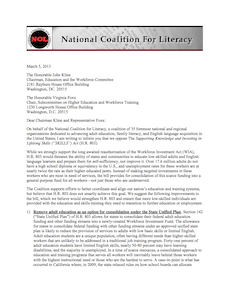
Each group has a slightly different take on the bill. I thought I’d try to summarize in a mostly non-technical way a selective list of what I think are the most critical issues raised between these two letters:
The Consolidation of Adult Education State Unified Plan – H.R. 803 allows states to create a “unified plan” to consolidate their WIA Title I job training money with their adult education funding under WIA Title II—along with a bunch of other training-related funding—into one big ball of money under a newly‐created “Workforce Investment Fund.” This in my mind is by far the most potentially dangerous provision of the bill for adult education. Merging adult education funds into other workforce funds would almost certainly, in my view, lead to a reduction in actual adult literacy services—as well as services to those with disabilities and others who are have been historically more challenging to serve. As NCL’s letter notes:
Adult education students are a unique population, often having different needs than higher‐skilled workers that are unlikely to be addressed in a traditional job training program. Forty‐one percent of adult education students have limited English skills, nearly 50‐80 percent may have learning disabilities, and the majority is unemployed.
I’ve written extensively about this issue in a previous post in response to a nearly identical provision proposed by House Republicans in their WIA reauthorization bill last summer.
As further evidence, NCL points to California, where a budget mechanism implemented in 2009 known as “categorical flexibility” allows school districts to divert funds from programs like adult education to support its K-12 programs. As a result, well over 40 adult schools have had their budgets cut by more than 50% since 2010. I think it’s highly likely that something similar will occur to adult education programs funded under Title II once you allow states to lump that Title II adult education money in with their job training money.
Interestingly, NCSDAE does not come out as strongly against this provision, asking only for clarification as to whether “considering Title I and Title II programs as one activity or program for purposes of the unified plan is not an indication of the committee’s intention to consolidate the programs.” I think a record of Congressional intent here would be helpful, but I’m not sure it would entirely remove the risk of consolidation. I’d rather see language in the bill itself that removes WIA Title II adult education funds from potential consolidation under the unified plan.
Profit-Making Entities Would Be Allowed to Compete for Title II (Adult Literacy) Funds – The SKILLS Act would allow private, for-profit institutions to receive funds for adult education services under WIA. NCSDAE argues that the Senate’s study of proprietary schools (presumably they are referring here to Sen. Harkin’s report on the for-profit college industry) “revealed these organizations had limited effectiveness and ability to demonstrate results” and thus for-profit organizations should not be able to compete for federal adult education funds.
NCL doesn’t call for an outright ban against for-profits competing for these funds, but recommends that the bill should “safeguard students against tuition or fee hikes as a potential result of adding for‐profit entities as an eligible provider of federal adult education funds.” NCL argues that for-profit agencies “are often a key source of innovation in education,” but notes that making federal funds available to them “requires a careful consideration of the potential impact on student access.”
Literacy Defined Narrowly – The SKILLS Act would modify the definition of literacy to focus exclusively on the proficiency necessary to obtain employment and to successfully make the transition to postsecondary education. It eliminates the current language in WIA that includes the ability to function in the family and in society as equally important purposes for literacy. As NCSDAE points out, for many people enrolled in or seeking adult literacy programs, low literacy profoundly affects their ability to function in these contexts, and helping adults help their children with schoolwork, exercise their rights as citizens, or take care of their own and their family’s health (to list a few examples) are also worthwhile policy purposes for improving adult literacy. (In fact, these non-work-related goals are often the reason many adult learners seek out programs to begin with, so it would be weird to define literacy more narrowly than the people actually enrolled in the programs.)
The narrow interpretation of literacy proposed in H.R. 803 also seems to assume that all participants in adult education are currently (or looking to re-enter) in the workforce, and that is not the case. The federal adult education system under H.R. 803, if enacted, would really result in a radical shift in the way in which we define the federal role in improving adult literacy—to one that is exclusively focused on employment. This is a shortsighted and foolish mistake—one that I think, for example, would undermine the efforts of those like myself who argue for more federal investment in adult education as a way to improve the emerging literacy skills of children.
Not Enough Funding – The SKILLS Act would create a ceiling on funding for Title II programs at just a little over $600 million for the next seven years. Obviously, as NSCDAE points out, that would mean essentially no growth in adult education programs over the next decade, at a time when there are already waiting lists nearly everywhere. I would also add that taking inflation into account, it actually means a gradual decline in federal support for adult education as costs go up over that seven-year period.
There’s no reason why the bill can’t establish a funding figure for 2014 and then provide for “such sums” as Congress determines as necessary in future years. (This is what NCSDAE recommends.)
More Money Reserved for National Programs – Under current law, there is a reservation of 1.5% for carrying out National Leadership Activities. These are activities conducted by the Office of Vocational and Adult Education at the Department of Education, such as studies, reports, demonstration projects, conferences etc.—often under contract with outside firms. In other words, this money doesn’t get used for providing actual adult literacy services at the ground level. NCSDAE notes that this funding is currently capped at $8 million. The SKILLS Act would provide that 2% of funds be reserved for this purpose and eliminates the cap. NCSDAE is opposed to this change in the belief that “the lack of a cap could result in fewer dollars available to send to the States to provide actual services.”
The Definition of Qualifying Adult Doesn’t Make Any Sense – This, in my view, is likely an unintentional error that the authors of the bill would probably agree to correct. Section 211(d) of H.R. 803 sets forth the criteria for determining who is eligible for Title II adult education services as follows:
QUALIFYING ADULT.—For the purpose of subsection (c)(2), the term ‘qualifying adult’ means an adult who—
(1) is at least 16 years of age;
(2) is beyond the age of compulsory school attendance under the law of the State or outlying area;
(3) does not have a secondary school diploma or its recognized equivalent; and
(4) is not enrolled in secondary school.
As NCSDAE points out, there should be an “or” between (3) and (4), not an “and.” Otherwise, it looks as if an individual would have to meet all four criteria in order to qualify. But as those of us in the field know well, there are many individuals—including many who currently attend adult education programs—who managed to earn a high school diploma but have very poor literacy skills.
Requiring States to Report on How They Are Building the Capacity of Community-Based and Faith-Based Adult And Family Literacy Programs – Section 224 of H.R. 803 basically outlines the things than need to be in the State plan that is submitted to the U.S. Department of Education. Under Paragraph (10)(A) of this section, states must provide a description of the steps they are taking to ensure direct and equitable access to Title II funds, including:
(A) how the State will build the capacity of community-based and faith-based organizations to provide adult education and family literacy education programs; and
(B) how the State will increase the participation of business and industry in adult education and family literacy education programs
NCSDAE is really opposed to (A) but not, apparently to (B). They write that “the wording of (A) would appear to single out a specific set of providers for special treatment.” They also believe that “there may be scores, if not hundreds, of community-based organizations in a state which, under this provision, could demand (my emphasis) that the state help them build their capacity.” I don’t agree with that interpretation. I don’t think there is any danger that a requirement to simply report on how you are helping to build the capacity of CBOs would create a legal entitlement for any and all CBOs in a state to demand capacity-building services be paid for by the state.
As to special treatment—well, yes, in a way. I think CBOs and faith-based groups have been especially burdened by the requirements of WIA. I’m convinced that there should be a federal role in ensuring or at least providing a little more pressure on states to ensure that this vital sector of the adult education system remains viable under WIA. I don’t think this provision creates an affirmative duty to do anything other than what they are required to do already to ensure direct and equitable access to Title II money—this requirement simply asks them to report on how they are doing it. And I don’t know think reporting on the specific steps a state is taking to ensure that they are meeting this requirement is any more burdensome than the other reporting requirements under the section, such as how they are increasing the participation of business and industry. (I should note, for full disclosure’s sake, that this provision closely resembles an idea I suggested to Senate/House staff a few years ago.)
Use of Funds for Credit Bearing Postsecondary Coursework – NCSDAE notes that Section 231 (b) of H.R. 803 appears to allow adult education funds to be used to pay for credit bearing postsecondary coursework. In this case, I believe their interpretation is correct, and if so, this is a big problem, because it would allow for the very limited funds available for adult education programs under WIA to be used for postsecondary education, which completely goes against the purposes of Title II. It’s one thing to support integrated adult education and training programs, but Title II funding is so paltry it doesn’t seem fair to be able to use that money pay for anything outside the adult education component of those integrated programs.
Maintenance of Effort – Both NCSDAE and NCL flag this one. Under current law, there is a “maintenance of effort” rule that basically requires states to maintain at least 90% of their previous year’s fiscal contribution to adult education or face a proportionate reduction in federal adult education funds. The SKILLS Act eliminates this requirement. Both organizations believe removing it will likely result in significant declines in state support for adult literacy, and given what we know has already happened in states like California in recent years—even with a maintenance of effort requirement—that seems like a reasonable assumption.
Comments? Corrections? Questions? Let me know in the comments…


 Literacy & Policy