Why Hasn’t Prison Education Led to Better Employment Outcomes in D.C.?

(Updated Below)

According to the Council for Court Excellence (CCE), an estimated 60,000 people in the District of Columbia have criminal records (this is roughly one in every ten persons), and about 8,000 of them return to the city each year after serving their sentences. Unfortunately, half of these individuals will end up back behind bars within three years of getting out.

Reducing recidivism improves public safety and strengthens communities, and is therefore a worthy policy goal. And the research tells us that one of the best ways to accomplish this is to provide inmates with access to education and training while they are in prison.

But it appears that education and training for incarcerated D.C. residents isn’t going to be enough unless we significantly reduce barriers to employment once people are out of prison.

Las year, CCE released a report on the employment challenges facing previously incarcerated D.C. residents after they are released. The report was based on the results of a survey of 550  formerly incarcerated individuals. Among the key findings: there was little or no difference in employment rates for those who earned a GED or job certificate before or after prison and those who did not:

The unemployment rate among survey respondents was about the same after incarceration as it had been prior to incarceration, even among those who used their time in prison productively to increase their skills. Over 30% indicated that they received a GED or higher in prison and 35% indicated receiving a job training certificate of some kind. CCE’s sample showed little or no difference in the unemployment rate for those who had earned a GED or job certificate in or after prison compared with those who had not. (my emphasis)

This finding is at odds with the findings of another recent recidivism study from another jurisdiction, conducted by Jake Cronin, a policy analyst with the Institute of Public Policy in the Truman School of Public Affairs at the University of Missouri.

Cronin studied Missouri Department of Corrections data and found that inmates who earned their GED in Missouri prisons were significantly more likely to find a job after release from prison than those who did not.

But Cronin also noted that recidivism rates went down most dramatically for those inmates had earned a GED and acquired a full-time job after release.

“Employment proves to be the strongest predictor of not returning to prison that we found,” Cronin said. “Those who have a full-time job are much less likely to return to prison than similar inmates who are unemployed. Recidivism rates were nearly cut in half for former inmates with a full-time job compared to similar inmates who are unemployed.”

It makes sense to me that education plus sustained employment has the most lasting impact on reducing recidivism. But in Missouri, at least, attaining an educational credential appears to increase the likelihood of employment, whereas in Washington it may have no effect at all. So the question is whether there are other significant barriers to employment for formerly incarcerated individuals here in the District—other than education—that may not be as prominent in Missouri. And if there are, what do we do about them?

I’ll concede that the biggest barrier to employment for many people these days is the lack of jobs to begin with. I’ll also concede that part of the problem may be that the jobs that do become available in the District may, on average, require more specialized training or post-secondary education than the jobs that are available in Missouri. (I don’t know that for certain, but it seems reasonable.) Nonetheless, there are also policies that can be put in place to make it easier for those returning from prison to find a job, and to encourage employers to hire them.

For their part, the Council for Court Excellence (CCE) believes that barriers to employment unrelated to education do exist, and in their report, they made several recommendations to address them, including, among other things, liability protection for employers and a “certificate of good standing” indicating that an individual has completed his or her sentence and is in good standing with conditions of release.

These two recommendations are the centerpiece of recent bill, the D.C. Re-entry Facilitation Amendment Act, introduced by D.C. Council Chair Phil Mendelson on July 10th.

UPDATE 9/27/12: My original headline (Why Hasn’t Prison Education Reduced D.C. Recidivism Rates?) was all wrong—I was making a point about employment outcomes, not recidivism rates—and was updated accordingly.
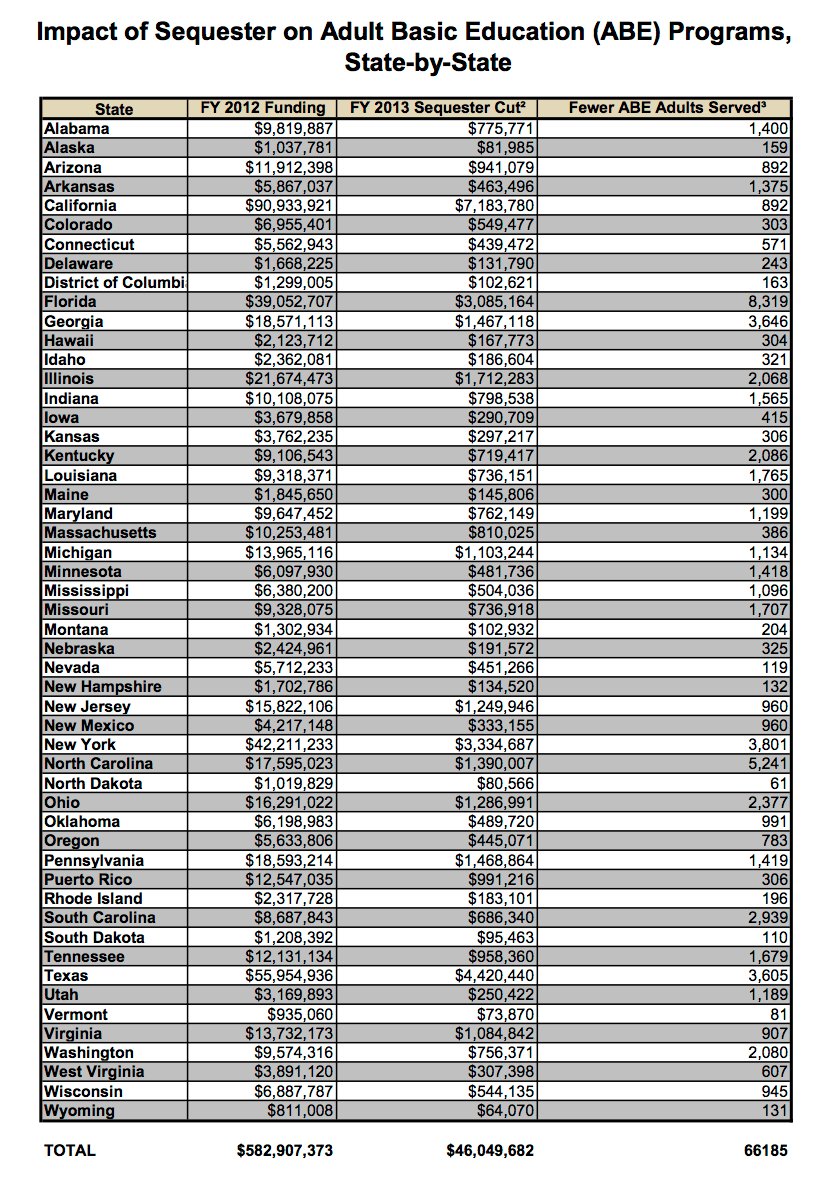
NSC Estimates that 66,000 Fewer Adult Learners Would Be Served Under Sequestration

A couple of weeks ago the National Skills Coalition released a report, “Disinvesting in the Skills of America’s Workforce,” which examined the potential impact of sequestration on key federal employment and training programs. The report estimates that Adult Basic Education (ABE) programs would serve 66,000 fewer learners if sequestration cuts go forward, as now required by law. Unlike the NEA numbers published earlier this year, NSC included not just the loss of federal dollars but also a proportional cut from required state matching funds. It includes a table that shows the impact on a state-by-state basis (click on the table to read the entire report):

NSC Sequester Analysis - Adult Education

NSC used a different methodology to calculate their estimates than the one used by the NEA for the tables they published a few months ago. The NSC’s estimate of 66,185 adult learners losing services is considerably lower than the NEA’s worst-case estimate, which was north of 200,000.

Either estimate likely understates the actual impact of sequestration on adult education because they do not include the impact of cuts to other non-defense discretionary programs that support adult education other than WIA Title II, such as Community Development Block Grants, community service programs, USCIS, and other programs. (Understandably—it would be challenging to come up with impact estimates across all of those other programs since they do not exclusively fund adult education programs.)

Republican Platform Essentially Endorses House Republicans’ WIA Reform Plan

(Updated Below)

The 2012 Republican platform was released today. For what it’s worth, it implicitly endorses the approach that Republicans in the House took with their Workforce Investment Act (WIA) reauthorization bill, H.R. 4297. This bill, which was passed by the House Education and the Workforce Committee in June, would consolidate all of the different WIA funding streams and convert them into a block grant program for states. H.R. 4297 isn’t mentioned specifically in the Republican platform, but consolidation of federal workforce programs is explicitly endorsed (see page page 7):

It is critical that the United States has a highly trained and skilled workforce. Nine federal agencies currently run 47 retraining programs at a total cost of $18 billion annually with dismal results. Both the trainees in those programs and the taxpayers who fund them deserve better. We propose consolidation of those programs into State block grants so that training can be coordinated with local schools and employers.

UPDATE 8/29/12: It’s also worth pointing out that, unsurprisingly, the GOP platform says nothing about adult education or adult literacy—with one exception: it offers explicit support for family literacy programs (See page 36):

Because parents are a child’s first teachers, we support family literacy programs, which improve the reading, language, and life skills of both parents and children from low-income families.

House and Senate Adult Literacy Resolution Roundup

Congressman Jared Polis (D-CO) is introducing a resolution in the U.S. House of Representatives to recognize the second full week in September as National Adult Education and Family Literacy Week. (As a D.C. resident, I was pleased to see that Congresswoman Eleanor Holmes Norton is a co-sponsor of the resolution.)

If you would like to ask your member of Congress to sign on as a co-sponsor as well, the National Coalition for Literacy (NCL) has all the information you need in order to make that ask. The deadline is tomorrow, July 31st.

In addition, Senators Patty Murray (D-WA) and Lamar Alexander (R-TN) have introduced a similar resolution in the Senate, and are also looking for co-sponsors among their Senate colleagues. For this one, the deadline is Wednesday, August 1st. For some reason, I can’t find this information on the NCL web site, but here is an e-mail NCL sent out last week with some helpful instructions on how to contact your Senator about it:

Senate Alert: Invite Senators to Cosponsor Resolution Dedicating National AEFL Week 2012!

Recently, Senators Patty Murray (D-WA) and Lamar Alexander (R-TN) introduced a senate resolution dedicating the week of September 10, 2012 as National Adult Education & Family Literacy Week! Already Jim Webb (D-VA) and Bernie Sanders (I-VT) have signed on as cosponsors to this measure. Would you like your U.S. Senator to support adult education and family literacy by cosponsoring this resolution?

If so, then please call his or her office today, requesting your U.S. Senator sign on as a co-sponsor.  Deadline to co-sponsor: Wednesday, August 1st

Instructions:

  1. Call your U.S. Senator’s office. Ask to speak to the legislative staff who covers adult education. Find the phone number here: http://bit.ly/Senate-AEFLWeek12
  2. Ask, “Will you please ask Senator __________________ to cosponsor a Senate Resolution recognizing the week of September 10 as National Adult Education & Family Literacy Week? The deadline to officially sign on as a cosponsor is August 1.”
  3. To cosponsor, legislative staff should call Jordan Smith on Senator Murray’s staff or Peter Oppenheimer on Senator Alexander’s staff. Offer to send the staffer acopy of the draft resolution.
  4. Talk about why it is important for the Senator to show his/her support as well as the success of local programs and impact of adult education in local communities. While NCL shares the “national picture” with Congress, only you have the local and personal story.
  5. Follow up as appropriate.

Also worth noting: Congressman Hansen Clarke (R) and Tim Scott (D), both of Michigan, introduced a House resolution at the very end of last month “[e]xpressing the sense of the House of Representatives that bolstering literacy among African-American and Hispanic men is an urgent national priority.”

The resolution, if approved, would, among other things, “affirm the goal of reducing adult illiteracy by 50 percent in these target populations and by 25 percent throughout the United States” over the next ten years; encourage local, State, and Federal agencies—as well as the private sector—to engage in “literacy promotion initiatives;” and encourage Federal agencies and private firms to support community-based organization programs and the use of trained volunteers to work with the target populations. (my emphasis).

Congressman Clarke also wrote a piece for the Huffington Post on Friday advocating for increasing resources for adult literacy programs—but without mentioning any specific support for legislation that would actually increase federal funding for adult literacy. Here are his recommendations:

First, rather than reducing school hours and facilities due to budget cuts, we must keep our schools open later and reopen libraries to serve students who are struggling to read. Second, we should boost funding for community-based organizations like Reading Works and ProLiteracy Detroit that provide adult literacy training. Such programs are understaffed and oversubscribed, with 74 percent of organizations nationally maintaining waiting lists. Third, we should reform our prisons to give inmates the tools they need to become successful members of the workforce. We can start to do this by providing more resources to teach literacy in prisons and by rewarding inmates who read more.