This article from The Madison County Courier serves as a useful reminder that there are other ways for out-of-school adults to attain a high school-equivalent credential other than obtaining a GED. With all the controversy surrounding the new GED and/or whether states can or should develop something new to replace it, EDP programs quietly continue chugging along as an alternative. When D.C. LEARNs’ hotline was running at full strength back in the 2004-09 period, we often suggested to callers that they meet with EDP programs, especially those callers who were working full-time in skilled jobs and who had a history of poor test-taking.
GED
GED President Presses New York to Pass the Cost Increase of the New GED Onto the Test Takers
There’s a good article in a recent edition of Crain’s New York Business for those interested in the changes coming in 2014 to the General Education Development test (more widely known as the GED), which I’ve previously written about here, and here. Not a lot of new information—but some interesting perspective from state officials in New York, and some interesting quotes from officials at the GED Testing Service, now a for-profit venture headed up by the British media company Pearson. A lot of the concern over the increased cost of the revamped test is coming out of New York because it is one of the only states in the country that prohibits charging fees to people who take the test—many states subsidize the costs to some degree, but in New York, the state picks up the full cost. According to the article, this will require New York taxpayers to pony up an additional $3 million annually to cover the anticipated increase in the cost of the assessment.
Interestingly, the President of the GE Testing Service, Randall Trask, told Crain’s that not only should New York change the law that prohibits test-takers from paying a fee—in other words, that they should pass the cost increase onto the test-takers, not the taxpayers—but that doing so will “make the test more widely available.” New York officials think the price hike will make the exam less accessible. They have tried to convince the GED Testing Service to rethink the fee increase and delay the release of the new exam, but told Crain’s they haven’t been able to get them to budge.
Molly Corbett Broad, president of the American Council on Education, which partners with Pearson on the for-profit venture, was really pushing the idea that the current test is out of date—so woefully out of date, in fact, that she comes close to suggesting that denying people access to the new assessment one second longer than necessary is going to leave them destitute:
“The existing test is so out of date that we need to make available at the earliest possible time the kind of examination that will prepare folks for work and college,” she said. “Putting it off only results in another generation of individuals denied the opportunity to prepare for jobs that will allow them to support their families. This is an issue of crisis for our country, so we wanted to move as quickly as we possibly could.”
But later in the article, Kevin Smith, the New York Deputy Commissioner for Adult Career and Continuing Education Services, calls the January 2014 deadline “arbitrary.”
The article claims that as many as 25 state are looking into the possibility of dropping the GED altogether, including possibly California, which is “weighing its options.” If Pearson loses the New York and California market, would the GED still be viable as a for-profit venture?
On the other hand, switching over to a different assessment may prove just as difficult. While I know at least one state director of adult education who is confident that a new assessment could be ready to go as an option to the GED by January of 2014, I also know that sometimes state directors underestimate the amount of work required at the program level to implement major systematic changes, including the professional development that could be needed to re-train teachers on how to help prepare people for a new test:
“Pursuing alternative pathways is important, but we are racing the clock,” said Sierra Stoneman-Bell, co-director of the Neighborhood Family Services Coalition. “With only 16 months to go, there is no clear plan for New York to transition to the new GED test or alternative assessments.”
Kevin Smith told Crain’s that “[w]e do have some viable alternatives, but our concern is whether those alternatives can get up and running because of the arbitrary time frame created by GED Testing Service,” and warns that if January 2014 rolls around and there are no viable options, including the GED, “there will be a political and public relations maelstrom that will not be pretty.”
Just like the “fiscal cliff” that is looming in January of 2103 for the federal budget due to sequestration, the U.S. adult education system seems to be headed for a credential cliff* in January of 2014. Kevin is right: like sequestration, the GED deadline is clearly arbitrary—and avoidable. I can’t find a source anywhere that makes the case that hitting the pause button on this thing is going to hurt anyone (although I recognize it will probably cost Pierson a lot of money), but it appears that in some parts of the country, at least, that there is a growing risk that the switch may make it more difficult for some adults to access high-school equivalent credentials, if only because states aren’t ready for it. This isn’t a question of whether the new assessment is an improvement, or is necessary—it’s a question of how you introduce a dramatic change in a marketplace that is not equipped to adapt quickly. The GED Testing Service seems to be putting a lot of effort into winning the PR war (and also, to be fair, putting a lot of effort in assisting states to make the transition); hopefully, behind the scenes, they are working even harder to negotiate some kind of compromise with the states that will make this feel more like a leap forward than a drop off a cliff.
(h/t David Rosen)
*Trademark!
Handy Flyer from USCIS on New Deferred Action for Childhood Arrivals (DACA) Immigration Policy
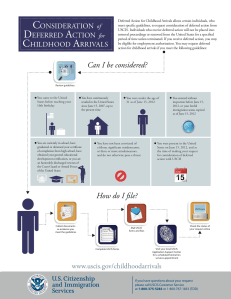 This new one-page flyer on the new Deferred Action for Childhood Arrivals (DACA) Immigration Policy, published by the US Citizenship and Immigration Services (USCIS), does a pretty good job explaining, in a visual way, how the new policy works, although it’s a little odd to me that they did not include the acronym for “general education development”—the GED—in this flyer, since it’s a much more well-known term.
Remember, as I noted yesterday, it appears that a person who is without a diploma or GED and not in school now—but who otherwise meets the eligibility requirements—may qualify by returning to school or by enrolling in a GED program before applying.
More information available at the USCIS site. (h/t Save Adult Ed!)
A Call to End the GED in New York
Thomas Hilliard, a Senior Fellow in Workforce Development Policy at the Center for an Urban Future, thinks the revamped GED, scheduled to launch in January, 2014, “could be a disaster for New York.” In a commentary published by the Times Union on July 17th, Hilliard notes that the state of New York as yet to come up with a plan to address the increased cost of the test or provide for an alternative:
The GED Testing Service, which has long administered the GED, announced plans to revamp the test to ensure that anyone who passed it would be ready for college-level coursework. This is understandable given the premium on college credentials in today’s economy. But as it set out to create a new test, the GED’s stewards decided to enter into a partnership with Pearson LLC, the world’s largest educational publisher. Pearson took over leadership of the GED Testing Service, and in May 2012 announced plans to raise the price of the GED to $120, effectively doubling its cost to New York state.
The increase is particularly troublesome because New York state bars the charging of a fee to take the GED and pays the full costs of testing out of the state budget—roughly $2.7 million last year. Unless the state doubles its expenditure—an unlikely prospect—the number of test slots for people to take the GED could fall by half, from 45,000 to 22,500.
As a result, New York could easily lose thousands of GED holders a year, a damaging blow to the state’s economic competitiveness and the job prospects of low-income youth and adults.
Hilliard concludes his piece by calling on New York State policymakers to drop the GED altogether: “It’s time for the state to end its partnership with the GED and give New Yorkers an alternative high school equivalency exam—preferably one that is less expensive but every bit as accepted by employers and colleges as the GED.” While acknowledging that the state has begun exploring alternative tests, he implores them to step up their efforts, noting that “time is running out” to establish an alternative by the end of 2013.
In related news, New York City’s unemployment rate climbed to 10 percent in June.
 Literacy & Policy