Fittingly, Nonprofit Free Speech Curtailed by Congress Before Anyone Had a Chance to Say Anything About It

A leftover nonprofit/1st amendment issue raised by the FY 2012 omnibus appropriations bill passed by Congress last December got some attention this week in the form of a strong opinion piece by Mark Rosenman, director of Caring to Change, and Gary D. Bass, executive director of the Bauman Foundation and affiliated professor at Georgetown University’s Public Policy Institute. Their article was published in both The Chronicle for Philanthropy and the Foundation Center’s “Philantopic” blog.

The issue concerns some language that was inserted into the bill that, in the author’s opinion, curtails the free-speech rights of certain non-profit organizations. Rosenman and Bass see this is part of a long history of efforts (primarily by right-wing political groups) to prevent nonprofits that receive federal dollars from informing policymakers and the public about issues they care about.

The authors do a nice job of describing the language that was inserted, (although you have to get almost halfway through the article to get to it), and I agree that nonprofit organizations should be concerned:

With the new law, groups that receive money under the appropriations measure cannot use federal grants for “any activity to advocate or promote” any “proposed, pending, or future” tax increase (at any level of government) or any “future requirement or restriction” on a “legal consumer product” (e.g., tobacco and alcohol products, junk foods and beverages, and guns).

None of those key terms is defined. Suppose a group received federal aid to fight cancer by decreasing tobacco use and wanted to educate the public about the health dangers of cigarette sales, especially to minors. Presumably, that wouldn’t be allowed under the law. Or say another nonprofit won a grant to curb obesity. It might want to suggest a surcharge on sodas and other sugary foods as a way to deter consumption, but it probably couldn’t promote that idea.

The new law also forbids nonprofits from using federal money to influence some regulatory and executive-branch actions. That means a charity that receives federal money to provide care and support to families with disabled children, for example, would no longer be allowed to use any of its government money to comment on proposed state regulations that govern residential treatment or in-home services.

The point I want to add to this is about the process. What a lot of people who don’t follow Congress very closely may not realize—and may be surprised by—is that policy language like this often finds its way into appropriations bills. Before I started paying attention to how the appropriations process worked, I just assumed that appropriations bills solely concerned… appropriations. That is, I thought they just described spending amounts, and didn’t include much else. But Congress often inserts policy language into these bills that can have far-reaching consequences.

Rosenman and Bass complain that “charity leaders didn’t find out about [the language] in time to take action to prevent their passage,” which is quite possible, because the omnibus bill was rushed into passage after Congress failed to get FY12 appropriations bills out under the normal process. This raises the question: is it a good idea for Congress to be able to insert legislative language like this into bills during an expedited process where there is little time for advocacy or debate? But overall the authors are more critical of the substance of the language that was inserted into the bill than by the process by which it got in there.

In any case, it’s a good lesson for advocates on the importance of paying attention to the appropriations process, and that it’s especially important to be alert when spending bills come together quickly, like this one did.
Half of the Students Seeking an Associates Degree Require “Remedial Training”

From an article in the National Journal published last Friday:

To achieve the high-tech manufacturing base that Obama envisions, it will be necessary to train hundreds of thousands of workers for skilled jobs that will require technical training and some college-level coursework. That’s a heavy lift in the current climate, in which about half of the students seeking an associates degree require remedial training that they should have gotten in high school, according to Complete College America. (my emphasis)

The article then goes on to argue that there is a lack of coordination between the White House and Congress on career and technical education legislation, citing the career and technical education “blueprint” released by the White House last week and the dueling Workforce Investment Act (WIA) bills in the House as examples. But the specific problem highlighted in the passage above is never mentioned again. According to the article, the WIA legislation would “rejigger job-training programs and help colleges tailor their curriculum to workforce needs,” but no mention is made of whether this or any of the other legislative proposals would address the problem that half the people who want to go to college can’t read or write or perform basic math well enough to be successful at the postsecondary level to begin with (which is what the somewhat cryptic phrase “requires remedial training” means). Nor does the author explore the degree to which those students’ basic skills fall short.

Which was not the point of the article, I realize. I just thought it was interesting that the author made this weirdly-phrased reference to the issue—and then dropped it.

White House Claims House Republican Budget Would Eliminate Training and Employment Services for 3,500 D.C. Residents Over the Next Two Years

The White House Office of Management and Budget has released a couple of charts showing what they believe to be the impact of House Budget Committee Chairman Paul Ryan’s budget plan, released last month.

Basically, they’ve taken the cuts and, using existing allocation formulas, spread them out proportionately across employment and training programs and, for education, across four major educational programs: Pell Grants, work study, special education, and Head Start. Unfortunately, the analysis of education program cuts does not include the District of Columbia, which is strange, since I can imagine more people in the District are impacted by the programs they highlighted than those living, in say, Wyoming.

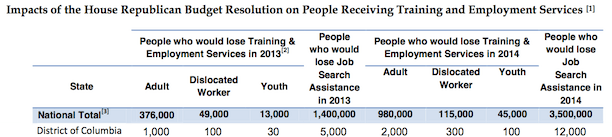
However, they do include D.C. in their analysis of employment and training programs. The projected decrease in participants in these programs was derived by applying the percentage reduction in funding for each state to the national projected reduction in the number of participants served. Here is the breakout nationally, and for the District:

D.C. Chart: Ryan Budget Impact on Job Training

Source: White House

As you can see, they estimate about 1,130 District residents across three categories (adults, dislocated workers, and youth) will lose employment and training services in 2013, and about 2,400 in 2014, for a total of 3,530 over two years. In addition, they estimate 17,000 people will lose access to job search assistance.

Here are links to both charts, which are a bit hard to find on the White House site:

AFL-CIO, NEA, and Other Organizations Oppose H.R. 4297

I don’t think this will come as a big shock to anyone who follows this issue: labor unions don’t particularly care for H.R. 4297, the House Republican’s proposal to update/revise the Workforce Investment Act (WIA).

In a blog post last week, just before a House Committee on Education and the Workforce hearing on the bill, the AFL-CIO characterized it as an attempt to “hand over the nation’s publicly-administered job training and workforce development system to the corporate sector.”

In addition, in a letter sent to members of the Committee last week, labor organizations echoed the concerns about program consolidation raised by workforce development advocates like the National Skills Coalition (see NSC’s Executive Director’s testimony from the hearing last week) and from the National Coalition for Literacy.* The letter, signed by 11 union organizations, including the AFL-CIO, the National Education Association, and SEIU, argues that consolidation would “eliminate the targeting of resources to workers and communities where the needs are greatest” and “make programs more vulnerable to funding cuts and pit one group of workers against another in competition for limited resources.” They go on to argue that “[s]uch consolidation of funding streams will undermine the accountability of the entire WIA system, enabling states to manipulate their resources in a manner that will result in the neglect of populations with the greatest needs.”

The bulk of the letter, however, is focused on the changes the bill would make to the composition of state and local workforce investment boards. According to their letter, H.R. 4297 would impose a new requirement that two-thirds of those board members be selected from the business sector, and it eliminates the mandate that the boards include at least two worker representatives nominated by unions and labor federations. The bill also eliminates the requirement that labor organizations have an opportunity to comment on state and local plans. The letter calls for unions to “be fully represented on WIA boards so that the workers are heard in the decisions that profoundly affect their careers.”

The board composition issue is interesting from an adult literacy perspective. As many of you reading this likely already know, WIA is made up of several different titles. Title I is concerned with the federal job training system (and hence the place where the language around workforce investment board composition is found), and Title I issues tend to dominate discussions about reauthorization. Title II, meanwhile, also known as “Adult Education and Family Literacy Act,” is focused entirely on adult and family literacy, and is typically less controversial (or even discussed). Back in 1998, when WIA was originally authorized, the goal of the law was to create an integrated employment, adult education, and vocational rehabilitation system. Those who advocated for the inclusion of the Adult Education and Family Literacy Act in WIA argued  that this would encourage more coordination between job training programs and adult education programs. I’ll leave it to others to discuss the degree to which the law has been successful in that regard.

But getting back to the board composition issue: I think it’s safe to say that even if all of the “unified plan” program consolidation language (see my earlier post about this) was taken out of the bill—which would make adult education advocates much happier with it—labor groups would still be strongly opposed to it over the board composition issue, and that makes the prospects for a bipartisan bill much less likely.

In addition—and here is my point, finally—whatever your position is on the composition of workforce investment boards, the wrangling over labor union participation is largely irrelevant to the adult and family literacy programs covered under Title II.

I understand—from both a strategic point of view and as a matter of policy—why the inclusion of adult and family literacy in WIA made sense back in 1998. My point is simply to note that every WIA reauthorization proposal seems to spark big, fundamental disagreements over issues in Title I, and even when our field is handed a bill we can support, we can still be held hostage, legislatively, to those Title I disagreements. Sometimes it feels like being trapped in the back seat of a car while the folks in the front seat argue about how to get it started again.

*The usual disclaimer here: I am a member of NCL’s board of Directors and participate in the development of NCL’s policy positions—but the opinions in this blog are my own.