Republican Platform Essentially Endorses House Republicans’ WIA Reform Plan

(Updated Below)

The 2012 Republican platform was released today. For what it’s worth, it implicitly endorses the approach that Republicans in the House took with their Workforce Investment Act (WIA) reauthorization bill, H.R. 4297. This bill, which was passed by the House Education and the Workforce Committee in June, would consolidate all of the different WIA funding streams and convert them into a block grant program for states. H.R. 4297 isn’t mentioned specifically in the Republican platform, but consolidation of federal workforce programs is explicitly endorsed (see page page 7):

It is critical that the United States has a highly trained and skilled workforce. Nine federal agencies currently run 47 retraining programs at a total cost of $18 billion annually with dismal results. Both the trainees in those programs and the taxpayers who fund them deserve better. We propose consolidation of those programs into State block grants so that training can be coordinated with local schools and employers.

UPDATE 8/29/12: It’s also worth pointing out that, unsurprisingly, the GOP platform says nothing about adult education or adult literacy—with one exception: it offers explicit support for family literacy programs (See page 36):

Because parents are a child’s first teachers, we support family literacy programs, which improve the reading, language, and life skills of both parents and children from low-income families.
Poll: 60% of Americans Say Balancing Federal Budget More Important Than Improving Quality of Education

In a recent Phi Delta Kappan/Gallup Poll, (as reported in Education Week) a majority of respondents (60%) said that balancing the federal budget was more important than improving the quality of education, “even though they said funding [was] the biggest problem facing public schools.”

The deficit issue gets a lot of attention in the media, so it would not surprise me if it’s true that many people fear the budget deficit to the point where they are willing to sacrifice federal investments in public education to reduce it. While it’s not actually necessary to sacrifice those investments any further in order to do so, it would also not surprise me to learn that it is a widely shared belief that deficit reduction must involve sacrifices  in every area of federal spending—even among people who are not, in general, hostile to a federal role in education, or to education spending in general.

These are a big hurdles for education advocates to overcome.

More on the poll in Education WeekPDK/Gallup Poll Offers Glimpse into Americans Views of Public Education – K-12 Talent Manager – Education Week.

h/t Committee for Education Funding for the pointer to the article

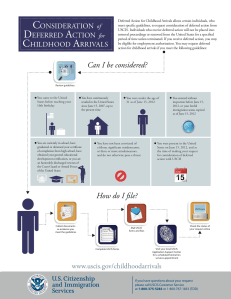
Handy Flyer from USCIS on New Deferred Action for Childhood Arrivals (DACA) Immigration Policy

This new one-page flyer on the new Deferred Action for Childhood Arrivals (DACA) Immigration Policy, published by the US Citizenship and Immigration Services (USCIS), does a pretty good job explaining, in a visual way, how the new policy works, although it’s a little odd to me that they did not include the acronym for “general education development”—the GED—in this flyer, since it’s a much more well-known term.

Remember, as I noted yesterday, it appears that a person who is without a diploma or GED and not in school now—but who otherwise meets the eligibility requirements—may qualify by returning to school or by enrolling in a GED program before applying.

More information available at the USCIS site. (h/t Save Adult Ed!)

Will New Administration Immigration Policy Increase Demand for GED Classes?

(Updated Below)

The Migration Policy Institute has increased their estimate of the number of unauthorized immigrants who may be eligible for temporary relief from the threat of deportation under the new Deferred Action for Childhood Arrivals (DACA) initiative. After taking a look at the more detailed eligibility guidelines released by the Department of Homeland Security on August 3rd, they now think that as many as 1.76 million unauthorized immigrants may be eligible (up from 1.39 million).

The DACA initiative will offer, on a case-by-case basis, a two-year grant of reprieve from deportation as well as work authorization for unauthorized immigrants who were under the age of 31 as of June 15, 2012, who entered the U.S. as children, and who can demonstrate that they meet certain other criteria, which you can read about here.

What changed? Among the list of eligibility requirements first released in June, when the policy was announced, was the requirement that applicants had to have a high school degree or have earned a GED—or be enrolled in school now. Last week, DHS clarified that those under 31 years of age lacking a high school diploma or a GED not currently enrolled in school will also be eligible, as long as they have re-enrolled by the date of their application. MPI estimates that this adds as many as 350,000 unauthorized young adult immigrants (ages 16 and older) without a high school degree or GED to the list of potential beneficiaries of this program, provided they meet the rest of the eligibility requirements.

It will be interesting to see if this results in an uptick in demand for GED and adult ESL services in the coming months.

UPDATE 8/28/12: While researching a post for D.C. LEARNs today, I read through the DACA guidelines a little more carefully. As noted above, to meet the DACA education requirements, an applicant must have graduated from high school or obtained a GED certificate, or must be “currently in school” on the date of application. The USCIS guidelines published here make it clear that their definition of “school” is fairly broad and includes most kinds of adult education programs. I’m planning to write a separate post about this in the near future.

UPDATE 8/29/12: This article from New America Media (NAM) notes that in Arizona, Proposition 300 bars state-funded schools from offering free GED classes to undocumented immigrants, so meeting the educational requirements of DACA by enrolling in a free GED program will not be an option for those living in that state.