OMB Sequester Transparency Act Report Is Released

OMB has just released its report on sequestration, which they were required to do by the Sequestration Transparency Act passed by Congress earlier this summer. (The report is actually about a week late.)

To me, it’s mainly of interest because it provides us with OMB’s best estimate, at this time, as to what the percentage cut will be: 8.2% for nondefense discretionary spending, and 7.6% for nondefense mandatory programs. (Adult education falls under the category of nondefense discretionary spending.) This is based on an assumption that FY 2013 discretionary spending will be at FY 2012 levels (the Act mandated that they do this). For fairly tedious reasons I won’t go into here, that’s not what’s actually going to happen, and so the final percentage cut will actually be a bit different. But we are moving closer towards understanding precisely what the numbers will be.

Sequester Transparency Report Excerpt

The report does not break out Adult Education separately. I’m too tired to calculate precise numbers for adult education alone, but without looking anything up, I believe an 8.2% reduction from FY 2012 levels is going to be just shy of $50 million.

Again, bear in mind that there are several other federal programs other than Title II of WIA that fund adult education in the U.S., and all of the estimates I’ve seen only look at WIA Title II. It would be very difficult to figure out with much precision what the combined impact of the cuts to the other programs that fund adult education would be, since these programs do not exclusively fund adult education—and the extent to which they support adult education services may vary from year to year. The point is, any analysis of the impact of sequestration that looks only at WIA Title II is surely underestimating the actual impact that sequestration will have on this field.

I also think that the even bigger danger for adult education funding may lie in possible replacements for sequestration being bandied about, which could conceivably cut even more from nondefense discretionary programs in over to prevent cuts on the the defense side.

By the way, there are pages and pages in this report identifying certain categories of spending as “sequesterable” or not. As a fun weekend sequester-themed activity—and one that might also help get more people talking about the issue—try using the word “sequesterable” in conversation at some point. Here is an example to get you started: “Boy, I am really in a sequesterable mood at the moment—I think I will go and sit in the closet.”
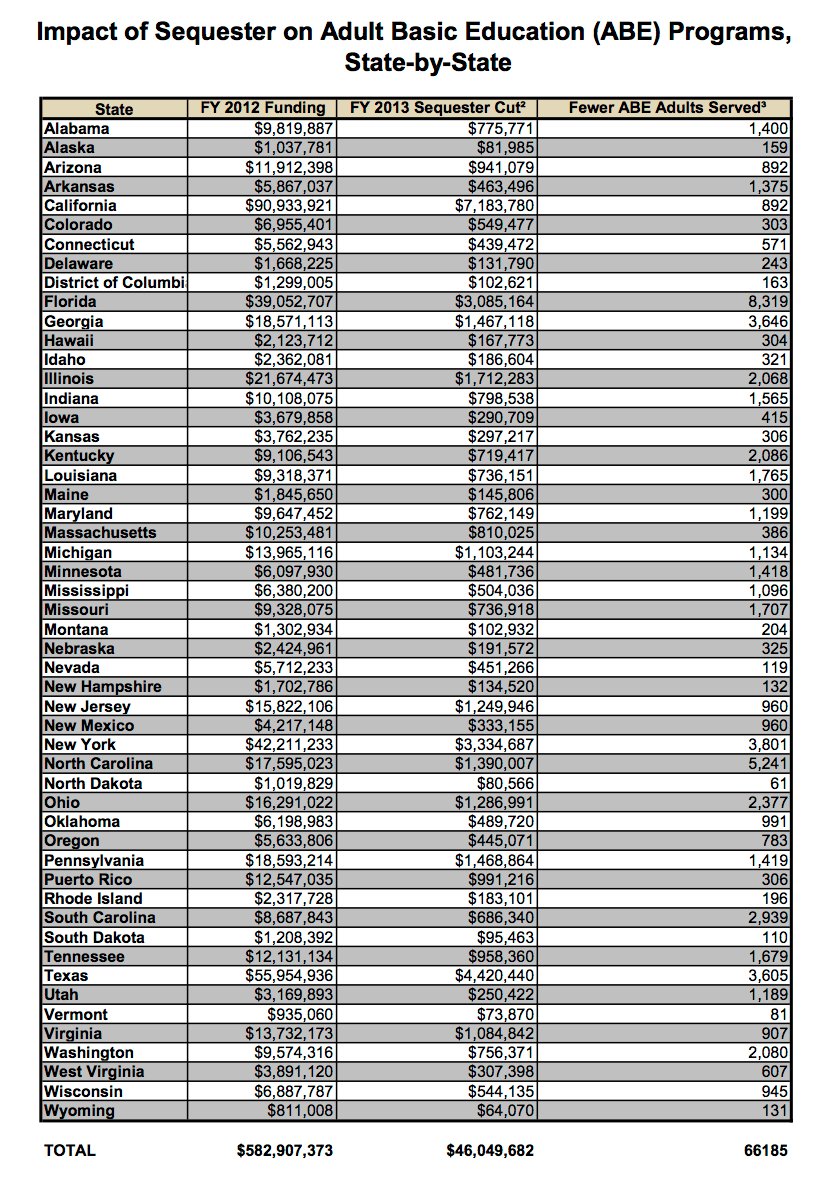
NSC Estimates that 66,000 Fewer Adult Learners Would Be Served Under Sequestration

A couple of weeks ago the National Skills Coalition released a report, “Disinvesting in the Skills of America’s Workforce,” which examined the potential impact of sequestration on key federal employment and training programs. The report estimates that Adult Basic Education (ABE) programs would serve 66,000 fewer learners if sequestration cuts go forward, as now required by law. Unlike the NEA numbers published earlier this year, NSC included not just the loss of federal dollars but also a proportional cut from required state matching funds. It includes a table that shows the impact on a state-by-state basis (click on the table to read the entire report):

NSC Sequester Analysis - Adult Education

NSC used a different methodology to calculate their estimates than the one used by the NEA for the tables they published a few months ago. The NSC’s estimate of 66,185 adult learners losing services is considerably lower than the NEA’s worst-case estimate, which was north of 200,000.

Either estimate likely understates the actual impact of sequestration on adult education because they do not include the impact of cuts to other non-defense discretionary programs that support adult education other than WIA Title II, such as Community Development Block Grants, community service programs, USCIS, and other programs. (Understandably—it would be challenging to come up with impact estimates across all of those other programs since they do not exclusively fund adult education programs.)

Interesting Look at How Federal Investments Drove Job Growth in Charlotte

(Updated Below)

For anyone interested in job creation and job training—and the debate over the federal role in both—this story on a new Siemens turbine plant in Charlotte in yesterday’s Washington Post is probably going to be more interesting than anything you’ll read coming out of either of the political conventions:

Ask Siemens executives why they placed their bet on Charlotte and they talk about public investments such as the state-funded rail spur that runs through their facility and the city’s international airport, which recently added a fourth runway using $132 million in federal funds.

They talk about the Export-Import Bank, an independent federal agency that in January approved a $638 million loan to finance the sale of turbines to Saudi Arabia, helping Siemens beat bids from companies in Germany, South Korea and Japan.And they talk about the quality of the workforce in Charlotte, where local leaders are retooling the public education system to churn out the engineers and skilled technicians needed to operate one of the most efficient gas-turbine plants in the world.

My only quibble with this piece: I don’t understand why the austerity budgets “favored by the GOP” are set aside as if they are somehow separate from Romney’s position.

Romney’s plan for growth centers on slashing government spending while cutting tax rates sharply for everyone. Romney claims his approach would create 12 million jobs over the next four years, a conclusion that relies heavily on research by Alan Auerbach, an economist at the University of California at Berkeley.

Auerbach, who has studied the economic effects of tax cuts, said lower taxes on savings and investment do cause people to plow more money into new investments, which “should lead to faster economic growth.” But “how much, how fast” is harder to say, Auerbach said. And that approach is, in any case, less likely to be effective in a sluggish economy, he said, when businesses are holding back on new investments not because they do not have the cash but because they are “looking first at whether they can sell stuff.”

“If the question is what would [Obama and Romney] do right now to spur economic activity,” Auerbach said, “I’m not sure either platform is particularly well designed for that.”

Meanwhile, the austerity budgets favored by the GOP would cut government spending in the very areas that do seem to matter. (my emphasis) In his most recent budget, Romney’s vice-presidential running mate, House Budget Committee Chairman Paul Ryan (R-Wis.), proposed spending 25 percent less on transportation over the next decade than Obama and 31 percent less on education and training.

As part of their campaign to shrink the size of government, House Republicans also tried to kill the Export-Import Bank, which encourages exports by financing the foreign purchase of U.S. goods and services, turning a profit for taxpayers. Spiegel said the bank was a critical factor in Siemens’s decision to build turbines for export in the United States. 

Romney has endorsed the Ryan budget cited here. It’s not as if Romney has one approach and House Republicans have another one that is on some kind of separate track (“meanwhile”). Whatever the merits are of Romney’s proposal to cut tax rates in order to spur growth, by endorsing that budget, he has completely embraced the federal infrastructure and education spending cuts proposed by Ryan and his party. Those spending cuts are just as much a part of his approach as his tax rate cut proposal. And if those cuts “do seem to matter,” then the differences between the two candidate’s approaches are perhaps more significant than this article suggests.

UPDATE 9/5/12 7:22pm: Added the last sentence and edited the whole piece slightly for clarity and emphasis.

What Would Sequestration Mean for the District of Columbia’s Most Vulnerable Residents?

Yesterday one of our local public radio stations here in the District (WAMU) broadcast a story on the potential local impact of sequestration, the across-the-board federal spending cuts that are set to go into effect in January—unless Congress passes some kind of legislation to avoid it. Right now these cuts are required by a law that this same Congress passed last summer, the Budget Control Act (BCA).

Stephen Fuller, director of George Mason University’s Center for Regional Analysis, told WAMU that federal spending accounts for roughly 40% of the D.C. metro area’s economy. Federal employees and contractors spend their paychecks here, and so businesses that rely on those dollars (and the housing market) are likely to suffer if that spending is cut back significantly:

“Federal payroll supports a lot of jobs at Giant and Safeway and CVS and other retail establishments,” he says, citing some examples. “There will be fewer high-income households that can afford big houses.  So we could see a rollback on housing values.”

In D.C. itself, the District’s chief financial officer, Natwar Gandhi, told WAMU that federal spending accounts for 60% (!) of the city’s annual economic output. He said that cuts to federal spending would likely result in reduced local tax revenue, which could lead to reductions in services for the city’s most vulnerable residents.

(Fun fact: the legislation that created sequestration was enacted by a Congress in which we do not have a vote, yet it sound like the pain associated with these cuts will likely be more painful here in this city than it will be in other parts of the country.)

Alternatives to sequestration may still include federal workforce reductions and pay freezes, so even if sequestration is scrapped, it’s replacement might not be so great for the local economy either. I recently attended a meeting with some Republican staffers who were still enthusiastically pitching S. 2065, a Senate bill that was introduced in February that would delay the first installment of the sequestration cuts by extending the current federal employee pay freeze though June 2014, and restricting federal hiring to only two employees for every three who leave. While I don’t think this specific bill is going anywhere at the moment, elements of this proposal could make their way into a sequestration-scrapping plan somewhere down the road.

Fuller told WAMU that federal contracting “has been a welfare program for the Washington metropolitan area. Taxpayers around the country send us their money, and we’ve been living well off of this, and now we have to face the music.” Sequestration alternatives that protect this long-standing corporate welfare program via reductions in federal hiring and pay freezes will likely have the same kind of depressive effects on the local economy as the across-the-board cuts required by sequestration.