Responding to Budget Cuts in Adult Education

Last week, the Council for the Advancement of Adult Literacy (CAAL) released In A Time of Scarce Resources: Near Term Priorities in Adult Education, a 34-page summary and analysis of responses submitted by more than two dozen “adult education leaders” about “priority areas in adult education at a time when resources are scarce.” (Not that they are plentiful most of time.) According to CAAL, “the main purpose of the paper is to motivate adult education planners, service providers, and policymakers to recognize the need to focus on highest priority next steps to take in this period of extreme funding constraints.”

Those surveyed, according to CAAL “stress[ed] that we can achieve a great deal, despite stagnant funding, if we set priorities and are all traveling in the same direction toward a comprehensive shared vision for the future.”

But is this true? You can obviously prioritize and work more efficiently to make do with what you have in almost any circumstance, (which is where a report like this one is useful), but I think we let policymakers off the hook when we say that “we can achieve a great deal” when budgets are drastically reduced, as they have been in many states in recent years. People in this field work so hard to figure out how to move forward with scarce resources—in doing so, my fear is that scarce resources are all we are ever going to get.

What Would Sequestration Mean for Adult Education?

(Updated Below)

In less than six months, more than 200,000 adults across the country may be facing the possibility of losing adult education services sometime in 2013, and as many as 730 adult education jobs in community colleges, community-based organizations, and public schools could be eliminated. (But see update below.)

These numbers come from an analysis just released by the National Education Association (NEA) on the potential consequences of sequestration on public education. Sequestration is the term used to describe the automatic federal budget cuts that are scheduled to kick in on January 1st, 2013, unless Congress passes some kind of legislation to defer, alter or avert it. Right now these cuts are required by a law that this same Congress passed just last summer—the Budget Control Act (BCA)—which raised the federal debt ceiling in return for an immediate federal budget cut of $900 billion and a commitment to come up with a plan (which could include spending cuts and/or tax increases) to reduce the federal budget deficit by another $1.2 trillion by 2021. The plan was supposed to come from a so-called  Congressional “super committee”—if they failed (and they did), automatic budget cuts were required in both defense and non-defense discretionary spending, beginning on January 1st of 2013, with across-the-board cuts to virtually every federal discretionary program (a few are exempted).

The NEA’s analysis of the impact this would have on adult education includes not only a national estimate, but state-by-state estimates as well. (NEA actually provides two estimates for the country and for each state. The Congressional Budget Office has estimated that nonexempt programs would be reduced by 7.8 pecent in 2013; an analysis conducted by the Center on Budget and Policy Priorities indicates that nonexempt, nondefense discretionary programs and nonexempt mandatory programs would be reduced by 8.4 percent and 8 percent, respectively.)

I asked the author of this analysis, Tom Zembar, about his methodology and he did point out that it’s impossible to know exactly how states and providers would actually react and readjust services once the cuts go into effect, but the point of the analysis was to help people understand the potential consequences of the cut in each state. I’ve included a reproduction of the first page of the adult education analysis below; click on the link to go to the full report. This page, and the state-by-state table that follows, are towards the end.NEA: Impact of Sequestration on Adult Education

UPDATE 8/1/12: A couple of clarifying points:

(1) First, in my lead, for the sake of being dramatic, I strongly created the impression that FY2013 funds will be cut instantaneously on January 1st. I should have pointed out that Adult Education under WIA Title II is a forward-funded program, meaning that funds don’t become available for obligation until July 1st of the fiscal year in which they are appropriated. On the other hand, since states start their budget process over the winter based on the amounts they expect to receive from federal programs later in July, I believe the impact of sequestration would start to work its way into proposed state budgets for adult education pretty quickly,  even if the actual federal reductions might not be felt until later in the year.

(2) Which brings me to my second clarifying point: no one can know with certainty what states are actually going to do once they get their sequestered numbers. I assume that any reduction in the Title II state grants resulting from sequestration would trigger an equivalent reduction in the state’s match and maintenance of effort obligations—but I don’t know exactly how that will work. In any case, a state could, conceivably, respond to the reduction in the federal grant by raising their state’s investment in adult education to offset the cut. I think that’s doubtful, at least on a widespread basis. It seem more likely to me that the NEA estimates above—which, for simplicity’s sake, don’t factor in potential state reductions, but just focus on the student service cuts and job losses resulting from the federal cutprobably underestimate the actual reduction in both services and jobs in most states if sequestration moves forward.

UPDATE 11/15/12: I’ve re-worded the opening paragraph for the reasons noted in the update above.
Senate FY13 Labor HHS Bill Would Partially Restore Pell Grant Eligibility for “Ability to Benefit” Students

The Senate Labor, Health and Human Services, and Education (Labor-HHS-ED) Fiscal Year 2013 appropriations bill, (S. 3295), which was approved Thursday, contained a little piece of good news for adult education in the form of an amendment included in the bill by Senator Murray (D-Wash) that would restore Title IV federal student aid eligibility (most importantly, Pell grant eligibility) for “ability-to-benefit” (ATB) students. The Consolidated Appropriations Act of Fiscal Year 2012, (that is, the FY 2012 Federal budget bill), passed back in December 2011, barred individuals without a high school diploma or equivalent from qualifying for this financial aid. In the past, these students could qualify by completing an “ability to benefit” test or by successfully completing six credits towards a certificate or degree.

This eligibility is scheduled to end for all students enrolling in college after July 1st.

Senator Murray’s amendment would not restore Title IV financial aid eligibility for all students, only those enrolled in very rigidly defined career pathways programs. The language in the bill basically mirror previous ATB eligibility requirements but then applies it only to those students enrolled in an “eligible career pathway program.” (See page 133 of the bill.)

In essence, Murray’s amendment protects financial aid eligibility for students enrolled in established programs such as Minnesota’s FastTRAC, Wisconsin’s RISE parternship, and Washington State’s I-BEST program. These programs—especially I-BEST—are the most oft-cited adult education models on Capital Hill. (If there is one thing that Congressional staffers and others policymakers with little knowledge of adult education may have heard of, it would likely be I-BEST.) In addition to the states where these programs are established, groups such as CLASP and Jobs for the Future are highly invested in these models, and those organizations are among the most visible adult education advocates on the Hill. When Congress ended financial aid for ATB students in December, they zeroed in on these models as the basis of their argument to restore financial aid eligibility for ATB students. Politically, it was also in all probability the only realistic strategy of getting any of that eligibility back, since the cost of restoring ATB financial aid eligibility for just those students enrolled in these established programs is probably going to be less than a tenth of the cost of providing full financial aid for ATB students under the old definition. In an excellent fact sheet prepared by CLASP on the subject, they estimated that about 90,000 college students qualified for Pell Grants under the old ATB provision; the number of students who would regain eligibility under Murray’s amendment would be a fraction of that number.

Here is the language in the bill that defines eligible career pathway programs (I’ve bolded what I think are the highlights):

(2) ELIGIBLE CAREER PATHWAY PROGRAM.—In this subsection, the term ‘‘eligible career pathway program’’ means a program that—

(A) concurrently enrolls participants in connected adult education and eligible postsecondary programs;

(B) provides counseling and supportive services to identify and attain academic and career goals;

(C) provides structured course sequences that—
(i) are articulated and contextualized; and
(ii) allow students to advance to higher levels of education and employment;

(D) provides opportunities for acceleration to attain recognized postsecondary credentials, including degrees, industry relevant certifications, and certificates of completion of apprenticeship programs;

(E) is organized to meet the needs of adults;

(F) is aligned with the education and skill needs of the regional economy; and

(G) has been developed and implemented in collaboration with partners in business, workforce development, and economic development.

If passed into law, even this partial restoration seems to me to be a significant win for the adult education community in that it preserves financial aid eligibility for students enrolled in models that have taken the adult education field forward in a promising direction. But it would also narrowly define the “benefit” that a student without a high-school diploma or the equivalent is deemed to be able to gain from a college education, at least for financial aid purposes. Such students would now be deemed to benefit from the education they are receiving only if they are enrolled in a very narrowly defined career pathways program—one that is tied to the skill needs of local employers (see paragraphs F and G, above), not necessarily the needs or interests of the student.

White House Claims House Republican Budget Would Eliminate Training and Employment Services for 3,500 D.C. Residents Over the Next Two Years

The White House Office of Management and Budget has released a couple of charts showing what they believe to be the impact of House Budget Committee Chairman Paul Ryan’s budget plan, released last month.

Basically, they’ve taken the cuts and, using existing allocation formulas, spread them out proportionately across employment and training programs and, for education, across four major educational programs: Pell Grants, work study, special education, and Head Start. Unfortunately, the analysis of education program cuts does not include the District of Columbia, which is strange, since I can imagine more people in the District are impacted by the programs they highlighted than those living, in say, Wyoming.

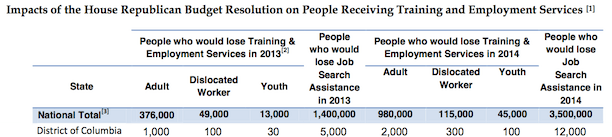
However, they do include D.C. in their analysis of employment and training programs. The projected decrease in participants in these programs was derived by applying the percentage reduction in funding for each state to the national projected reduction in the number of participants served. Here is the breakout nationally, and for the District:

D.C. Chart: Ryan Budget Impact on Job Training

Source: White House

As you can see, they estimate about 1,130 District residents across three categories (adults, dislocated workers, and youth) will lose employment and training services in 2013, and about 2,400 in 2014, for a total of 3,530 over two years. In addition, they estimate 17,000 people will lose access to job search assistance.

Here are links to both charts, which are a bit hard to find on the White House site: