U.S. Chamber of Commerce Claims There Is a “Surplus” of Skilled Workers in U.S.

From an April 2nd NEWS.com.au story on the Australian government’s plan to fill Australian jobs with U.S. workers (which, according to the story, is supported by Australian and U.S. business groups):

“In contrast to the surplus of skilled workers in the US, Australia has intensifying skill shortages and comparatively low unemployment,” said a joint statement from the Australian Industry Group, the Business Council of Australia, the American Chamber of Commerce in Australia (Amcham), and the US Chamber of Commerce. (my emphasis)

Economic Growth as Spectator Sport

Secretary of Education Arne Duncan appeared at a forum on education at American University here in Washington last Friday, and, according to news reports, told the audience that, “[a]s a country we’re going to educate our way to a better economy or we’re going to struggle.” Sec. Duncan uses this line—or variation of it—a lot. (He used it during his appearance on The Daily Show a couple of weeks ago, for example.)

But if a “better” economy is one in which lower and middle class incomes are rising, then we may have additional work to do. From a post by Jared Bernstein on his blog today:

All of the factors driving up inequality remain in place, most notably, high unemployment, and we know from profits data (way up), corporate balance sheets (way flush), and real paychecks of middle-class workers (way flat), that what growth has occurred hasn’t reached much below the top end.

If this expansion is to be one where growth is more than a spectator sport for average folks, we’ve got some serious policy work to do.

In other words, if this is how our economic recovery is playing out, will improving education and increasing the skills of our workforce—while undeniably good policy goals—be enough to move low and middle class wages in the right direction?

Dean Baker Thinks Unfilled Jobs More Due to “Incompetent Managers” Than Skills Gap

Today I noticed that Dean Baker of the Center for Economic and Policy Research, who knows a lot more about this stuff than I do, shared my skepticism about this Washington Post article on the alleged skills gap in the manufacturing sector. Actually his response was a lot stronger than mine:

The Washington Post told readers that the manufacturing industry is suffering from incompetent managers and therefore is not hiring as many workers as it should. According to the Post, managers don’t realize that it is necessary to raise wages to attract more workers and instead are whining that they can’t get the workers they need to fill vacancies.

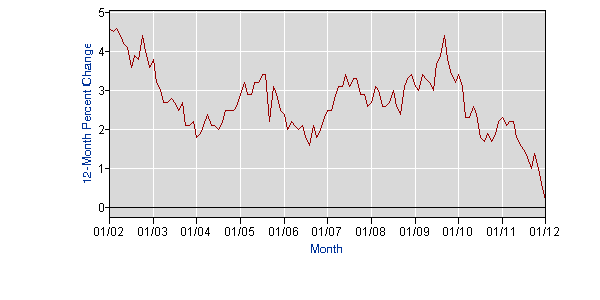
Baker produced a chart showing how far hourly wages for non-supervisory workers in the manufacturing sector has fallen in recent years, and it’s kind of astounding:

Chart showing decline in manufacturing wages

Source: Dean Baker, CEPR, using Bureau of Labor Statistics data.

Disinvesting in Libraries: Anti-Stimulus

Yesterday, the Lompoc Record (Lompoc, Calif.) published a story about a new round of budget cuts facing the Lompoc Public Library system. (Similar cuts taking place all over California, and in other states.)

Budget cuts have already left a “shovel ready” children’s library expansion project in limbo as the Lompoc library recently lost $1.05 million in construction funding. They now need $2.04 million to get the project underway, and “there’s no timeline for construction.”

Meanwhile, Lompoc Public Library board member Maria Aguiniga notes that the cuts to library services “are affecting some of the most vulnerable in the community.”

“I think that some of us are fortunate to have computer and Internet in our household,” Aguiniga said. “We think everyone has the same access and that is not the case. People go into the library to seek employment, to type up resumes and to do research.”

In other words, the Lompoc Public Library has been forced to (1) indefinitely delay an initiative that is immediately stimulative to the economy (construction of a new children’s library), and (2) reduce services that provide a long-term benefit to the economy by providing resources for people to improve their skills and look for work.

Multiply this by a few thousand communities where similar cuts and funding gaps exist, and it’s not hard to imagine how library cutbacks can act as a drag on overall economic growth, especially in states where cuts have been the most severe.

In the District of Columbia, where I live, public library budget cuts haven’t been quite as bad as they have been in states like California, particularly in terms of new construction: several beautiful brand new or revamped branch libraries have opened in D.C. neighborhoods over the last few years. But many of those branches have been forced to reduce their hours, and funds for new materials has been dramatically reduced because of overall budget cuts to the system.