Interactive Chart Shows Decline in Good Jobs Despite Growth in Educational Attainment

Earlier this week, Colin Gordon of the Center for Economic and Policy Research (CEPR) published an interactive chart on CEPR’s blog based on “In Where Have All the Good Jobs Gone?” a report published by CEPR in July. That report used CPS data to show that the share of good jobs (which they define as those with an earnings threshold of $18.50/hr plus health coverage and a retirement plan) has fallen—even as the age and educational attainment of the workforce has gone up.

Using this chart, you can select different combinations of demographics and “good job” elements (earnings, health coverage, retirement plan) to compare and contrast. If you enjoy pointing and clicking at charts and getting depressed about the economy, this is definitely worth checking out. I especially recommend it to recent college grads…
A Call to End the GED in New York

Thomas Hilliard, a Senior Fellow in Workforce Development Policy at the Center for an Urban Future, thinks the revamped GED, scheduled to launch in January, 2014, “could be a disaster for New York.” In a commentary published by the Times Union on July 17th, Hilliard notes that the state of New York as yet to come up with a plan to address the increased cost of the test or provide for an alternative:

The GED Testing Service, which has long administered the GED, announced plans to revamp the test to ensure that anyone who passed it would be ready for college-level coursework. This is understandable given the premium on college credentials in today’s economy. But as it set out to create a new test, the GED’s stewards decided to enter into a partnership with Pearson LLC, the world’s largest educational publisher. Pearson took over leadership of the GED Testing Service, and in May 2012 announced plans to raise the price of the GED to $120, effectively doubling its cost to New York state.

The increase is particularly troublesome because New York state bars the charging of a fee to take the GED and pays the full costs of testing out of the state budget—roughly $2.7 million last year. Unless the state doubles its expenditure—an unlikely prospect—the number of test slots for people to take the GED could fall by half, from 45,000 to 22,500.

As a result, New York could easily lose thousands of GED holders a year, a damaging blow to the state’s economic competitiveness and the job prospects of low-income youth and adults.

Hilliard concludes his piece by calling on New York State policymakers to drop the GED altogether: “It’s time for the state to end its partnership with the GED and give New Yorkers an alternative high school equivalency exam—preferably one that is less expensive but every bit as accepted by employers and colleges as the GED.” While acknowledging that the state has begun exploring alternative tests, he implores them to step up their efforts, noting that “time is running out” to establish an alternative by the end of 2013.

In related news, New York City’s unemployment rate climbed to 10 percent in June.

CEPR: People Living Below the Income Poverty Line Today are Better Educated than Ever

Last April,  the Center for Economic and Policy Research (CEPR) published Low Wage Workers Are Older and Better Educated than Ever, an issue brief showing that the average low-wage worker today is both older and much better educated than the average low-wage worker was in the past.

Yesterday, Shawn Fremstad noted on CEPR’s blog that, in addition, the number of middle-aged workers living below the poverty line with at least some college or a Bachelor’s Degree has nearly doubled between 1979 and 2010. In addition, the number of middle-aged workers living below the poverty line without a high school diploma has dropped by nearly 50% during that same period. Fremstad looks at this data nd concludes:

Increasing educational attainment by itself is not at all sufficient to reduce inequality and income poverty — we need stronger labor market institutions, particularly ones that increase workers bargaining power to address these issues.

White House Claims House Republican Budget Would Eliminate Training and Employment Services for 3,500 D.C. Residents Over the Next Two Years

The White House Office of Management and Budget has released a couple of charts showing what they believe to be the impact of House Budget Committee Chairman Paul Ryan’s budget plan, released last month.

Basically, they’ve taken the cuts and, using existing allocation formulas, spread them out proportionately across employment and training programs and, for education, across four major educational programs: Pell Grants, work study, special education, and Head Start. Unfortunately, the analysis of education program cuts does not include the District of Columbia, which is strange, since I can imagine more people in the District are impacted by the programs they highlighted than those living, in say, Wyoming.

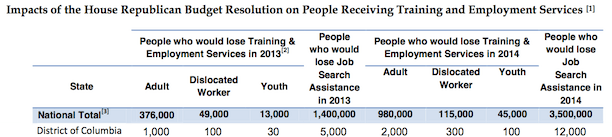
However, they do include D.C. in their analysis of employment and training programs. The projected decrease in participants in these programs was derived by applying the percentage reduction in funding for each state to the national projected reduction in the number of participants served. Here is the breakout nationally, and for the District:

D.C. Chart: Ryan Budget Impact on Job Training

Source: White House

As you can see, they estimate about 1,130 District residents across three categories (adults, dislocated workers, and youth) will lose employment and training services in 2013, and about 2,400 in 2014, for a total of 3,530 over two years. In addition, they estimate 17,000 people will lose access to job search assistance.

Here are links to both charts, which are a bit hard to find on the White House site: