Report: Immigration Reform Push To Begin This Month

An Obama administration official has told the Huffington Post that despite the likelihood of another time-consuming fiscal confrontation with Republicans later this winter, President Obama still plans to push for immigration reform in January:

An Obama administration official said the president plans to push for immigration reform this January. The official, who spoke about legislative plans only on condition of anonymity, said that coming standoffs over deficit reduction are unlikely to drain momentum from other priorities. The White House plans to push forward quickly, not just on immigration reform but gun control laws as well.

Bu the story goes on to say that the path to an approved bill could be a long one:

Aides expect it will take about two months to write a bipartisan bill, then another few months before it goes up for a vote, possibly in June. A bipartisan group of senators are already working on a deal, although they are still in the early stages. Rep. Zoe Lofgren D-Calif. will likely lead on the Democratic side in the House. While many Republicans have expressed interest in piecemeal reform, its still unclear which of them plan to join the push.

Politics of the Charitable Deduction, Part II

(Updated below)

Earlier today the White House released a new report from the National Economic Council) that argues forcefully against the idea of a fixed-dollar-amount cap on tax deductions for taxpayers at all levels of income as a viable deficit-reduction strategy. This follows a White House blog post from last Friday by Jason Furman and Gene Sperling, two of President Obama’s top economic advisers, that was also critical of the idea; and a story in The Washington Post, also from last Friday, about a document “being shared with congressional Democrats and other White House allies” that contained “a rebuttal to Republican arguments that eliminating loopholes and deductions could raise just as much money for deficit reduction as raising the income tax rates on top earners.”

In all cases, the administration’s analysis has been focused on a $25,000 fixed-dollar-amount cap on deductions. (I don’t believe the Republicans have actually made a specific proposal yet regarding a cap on tax deductions, other than general support for the idea of limiting deductions and loopholes.)

In addition, the administration’s initial set of objections to the idea of a fixed-dollar-amount cap never appear to have mentioned the President’s own longstanding proposal to lower the cap on deductions at 28% for those earning more than $200,000 a year (and married couples earning more than $250,000 a year), which led me to speculate whether the administration was quietly tabling that idea as well. In the Post article from last Friday, for example, there was a specific reference to a White House desire to “preserve tax breaks for charitable giving,” and no mention of their earlier proposal that would do just that (although in a much, much less substantial way than a fixed-dollar-amount cap would do).

But by late yesterday, just as nonprofit interest groups were leaving town after a huge lobbying effort this week to protect the charitable deduction, that 28% proposal started seeing some daylight again. Most significantly, it was specifically mentioned as an alternative in that National Economic Council report issued this morning. This report contains a more detailed argument as to why a dollar amount cap is a bad idea, (in a nutshell, they argue that it basically wipes out the charitable deduction because under a fixed-dollar-amount cap, after people take their mortgage deduction and other automatic deductions, they’ll hit or already be above the cap). But now they are also making a reinvigorated pitch for the President’s 28% deduction cap on top earners as a responsible alternative.

In an earlier post I suggested that the specific critique coming from the White House last week didn’t matter as much as the fact that the they were coming out so strongly against a cap on deductions at all, without mentioning the President’s earlier proposal. I initially thought that the absence of any reference to that earlier proposal might have meant they were backing off of it completely, which was not the case.

What’s interesting to me about all this is that the nonprofit interest groups, while obviously much more alarmed about the impact of a fixed-dollar-amount cap, (and I think the administration has made a strong case that there is in fact a big difference between a fixed-dollar-amount cap on all taxpayers and a 28% cap on top earners only) were really unhappy about the 28% cap idea when the President first introduced it. Have those groups softened their opposition? If so, is it because the administration has convinced them that the 28% cap is not going to have a significant impact, or is it because they are convinced that at least it’s not as bad as what the Republicans want to impose? (It’s also worth noting again that just after the election, both parties were talking about deduction caps, and less of a distinction was made between Romney and the President’s approaches.)

UPDATE 12/10/12: As I mentioned above, groups that represent the nonprofit sector in D.C. had been pretty clear that were opposed to any changes to the charitable deduction rules. Here is an article from The Philanthropy Journal from just after the election that summarizes this opposition.

Again, White House is now positioning their earlier proposal to limit deductions to 28% for high-income taxpayers as a responsible alternative to what essentially was Mitt Romney’s proposal to limit deductions. I’m still not clear to what extent anyone since the election is still really pushing the fixed-dollar-amount cap he proposed.
What Does Governor Romney’s Pledge Not to Cut Education Spending Really Mean?

During last week’s debate, Mitt Romney made what sounded like, to many, a straightforward promise not to cut federal education spending if elected: “I’m not going to cut education funding. I don’t have any plan to cut education funding and—and grants that go to people going to college… I’m not planning on making changes there.”

How seriously you take this pledge seems to depend a lot on which candidate you support. But it’s fair to argue that there’s some wiggle room in Romney’s statement. For one thing, we know that presidents can propose what are ultimately going to be de facto program cuts to some programs but call them something else. Over the last several budgets, for example, the Obama administration has proposed what are essentially cuts to certain federal education programs by proposing to “consolidate” them under broader program titles. While that doesn’t necessarily mean that overall education spending gets cut, it can lead to certain funding streams being reduced under the new consolidated programs, whatever they may be. (Thus the administration was able to say that they proposed an overall increase to education in FY11, even while creating conditions that essentially resulted in the elimination of federal funding for family literacy when it consolidated away the Even Start program.)

There are also programs outside the Department of Education budget, such as the Corporation for National and Community Service (to pick one example) that provide educational programs. This you could eliminate CNCS while still claiming you are technically not cutting education, even though elimination of this program would effectively reduce federal education resources. (By this logic, some would argue that eliminating funding for PBS, as Romney did say he would do, would also effectively be an education cut.)

And while the automatic, across-the-board sequestration cuts that are currently set to occur on January 2nd can’t by any stretch be considered Romney policy, if he is elected and those cuts go into effect, he will in fact be presiding over a significant cut to education spending, and/or be working with Congress on legislation to eliminate sequestration with another plan.  His pledge to not cut education spending would be more significant, I think, if he would make it explicit that his sequester replacement plan would leave education spending untouched.

Most importantly, as we’ve seen over the last several years, Congress and the administration often must compromise in order to get a budget passed, and in that compromise the administration may be forced to cut programs it would rather not cut in order to preserve funding for programs it believes are more important. If Romney is elected, we can assume that Republicans will retain control of the House, and possibly gain control of the Senate (where Paul Ryan would have the tiebreaker vote). Doesn’t it seem likely that Congressional Republicans would craft a budget with significant education cuts whether Romney likes it or not? And then what would he do? Would Romney actually pick a fight with his own party over these cuts?

I think it’s safe to assume that the Obama administration did not intend to reduce education spending when it took office in 2009. But that hasn’t prevented federal education spending from declining significantly. Is it reasonable to expect that a Romney administration would make the same effort—and with better success—at fighting off Congressional spending cuts to education than the Obama administration has?

A good followup question to Romney about his debate statement would be: Does your pledge not to cut education spending include a promise to veto any legislation passed by Congress that includes education cuts? I hope this comes up again in a future debate.

P.S. For adult education advocates, it’s also worth thinking about what other areas of the budget Romney might propose going after in order to preserve K-12 and higher education funding. Is adult education part of the education funding Romney is pledging to protect? (Doubtful.) If not, would adult education be even more vulnerable to cuts as Romney struggles to find other areas of discretionary spending to eliminate in order to offset the K-12/higher education spending holds?

NSC Estimates that 66,000 Fewer Adult Learners Would Be Served Under Sequestration

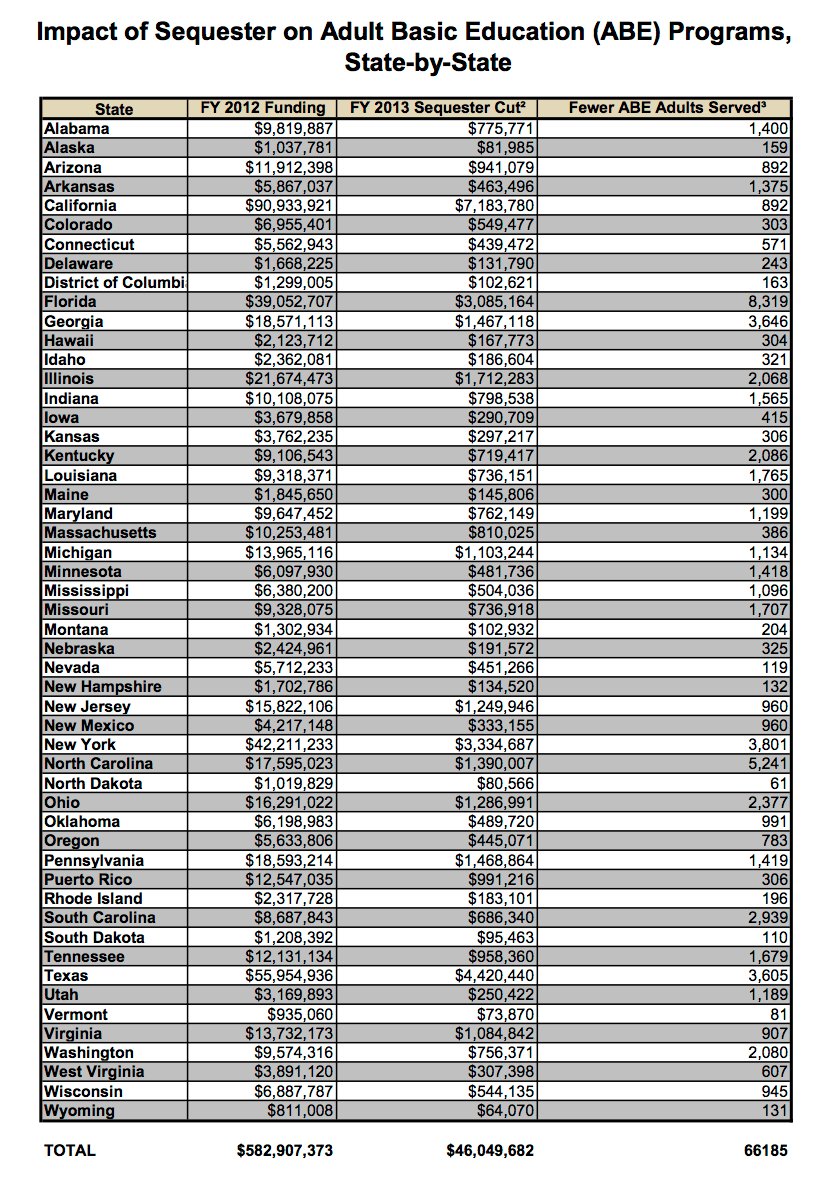
A couple of weeks ago the National Skills Coalition released a report, “Disinvesting in the Skills of America’s Workforce,” which examined the potential impact of sequestration on key federal employment and training programs. The report estimates that Adult Basic Education (ABE) programs would serve 66,000 fewer learners if sequestration cuts go forward, as now required by law. Unlike the NEA numbers published earlier this year, NSC included not just the loss of federal dollars but also a proportional cut from required state matching funds. It includes a table that shows the impact on a state-by-state basis (click on the table to read the entire report):

NSC Sequester Analysis - Adult Education

NSC used a different methodology to calculate their estimates than the one used by the NEA for the tables they published a few months ago. The NSC’s estimate of 66,185 adult learners losing services is considerably lower than the NEA’s worst-case estimate, which was north of 200,000.

Either estimate likely understates the actual impact of sequestration on adult education because they do not include the impact of cuts to other non-defense discretionary programs that support adult education other than WIA Title II, such as Community Development Block Grants, community service programs, USCIS, and other programs. (Understandably—it would be challenging to come up with impact estimates across all of those other programs since they do not exclusively fund adult education programs.)