Adult Education Funding in 2014: Why an increase Isn’t an Increase

(Updated Below)

I was talking to someone last Friday who was a bit confused by this post—specifically, by what I’m counting when measuring the federal investment in adult education—and I thought a followup post might be helpful to others who might be confused as well.

Again, to start with, I’m looking at WIA Title II/AEFLA only. That is by far the biggest source of adult basic education/literacy funding in the federal budget. (In fact, I’m pretty sure it’s the only line item you’ll see in the federal budget where adult literacy is mentioned.)

The U.S. Department of Education produces a lot of different tables and charts related to the programs that they fund. Sometimes it takes a little work to figure these out—and that work is made much harder if you are not familiar with the programs in question.

For example, this set of tables, last updated on January 23rd of this year, is the latest Department compilation of funding levels for each program it funds, based on the Consolidated Appropriations Act of 2014 (where one will find the final appropriation amounts set by Congress for FY 2014).

The question posed to me last week was why my chart shows I’ve been claiming no change in WIA Title II funding from FY 2013 to FY 2014. Apparently the Department of Education claims there was an increase of about $3 million. Which is technically true if you look at the entire subtotal for adult education (see chart below), but that’s not the number you want to look at when trying to figure out how much the federal government is investing adult education programs. My chart is looking specifically at the line item for adult education state grants, which is where all the money for local programs actually comes from. The other line item that makes up the aggregate subtotal for WIA Title II/AEFLA funding is national leadership activities—money used by the Office of Career, Technical, and Adult Education (OCTAE) for a variety of national projects: standards development, curriculum material, research, etc. It’s conceivable that some of this money may find it’s way into the hands of local programs (for a demonstration project, for example), but it is not by definition money that is used to support local program services. So for the purposes of tracking federal adult education funding that actual goes to programs, I track the state grant program, which is where that money comes from.

You can see in the Department’s chart below that, yes, the total line time for adult education did in fact rise by $3 million, from $574,667,000 in FY 2013 to $577,667,000 in FY 2014. But the key number is in the second to last column, under the line item “Adult basic and literacy education State grants,” which as you can see shows an increase of exactly zero between FY 2013 and FY 2014. The increase in funding for adult education in FY 2014 was entirely allocated to OCTAE for national leadership activities.

(Click on the graphic to see it full size.)

adult-ed_overview_budget_budget14_14action_pdf

One other possible source of confusion: in the tables above, the Department simply lists “Adult basic and literacy education State grants” without noting that a certain percentage is set aside specifically for states to fund ESL/civics programs. Which makes sense, as this is not a separate program but a set-aside. Sometimes, however, the Department breaks that out in their tables. for example, in their “State History Tables by Program tables. here, there are two tables you need to look for in order to get the total for the state grant program for each year: “Adult Basic and Literacy Education State Grants” and the table that follows, “English Literacy and Civics Education State Grants (Excluded from Adult Basic and Literacy Education State Grants)”

You have to add up the totals in each of those tables to get the aggregate total for state grants for that year.

UPDATE 3/10/14: Ugh. I hate having to make a clarifying correction to a post that was in part meant as a clarification to begin with. In the 5th paragraph above, I mistakenly implied that my inflation chart included the FY 2014 appropriation. It doesn’t. It stops at 2013. The question referenced the chart in relation to a point I had made somewhere else (Twitter?) about the FY 2014 appropriation not including an increase for AEFLA state grants.

None of that has anything to do with the substance of my post, but it might have been confusing to anyone you clicked on the link to the chart looking for the FY 2014 appropriation. More on the FY 2014 appropriation here.
Second Chance Act Reauthorization Adds Support for Adult Education

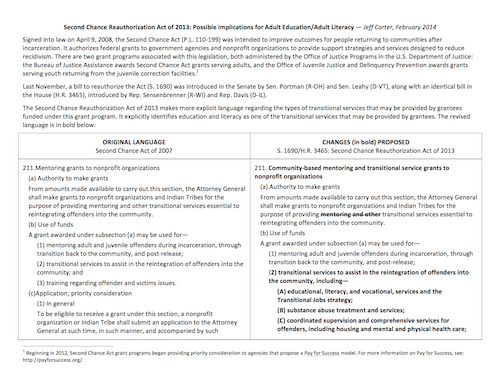
Looking for a small federal policy win for adult literacy? Then I invite you to take a look at The Second Chance Reauthorization Act of 2013, a bipartisan (!) bill recently introduced in both the House and the Senate containing language that appears to open up a Department of Justice grant program to adult education/literacy providers by making it explicit that such services qualify.

Signed into law on April 9, 2008, the Second Chance Act (P.L. 110-199) authorizes federal grants to government agencies and nonprofit organizations that provide support strategies and services designed to reduce recidivism. There are two grant programs associated with this legislation, both administered by the Office of Justice Programs in the U.S. Department of Justice: the Bureau of Justice Assistance awards Second Chance Act grants serving adults, and the Office of Juvenile Justice and Delinquency Prevention awards grants serving youth returning from the juvenile correction facilities.

Last November, a bill to reauthorize the Act (S. 1690) was introduced in the Senate by Sen. Portman (R-OH) and Sen. Leahy (D-VT), along with an identical bill in the House (H.R. 3465), introduced by Rep. Sensenbrenner (R-WI) and Rep. Davis (D-IL).

The reauthorization bill(s) offer more explicit language regarding the types of transitional services that may be provided by grantees funded under this grant program. It explicitly identifies education and literacy as one of the transitional services that may be provided by grantees. I know zippo about how/why this language got in there, but if the bill passes with this provision intact, it seems to me it presents an interesting opportunity for adult education providers.

The document below (click on it for a PDF) highlights the pertinent section. The new language is in bold.

Second Chance Reauthorization Act of 2013

The World Did Not End on January 1st

I get the feeling from talking to reporters covering the GED revamp that some are working under the assumption that the entire adult education system is in the process of imploding in the wake of the official launch of the new test at the start of the year.

The GED test has typically undergone a revision every decade or so. True, the 2014 changes, particularly the switch to a computer-only exam, and the increase in the cost, are likely to have more dramatic effects than previous revisions, but those effects are going to roll out gradually over the course of the next few years. We don’t know yet, for example, the extent to which computer-based testing will be a barrier for some who want to take the test, and we won’t really know—beyond individual anecdotes—until the new exam has been in place for a few years. In the short terms, there will be plenty of individual stories suggesting that the critics are right, and also many success stories (you can count on the GED Testing Service publicizing the success stories!)—but until we can study overall trends over a period of at least a few years, I would caution people from drawing broad conclusions from individual stories. (Not that I think we should ignore the stories—I’m definitely going to keep passing them along—I just think we need to understand the limitations this kind of evidence.)

We also won’t know for a while whether the efforts to align test content with new common academic standards for high schools is making much of difference to adult leaners, or providing more value to the high school credentials they earn by virtue of passing one of these exams. Reporters need to be skeptical of claims made by anyone before a reasonable amount of data is in. That holds true not just for the GED folks, but their competitors as well: CTB/McGraw-Hill’s TASC exam, and the Educational Testing Service’s HiSET.

I’ve been critical of the GED Testing Service’s rollout of the new test. Early on, I think even they would agree that communication with state adult education offices and the field was not great. I worry about how the switch from a non-profit business model to a for-profit business model in a marketplace with limited resources is going to work. The GED Testing Service’s aggressive marketing campaign has been, at best, an odd fit in the adult education world. I’m dubious about claims made by computer-based testing proponents that preparing for a computer-based exam provides learners with “real-world” computer skills much beyond the skills required to take a test on a computer—again, until more evidence is in. I’m definitely worried about imposing unnecessary barriers to adult learners without evidence that the benefits justify it. And I’m not immune to making dire predictions—if you comb the archives of this blog, you’ll surely find some. But I’m also not dismissing what teachers and others who have been working diligently over the last year to make this adjustment are saying—some are quite effusive in their praise of the new test and feel that the switch to computer-based is the way to go.

The point is, we have a long way to go before we know much about the impact of all these changes. I hope reporters who have jumped on this story looking for disaster this month will return in a year or two to look at what has actually unfolded.

Here’s How the Budget Deal Will Impact Adult Education

(Updated below)

I have no idea.

The Bipartisan Budget Act of 2013 set overall discretionary federal spending for FY 2014 and 2015, ($1.012 trillion and $1.014 trillion, respectively), but we won’t know how this will specifically impact federal adult education spending—most importantly, the primary source of federal adult education spending, Title II of the Workforce Investment Act (WIA)—until the Fiscal Year (FY) 2014 appropriations process plays itself out over the next several weeks.

But I do know  it’s going to work (based on reports from various sources): The agreement provides $63 billion towards sequester replacement: $45 billion for FY 2014 and $18 billion for FY 2015. In other words, the sequester level-spending limits that were going to be in effect for the next two years have been bumped up by $63 billion in FY 2014 and $18 billion in FY 2015.

Once the agreement is signed into law by the President, Senate and House appropriators have to figure out—pretty quickly—how they want to actually spend this money in FY 2014, (which actually began back in October). So they are getting ready to embark on something of a normal—if very abbreviated—appropriations process over the next several weeks (they have to finish by January 15th).

What’s interesting (if you can describe any of this as actually interesting) is that the new $1.012 trillion top line for FY 2014 presents a starkly different set of challenges for Senate and House appropriators as they put together their bills:

  • House appropriators are facing the task of adding money to the appropriations bills they wrote earlier that assumed a top line of just $967 billion. (Note that the House never produced a Labor-HHS-ED bill, so we never learned what they were planning to cut in terms of any education programs.)
  • The Senate, on the other hand, will have to trim spending back from the $1.058 trillion top line that Senate Democrats had used in their original FY 2014 budget. Unlike the House, the Senate did pass all 12 of their appropriations bills, including a Labor-HHS-ED bill at $164.33 billion, which proposed adult education funding of $594 million for FY 2014 (about $30 million over FY 2013 sequestered levels). That doesn’t mean Senate appropriators will propose an increase again this time around, but it’s possibly a clue into what they are inclined to do.

It’s possible that appropriators will simply propose a proportional increase for adult education relative to the overall increase in spending in the budget agreement—more or less putting adult education back to where it was before the 2013 sequester cut. But they could go for more—or less. So stay tuned. But also, you might want to consider contacting members of Congress and letting them know how important this funding is—particularly if they are on one of the House or Senate Labor-HHS-ED appropriations subcommittees.

Also—and I feel like I need to insert this reminder every time I write about the budget—remember that not all federal adult education spending comes out of Title II of WIA. Community Development Block Grants, AmeriCorps funding, funding for immigration programs, and some other pots of education money are also source of funding for some programs. So, if you care about adult education spending, remember that there will be several places in those appropriations bills you need to look at. I’m only paid to track WIA these days, so I don’t know how closely I’ll be following the allocations for these other programs.

Side Note: The budget deal did not include an extension of the longer term unemployment insurance benefits, which expire December 28th. Democratic leadership in the House and Senate are saying they plan to take up a one-year extension of the emergency unemployment program when Congress returns in January and something of a strategy to make it happen. This is worth keeping an eye on because two years ago during debate over extending UI, Republicans tried to insert several conditions to the extension, including a requirement that benefits be restricted to those who had passed the GED (or equivalent) or, if they had not, were enrolled in a course of study towards such a credential. I really don’t expect this to happen this time… but still, worth watching.

UPDATE: 12/20/13: Patrick Caldwell of Mother Jones quoting Joel Friedman of CBPP on the challenges facing appropriators over the next several weeks:

“It will be difficult,” says Joel Friedman, vice president for federal fiscal policy at the Center on Budget and Policy Priorities. “They’ve added back some, but not the full amount of the sequester cuts. There will continue to be unmet needs. Not everybody is going to get the level of funding that they would like out of this.”