Some New(ish) Federal Adult Education Data to Chew On

UPDATED 9/22/14: The first chart below was the wrong chart, although this didn’t make any difference in terms of the point I was trying to make about total enrollment.

While preparing for a panel discussion tomorrow, I was reviewing the latest National Reporting System data on adult learners served by Title II of the Workforce Investment Act (WIA)—now reauthorized as the Workforce Innovation and Opportunity Act (WIOA).

I haven’t had a chance to update the “Primer” page on this site in a while. One of the things I need to update is the “Participants by Program Type” table, which also includes the total number of adults served. We now have data for the 2012-13 program year. This may not be that new—I just hadn’t had a chance to look to see if had been updated. Anyway, the numbers are not good:

2013-14 NRS Enrollment Data

Source: Office of Career, Technical, and Adult Education, National Reporting System

You can see from this table that overall enrollment numbers are down once again, from 1.8 million to 1.7 million, a drop of almost 111,000 people. This is (or should be) really distressing, and again raises the question: will the new WIOA legislation do anything to stem the decline in adult education enrollment that has been occurring over the last several years? A lot of this decline has to do with funding, and the funding picture for WIOA is not good. (I realize that some of this enrollment could have been picked up by private, non-federally funded programs or via self-study, but I know of no data to support that. But I strongly suspect that enrollment in privately funded programs is not rising enough to offset the decline in WIA Title II enrollment.)

Here’s another interesting piece of data that is important to keep in mind when discussing the additional emphasis on employment skills in WIOA:
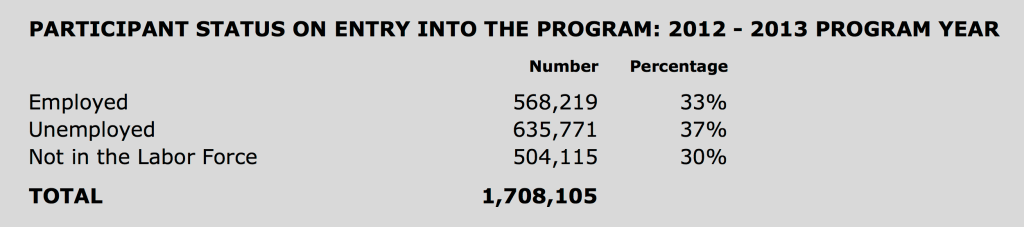
NRS Labor Market 2012-13

Source: Office of Career, Technical, and Adult Education, National Reporting System

As you can see from this table, during the most recent program year, 2012-13, almost a third of all adults participating in WIA Title II were not in the labor force. We need to know more about this population. Do we? Can anyone point me to a source? I don’t know, for example, how many of them are likely to be permanently out of the labor force. Or how many have simply given up (and of those who have given up, to what extent they identify skills issues as being the reason why). I know that during this same program year, about 60,000+ of adult learners were served over the age of 60, and presumably a lot of those folks are out of the workforce for good. Anyway, we likely need a lot of additional research here. In the meantime, it’s important to bear in mind that a significant number of people enrolling in a WIA-funded program are not part of the labor force.
Mr. Cranky’s Post of the Day

Earlier this week, when I was reviewing International Literacy Day blog posts and news items, a sentence from this post on the Global Partnership for Education’s Education for All Blog, by Aaron Benavot, caught my eye:

“One reason for slow progress in enabling adults to acquire basic literacy skills is inadequate education in their childhood.”

It says something, I think, about the degree to which early childhood education is seen as a silver bullet in conventional policy circles that a perfectly well-meaning person can make such a statement without noticing that it contains a fundamentally illogical premise. Until we gain the power of time travel, helping adults acquire basic literacy skills by going back in time and improving the education they received as children is not a realistic policy strategy.

Improving childhood literacy is a worthy and important goal, but it can only have an impact on adult literacy rates in the future, and only the relatively distant future, when those children are actually adults (15-20 years in the future). I think that is what Benavot is trying to say. But, to be clear, it does nothing to improve current adult literacy rates. Nothing. Assuming we also want to improve adult literacy right now, or in the relatively near future—and we should be—we need to invest resources in efforts that actually address adult education. Right now. Otherwise we are punting on the current generation of low-skilled adults in favor of a strategy that is solely focused on investing in future generations. Not, I think, what this post is actually suggesting, but I think it’s fair to point out that this sentence futzes up this point, and that many early childhood education advocates seem to do so as well.

Literacy for Work – Why Novels Count Too

Yesterday a major report was released examining the impact of illiteracy and innumeracy in the U.K. I was reading some of the responses to that report last night, and I came across a really smart blog post by Brian Creese of the U.K.’s National Research and Development Centre for Adult Literacy and Numeracy. His post included a superb description of how literacy skills are actually used in the workplace, while simultaneously arguing that reading for pleasure is a critically important component of literacy development:

The use of literacy and numeracy skills in the workplace is complex; different jobs, and the various elements within them, involve a range of literacy and numeracy practices, with workers often learning the specific skills they need for their job from peers and co-workers. Employees consistently report that they have adequate skills to do their jobs. What we see in the workplace is that we often work with others in ways that maximize our strengths and allow us to learn from them. We also see how workplaces can be adapted to remove the demand for literacy and numeracy or to scaffold its use.

Despite the policy focus on the workplace, we have continued to work with emergent adult readers on reading for pleasure. Those less confident with their reading may get great joy from reading novels, biographies or other texts in supportive, collaborative environments. They use adult experience and expertise to develop reading confidence, skills and practices gradually and communally – and in doing so are more able to tackle some of life’s other challenges, such as job interviews or finding better heating deals. (My emphasis)

This read to me like a gentle push back against rigidly contextualizing adult literacy instruction, at least insofar as it suggests a practical benefit from developing a habit of reading for pleasure, regardless of context.

International Literacy Day 2014

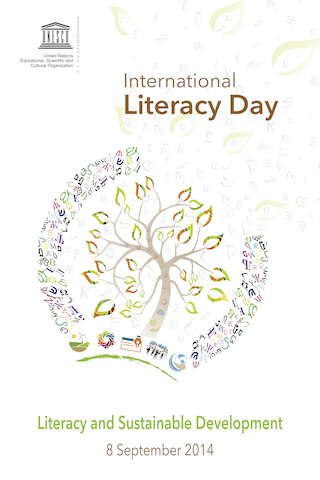
ILD 2014 Poster(Updated Below)

Today is International Literacy Day, an annual observance aimed at focusing attention on the importance of literacy around the world. There are events in schools and communities around the globe today to mark the occasion, including a United Nations conference in Dhaka, Bangladesh.

The theme of International Literacy Day 2014 (ILD 2014) is “Literacy and Sustainable Development.” According to UNESCO, “[l]iteracy is one of the key elements needed to promote sustainable development, as it empowers people so that they can make the right decisions in the areas of economic growth, social development and environmental integration.”

This UNESCO page has links to some of the more prominent ILD 2014 events. Here are a couple of other interesting ILD 2014-related announcements and news items that have come across my desk this morning:

  • In the U.K., the House of Commons Business, Innovation and Skills Select Committee has published a report examining the impact of illiteracy and innumeracy in England, calling on the government to launch a national campaign to address the issue, which they say is undermining the UK’s economic performance.
  • At an ILD 2014 event in India, President Pranab Mukherjee called for the “complete eradication” of illiteracy from the country, with a particular focus on improving literacy rates among the most disadvantaged sections of Indian society.
  • The Philippine Daily Inquirer has marked the day with an interesting story about a woman in the Philippines who made a decision to re-engage with education after being belittled by her employer.

A few interesting opinion pieces:

  • Lifelong Learning for Literacy and Sustainable Development – Worrel Hibbert, Executive Director of the Jamaican Foundation for Lifelong Learning, writes about Jamaica’s implementation of a new High School Diploma Equivalency (HSDE) programme for adult learners. (More from Jamaica here.)
  • How Adult Literacy Is Transforming a Village – Craig and Marc Kielburger, co-founders of the international charity, Free The Children, write about an adult literacy class in the south-central China village of Waer, where residents are still recovering from the 2008 Sichuan earthquake.
  • An editorial from the Gaston Gazette (North Carolina) argues that “before job-ready education can begin, a student and prospective worker must be able to read.”

International Literacy Day celebrations are generally more prominent outside of the Unites States, although many adult literacy programs mark the day with events or announcements. For example, in New York, LiteracyCNY has posted a 52-year retrospective of their work in the community.

Finally, those of you who are fans of infographics, here is the official UNESCO ILD 2014 infographic (click on it to see the entire thing):

Link to ILD 2014 Inforgraphic

This is just a teaser—there will be hundreds of events and surely more news about ILD 2014 as the day progresses. I don’t have time to track it all, but I encourage you poke around the inter webs today and see what else is out there. Find anything interesting? Want to promote an event in your community? Feel free to post it in the comments.

UPDATE 9/8/14 2:30 PM: Had some time during my lunch break to poke around for some additional stories. Here is the best of what I found:

Some additional opinion pieces: