Preteen Girls With Low Literacy More Likely to Become Pregnant as Teens

A new study provides more evidence that investments in literacy pay off in ways that aren’t directly concerned with job training or career prep.

Released this week at the American Public Health Association’s annual meeting in San Francisco, a University of Pennsylvania study suggests that independent of other factors, preteen girls with below average literacy are more likely to get pregnant as teenagers.

The researchers examined the reading scores of 12,339 girls with an average age of about 12 years, together with the birth records among those girls from 1996 to 2002. Girls who had below-average reading skills were 2.5 times more likely to have a child in their teen years than those with average reading skills.

Healthline reported some interesting comments made by the researchers during their presentation:

“This study underscores the importance of investing early in programs to improve literacy across the board, said Dr. Rosemary Frasso, Ph.D., University of Pennsylvania and APHA presenter, in an interview with Healthline. “The potential reduction in teenage childbearing is one of the many positive payoffs here.”

Frasso points out that because African American and Latina girls were found to have lower literacy levels, literacy programs may particularly help prevent unwanted teenage pregnancies in those groups. “Education success and better literacy in young children is protective for preventing teenage childbearing, particularly for Latina and African American girls.” (my emphasis)

Frasso went on to say that  increasing collaboration between educators and healthcare providers would be “a good idea.” Specifically, according to the Healthline post, doctors should help preteen patients connect with literacy programs.

There’s more about this research from Science Daily and Public Health Newswire. The study itself is scheduled to be published in the February 2013 issue of Contraception.

This research illustrates the why, from a public policy perspective, it is a mistake to link investments in literacy for youth and adults so rigidly to job skill outcomes. This could lead to a narrowing of the public’s perception of the role that literacy has on other critical social issues, such as health, nutrition, pre-natal care, safety, and community engagement (just to name a few)—and limit opportunities for literacy programs to collaborate on efforts to address them. It’s critically important that public officials, foundations, and other private funders are shown how investments in literacy can positively impact their efforts to address a wide variety of issues.
History of TANF Block Grants Illustrates Why WIA Block Grants Pose a Threat to Adult Education Funding

Yesterday I gave a short talk on federal adult education policy issues at the WATESOL Fall Convention in Maryland, as part of a larger panel discussion on advocacy.

One of the policy trends I mentioned was the Republican inclination toward reducing the number of federal programs and consolidating them into state block grants, thus providing states with more decision-making power in how those federal funds are used. (They also tend to want to reduce federal spending to begin with, of course, at least for non-defense programs.) Their argument is that state officials are in a better position to decide how federal funding can best meet the particular needs of their state.

I want to describe in detail why I think federal program consolidation is a threat to federal funding for adult education.

My specific point of concern is with House Republicans’ Workforce Investment Act (WIA)  reauthorization bill, H.R. 4297 (The Workforce Investment Improvement Act of 2012), which was passed by the House Education and the Workforce Committee in June, (but has yet to be voted on by the full House, and probably won’t be). This bill would consolidate all of the different WIA job-training programs and convert them into a block grant program for states. It’s worth noting that the 2012 Republican platform also proposes consolidation of federal workforce programs into state block grants “so that training can be coordinated with local schools and employers.”

Title II of WIA—which specifically supports programs focused on helping people improve their literacy skills—is not subject to this consolidation provision. However, H.R. 4297 would give states the option to further consolidate their federal adult education funds—and a bunch of other non-WIA training funds—into a Workforce Investment Fund that would be also created under this bill. This option can be thought of as the turbo version of consolidation. If states chose to do this, they would have a great deal of flexibility on how to use the dollars they assign to the WIF. Most significantly, from an adult education perspective, once Title II money is assigned to the WIF, it would no longer have to be used to serve the specific purposes of Title II.

And the evidence seems to be pretty strong that this is exactly what would happen if this bill (or something like it) should ever become law.

The history of Temporary Assistance for Needy Families (TANF) block grants is instructive. As noted in a recent report from the Center for Budget and Policy Priorities (CBPP), in the years since the Aid to Families with Dependent Children (AFDC) program was converted into a block grant program, states have often used the flexibility of TANF block grants to redirect TANF funds to plug holes in state budgets or free up funds for purposes unrelated to TANF’s stated purposes.

We also know that money tends to flow away from adult education when public officials have the flexibility to re-purpose adult education dollars. The most dramatic example is in California, where in 2009 the legislature passed a bill that gave individual school districts the flexibility to take money from one funding category and move it into another. In the years since the passage of this bill, hundreds of school districts have used funding originally intended for adult education to fill gaps in their K-12 budget. This has reduced overall state adult education funding in California by nearly half, from $754 million to $400 million. (I argued last year that the CBA is probably the worst piece of legislation for adult education in the entire U.S. over the last several years.)

I’ll concede that in some states, it’s possible that enlightened leadership might actually use the flexibility under the Republican approach to increase services for adult education—and theoretically states could even target more money towards individuals not well-served under the current system. (CPBB notes, for example, that in the case of TANF, some funds were used for child care and welfare-to-work programs— and other reasonable welfare reform efforts—particularly in TANF’s early years.) But I think the evidence above suggests that the opposite is more likely over time: that states would tend to use the flexibility of block grants to steer WIA money away from it’s intended purposes, and that this would lead to budget gaps in job training programs when demand is high. State officials would then be tempted to move adult education funds over to job training programs to shore up those gaps, in the same way that school officials in California diverted adult education money to shore up their K-12 budget gaps.

In it’s report on TANF, CPBB warns that “block grants can lead to less accountability, lessened federal direction and oversight, and significant amounts of federal funds being spent in ways that Congress did not envision or intend.” Given what we know, diminished federal oversight over adult education funding will likely result in a substantial reduction in that funding across the country.

WIA reauthorization my be on hold for now, but I expect consolidation to be part of the WIA debate in the next Congress.

International Literacy Day: An Opportunity to Think About How Literacy Is Viewed Around the World

September 8th was International Literacy Day (ILD). Reading the ILD coverage over the weekend was an interesting reminder of how literacy is viewed around the world as we head into Adult Education and Family Literacy week in the U.S., which begins today.

The theme of this year’s International Literacy Day 2012, for example, was “Literacy and Peace.” From UNESCO’s ILD page:

Literacy contributes to peace as it brings people closer to attaining individual freedoms and better understanding the world, as well as preventing or resolving conflict. The connection between literacy and peace can be seen by the fact that in unstable democracies or in conflict-affected countries it is harder to establish or sustain a literate environment. (my emphasis)

Irina Bokova, UNESCO Director General:

Education brings sustainability to all the development goals, and literacy is the foundation of all learning. It provides individuals with the skills to understand the world and shape it, to participate in democratic processes and have a voice, and also to strengthen their cultural identity(my emphasis)

UN Secretary-General Ban Ki-moon’s message for International Literacy Day 2012:

Literacy provides tools for men and women to better understand the world and shape it to meet their aspirations.  It is a source of individual dignity and a motor for the healthy development of society.  International Literacy Day is an opportunity to celebrate this transformative force and mobilize to make the most of it. (my emphasis)

On Friday, South Sudan officially launched a nationwide campaign as part of the “education for all programme”, seeking a 50 percent reduction in adult illiteracy among its population by 2015. A UNESCO official recently claimed that South Sudan had the worst literacy rate in the world, at 27%:

Telar Riing Deng, South Sudan’s presidential advisor on legal affairs described lack of education as an enemy, which keeps a nation in the past.

“Illiteracy is the enemy within. We have to promote literacy that ensures the culture of peace in our societies,” he said, while speaking on behalf of South Sudan President, Salva Kiir.

South Sudan should focus on building a nation of peace and tolerance, while focusing on education systems that provide opportunities for self-actualization of citizens, he said.

Zarina Patel, in an article published in recognition of ILD by Pakistan’s financial daily Business Recorder:

There is a strong relationship between literacy and peace. Literacy ensures development, peace and democracy. It is vital to amalgamate literacy with peace-building processes in order to promote harmony among different sects of a society. Literacy provides youth and adults basic skills they need to live with harmony in a society. (my emphasis)

The relationship between literacy and culture, democratic participation, civil rights, individual freedom, and peace are important to many people who participate in adult education in the U.S., but those themes are largely absent from adult literacy policy discussions in the U.S. Most of the traction we get on this issue from a policy perspective comes from focusing the discussion on adult literacy’s relationship to workforce development, often framed by the perspective of employers (AEFL week statements this week from around the country will likely talk about how adult education programs help people get the skills and credentials required by employers, for example). As a policy tool, AEFL week serves to amplify that connection, but, alternatively, it might be interesting one day to promote AEFL week as an opportunity to emphasize how adult literacy can strengthen communities in over ways, like improving health, promoting conflict resolution, enhancing cultural pride, and encouraging civic involvement.

NSC Estimates that 66,000 Fewer Adult Learners Would Be Served Under Sequestration

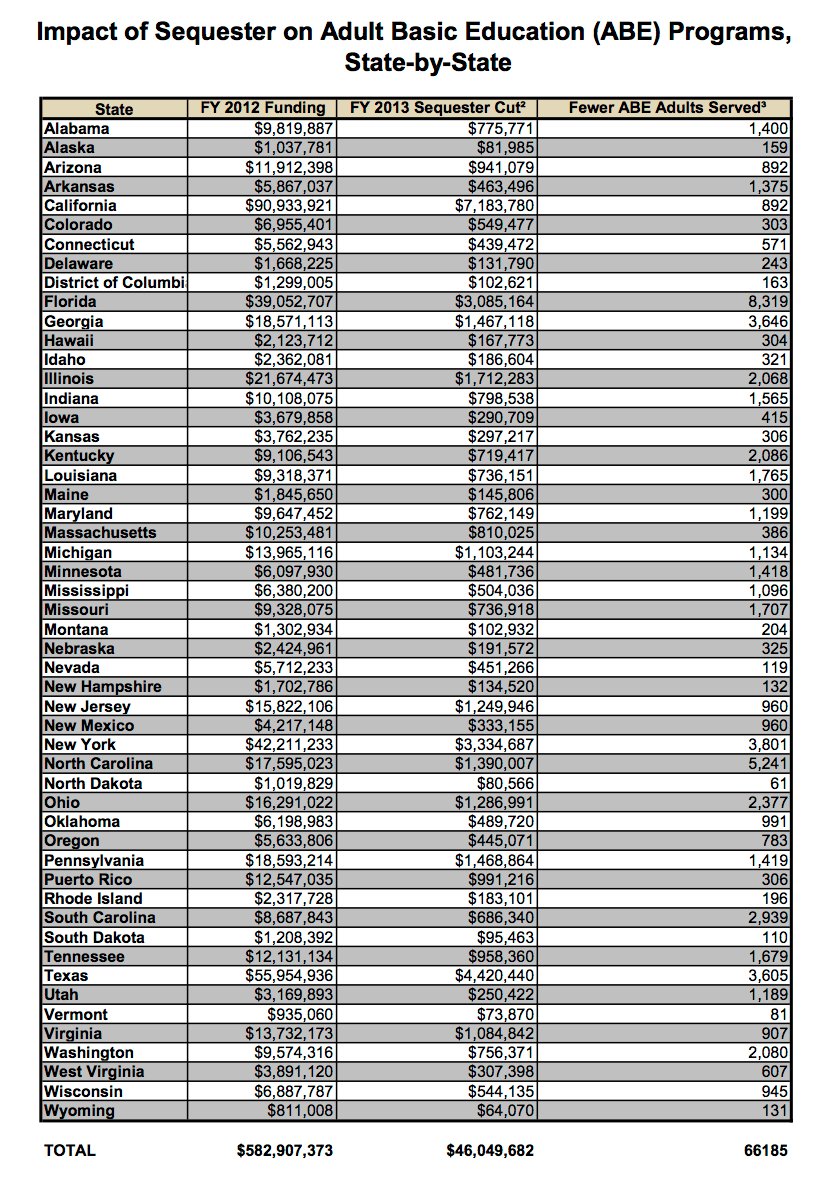
A couple of weeks ago the National Skills Coalition released a report, “Disinvesting in the Skills of America’s Workforce,” which examined the potential impact of sequestration on key federal employment and training programs. The report estimates that Adult Basic Education (ABE) programs would serve 66,000 fewer learners if sequestration cuts go forward, as now required by law. Unlike the NEA numbers published earlier this year, NSC included not just the loss of federal dollars but also a proportional cut from required state matching funds. It includes a table that shows the impact on a state-by-state basis (click on the table to read the entire report):

NSC Sequester Analysis - Adult Education

NSC used a different methodology to calculate their estimates than the one used by the NEA for the tables they published a few months ago. The NSC’s estimate of 66,185 adult learners losing services is considerably lower than the NEA’s worst-case estimate, which was north of 200,000.

Either estimate likely understates the actual impact of sequestration on adult education because they do not include the impact of cuts to other non-defense discretionary programs that support adult education other than WIA Title II, such as Community Development Block Grants, community service programs, USCIS, and other programs. (Understandably—it would be challenging to come up with impact estimates across all of those other programs since they do not exclusively fund adult education programs.)