What’s in the FY 2015 Federal Spending Bill for Adult Education

Members of the House and Senate reached an agreement late yesterday on a nearly $1.1 trillion FY 2015 spending bill that will fund most of the federal government through September 30, 2015. The one exception: funding for the Department of Homeland Security is funded only through February. This is supposedly going to give Republicans some leverage in the next Congress to block President Obama’s recent executive order on immigration.

Here is how adult education made out:

Total amount for WIOA Title II adult education is $582,667,000. State grants were funded at $568,955,000. (This is the money that is sub granted to programs for direct services.) The FY 2014 figure for state grants  was $563,955,000, thus this is a $5 million increase. National Leadership funding (basically funding that goes to the U.S. Department of Education to manage the WIOA Title II program and provide assistance, research etc.) was level-funded at $13,712,000 (but note that this line item did get a slight bump up in FY 2014).

There is also some report language on the National Leadership funding:
Career Pathways Report Language

No one is going to complain about an increase—whatever the amount—and in the current fiscal environment, even a relatively small $5 million increase should arguably be viewed as a victory. But as far as I can tell, nearly every adult education or WIOA advocacy group that spoke out about the FY 2015 budget advocated for a larger increase, and with ample justification. A $30 million increase was needed to bring state grant funding back to the pre-sequestration level of $595 million. This was what the House Democrats’ proposed Labor-HHS-Education bill included. The National Coalition for LIteracy advocated for the House Democrats’ proposal, noting that it would not only have restored state adult education grants to the pre-sequester level, it would have also maintained the slight bump up in national leadership programs that was included in the Fiscal Year (FY) 2014 Consolidated Appropriations Act. For those interested, I have a post here that summarizes the different proposals for adult education funding under WIOA that were released over the course of the last year.

For what it’s worth, the total amount for WIOA Title II adult education contained in this bill—$582,667,000—is actually above the funding level authorized under WIOA for FY 2015, which simply carried over the FY 2014 funding level of $577,667,000. But as noted by myself and others, the WIOA authorized amounts are not even close to what is needed to meet the need for adult education in this country.

The new spending bill also includes a provision “reinstating” ability-to-benefit (ATB) financial aid eligibility for students without high school diplomas enrolled in career pathway programs at community colleges. Note that this is in fact a partial reinstatement of ATB, since the older provision didn’t restrict eligibility to those enrolled in career pathway programs. Regardless of whether you think such a restriction is a good or bad idea, I think it’s important to remember that this is not a full restoration of ATB.

The House and Senate are expected to try to quickly pass the bill this week.

Here is the source for all the FY 2015 information above.
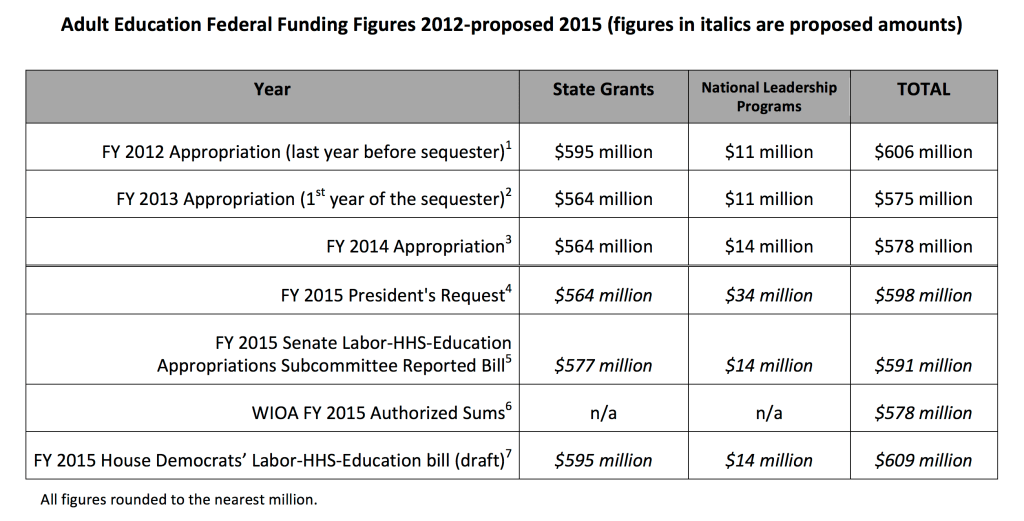
Summary of Fiscal Year 2015 Funding Proposals for Adult Education

The National Coalition for Literacy (NCL) recently sent a sent a letter to members of Congress urging them to approve an FY 2015 omnibus appropriations bill before the end of the calendar year, including an increase in funding for adult education to at least the $609 million level proposed in the Labor-HHS-Education bill released by Representative Rosa DeLauro in September. (Full disclosure: I am the current President of NCL.)

While working with NCL members to put together our recommendation, I needed to pull together all the recent proposals for federal adult education funding for FY 2015, including the President’s original budget request, the Senate Labor-HHS-Education Appropriations Subcommittee Reported Bill, the House Democrats’ Labor-HHS-Education bill, as well as the figures authorized by the new WIOA legislation. Rather than just file that away, I thought I would share it here, in case it might be useful to others.

Adult Education Recent Federal Funding

Note that the House Democrats’ proposal is probably the high-water mark for potential adult education funding in FY 2015. It’s also worth noting that there is increasing concern that an omnibus bill will be blocked by Tea Party Republicans upset with President Obama’s imminent executive action on immigration. It’s really unclear to me what is going to happen with the FY 2015 federal budget. If I had to guess, I’d put my money on a short-term Continuing Resolution (CR) that punts the decision into January and the newly elected Congress.


Adult Literacy Programs at the Library of Congress Literacy Awards

LOC  Literacy Awards BookletI had the good luck to be in attendance at the presentation of the 2014 Library of Congress Literacy (LOC) Awards on October 8th. Now in its second year, this program, supported by philanthropist David Rubenstein, honors organizations that have made “outstanding contributions to increasing literacy in the United States or abroad.” This year’s top honors went to Room to Read, which was awarded the David M. Rubenstein Prize ($150,000); Start Making a Reader Today (SMART), winner of the American Prize ($50,000); and the Mother Child Education Foundation (AÇEV), winner of the International Prize ($50,000).

None of these organizations are adult-focused, although the AÇEV program provides adult literacy services for low-income mothers of the children they serve. (AÇEV also employs technology extensively in their program, using a mix of television and online materials. If you are at all interested in technology and adult education,  I suggest you check them out, although I should note that their Web site is in Turkish.)

I bring all of this to your attention because this year there was an increased emphasis on the other purpose of the program, which is the dissemination of effective practices, culled from not only the three prize-winners, but also a subset of the organizations that applied for an award this year but did not win. The LOC has published a Best Practices booklet summarizing those practices, and additional resources, such as symposia and webcasts, are in the works. Here, several adult education organizations are featured, including ProLiteracy, the Literacy Assistance Center of New York City, Literacy Volunteers of Greater Hartford, and California Library Literacy Services (CLLS).


Influential Research Center Has Closed

The Boston Globe is reporting that Northeastern University has closed the Center for Labor Market Studies, following on the heels of the retirement of its founder, Andrew Sum. For those of you who unfamiliar with Sum, he is one of the first I know of to study in depth the impact of literacy proficiency in the labor market. A huge influence in the adult education policy world.

Some samplings of his work: