Final Estimated Federal Funding for Adult Education for Fiscal Year 2013

(Updated Below)

On April 30th, the Department of Education released funding tables (by program and by state) for FY 2012 and FY 2013 appropriations, and FY 2014 estimates. As a result, we now know the final estimated total allocation for WIA Title II (or AEFLA) Adult Basic and Literacy Education State Grants for FY 2013: $563,954,515. This includes $70,811,239 for English Literacy and Civics Education State Grants. That’s a cut of about $31 million dollars of federal support for adult literacy in comparison with FY 2012. (But it’s worse than that when you adjust for inflation—see below.)

Fiscal years 2012 and 2013 are based on currently enacted appropriation bills, and the amounts listed for FY 2013 include the effect of the sequester and an across-the-board cut in the final appropriation. FY 14 estimates are based on the president’s proposed budget, and barring a miracle, those estimates are well over what we’ll actually see in the final FY 2014 appropriation.

These tables also include the estimated state allocations. I’ve pulled those out for you here:

State AEFLA Allocation rev05-13-13State Allocations: Adult Basic and Literacy Education State Grants: FY 2012 Appropriations, FY 2013 Appropriations, and FY 2014 estimates
State AEFLA ELCivics Allocation rev05-13-13State Allocations: English Literacy and Civics Education State Grants (Excluded from Adult Basic and Literacy Education State Grants): FY 2012 Appropriations, FY 2013 Appropriations, and FY 2014 estimates

These tables were updated yesterday, but no changes were made to the WIA Title II grants, at least as far as I can tell.

As I mentioned above, federal funding for adult education is even more grim once you adjust for inflation. Based on these figures, I took a stab at estimating the buying power of $563,954,515 in 2002 dollars. I used that figure because the last time I saw this calculated, 2002 was used as the baseline. I plan to follow up at some point with a longer post on calculating the effect of inflation, and the effect of using different baselines (and maybe even different methods, too) but for now this seemed like a good place to start. (For FY 2010, I did not include the one-time adjustment made by the Department of Education to make up for several years of underpayment to some states—that anomaly wasn’t carried over and shouldn’t be interpreted as growth, so I left it out.) (Note: this chart was updated 02/18/14.)
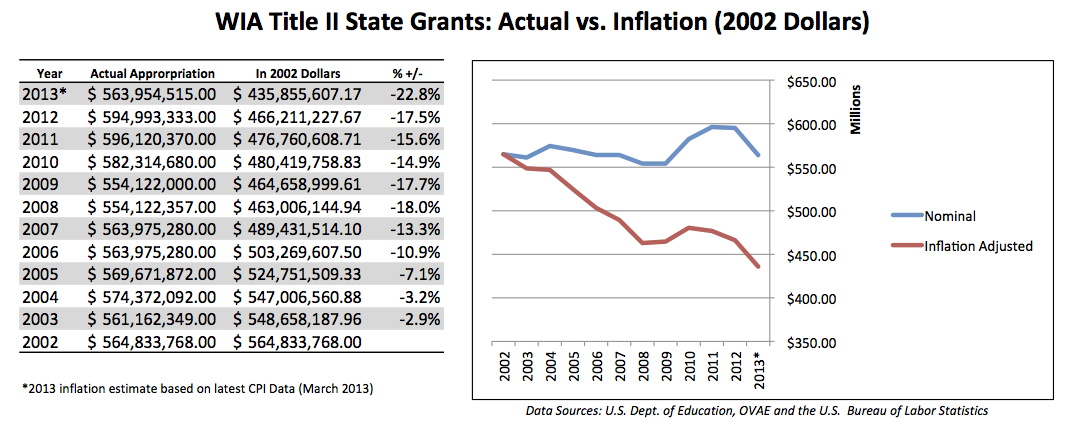
AEFLA Grants to States 2002-13 Graph

Using the most recent CPI (March), I calculate that $563,954,515 equals about $435,855,607 in 2002 dollars. Again, that’s a rough estimate, using the March CPI (for the other years I can use an annual average), but it’s close enough. The main takeaway here is that pre-sequestration the field was receiving somewhat stable, more-or-less flat, funding (that’s the blue line)—even, arguably, with the 2013 cut—but once you adjust for inflation (the red line)  you can see that the field has actually lost about 23% in real dollars in comparison with the appropriation of 2002.

Finally, don’t forget that other federal programs that are vital to adult education programs (Community Development Block Grants, CNCS/AmeriCorps, grants from USCIS, etc.) were also subject to sequestration cuts.

That’s a lot to chew on. Take a look and let me know if you have any comments or corrections.

UPDATE 2/18/14: This table has been updated to reflect the final 2013 CPI numbers.

New Aspen Institute Report: “Helping Adult Learners Navigate Community College and the Labor Market”

After all that depressing news about college in my last post, the least I can do is share this new report, Helping Adult Learners Navigate Community College and the Labor Market, released by the Aspen Institute’s Workforce Strategies Initiative back in February— although I just got a notice about it today.

The report looks at the challenges adult learners face “as they attempt to enter community college, persist to completing a certificate or degree, and successfully transition to employment,” and is designed to assist workforce development leaders, community colleges, and workforce investment boards help adult learners navigate both  the community college campus and the labor market.

Immigration Reform Update

For those interested in the immigration reform legislation currently under consideration in the Senate, I co-authored a more detailed followup to my earlier quick take on the  bill for the National Coalition for Literacy. Here is the link to that post.

What It Takes

(Updated Below)

A small contingent of adult learners attending the National Adult Learner Leadership Institute here in Washington paid a visit this afternoon to the U.S. Department of Education to meet with the Secretary of Education, Arne Duncan, and the Assistant Secretary for Vocational and Adult Education, Brenda Dann Messier. I was fortunate enough to be able to tag along.

Looking over my notes from the discussion, I am struck by how often the discussion turned to (1) what I’d call non-academic issues that nonetheless make adult education a challenge for many adults (especially low-income adults): busy work schedules, raising children, transportation, etc.; and (2) the impact that prior trauma and/or existing disabilities can have on learning, and the need for more resources that are appropriate for these learners.

This isn’t surprising, really—and these issues are well-known by people in the field—but it occurred to me that from a public policy perspective, our efforts to think about and address these issues are a bit underdeveloped. Adult education policy leans a bit more in the direction of what I think of as academic issues (teacher quality, professional development, standards, assessment, etc.) and less on the non-academic issues that can have as much of an impact on adult learner success as anything else. The best instruction in the world can’t do much for a mother who can’t come to class because she can’t find a childcare provider. This is why adult education advocacy can’t begin and end with the number in the line-item for adult education—a cut to housing services or childcare in the state or local budget can have every bit as much of a destructive impact on adult education enrollment and success as a cut to adult education itself.

As for special needs: again, it’s not that adult education policymakers (or programs) ignore these populations, but outside of what are commonly thought of as learning disabilities (such as dyslexia), it’s fair to say that few adult education programs or teachers specialize in serving those with physical/sensory/cognitive disabilities or mental health issues, and I don’t think there is much policy-oriented research available on how best to meet their needs. (This is yet another case where I’d really love to be wrong, so please correct me if I am—but I’ve been in many, many big-picture adult education policy meetings in my life and rarely—if at all—are mental health or disability issues discussed. But these issues come up often, one way or another, when you discuss policy with adult learners.)

Not surprisingly, many of the best programs in adult education do provide or arrange for other support services, including counseling, child care, health and mental health services (including drug and alcohol treatment), service coordination (case management), homelessness and housing services, and other social services. But again I’d say that programs offering a full range of wrap-around services are still pretty rare.

A lot of things have to be in place in order for some adult learners to succeed. If we agree that it makes good public policy sense to provide all adults with limited skills and/or lacking academic credentials with the opportunity to be successful adult learners, we need to look more carefully at what it takes—not only inside the classroom but outside of it—and advocate for policies that support those conditions.

UPDATE 5/10/13: Right after I wrote this post, I learned that World Education is offering an online course this summer for teachers interested in learning more about how chronic stress, trauma, and other adverse life experiences can affect learning. More information here.

UPDATE 5/23/13: The Department of Education has published a blog post about the visit with Secretary Duncan. The post includes a great video of one of the meeting participants, Shamika Hall, talking about her experience going back to school as an adult: