Interesting New DACA Data to Ponder

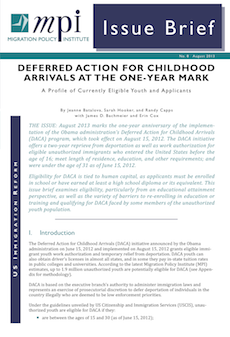
MPI - One Year DACA ReportThe Migration Policy Institute has just published a new policy brief, Deferred Action for Childhood Arrivals at the One-Year Mark: A Profile of  Youth and Applicants, which includes MPI’s most recent estimates on the current and prospective Deferred Action for Childhood Arrivals (DACA) population, and broken down into categories, such as educational attainment, English proficiency, state of residence, country of origin, age, gender, labor force participation, poverty and parental status.

MPI researchers think that about 1.9 million unauthorized immigrants are potentially eligible for the DACA program, with 1.09 million currently meeting the age, education, length of residence, and other criteria. About 392,000 of these individuals are too young to apply now but would become eligible once they reach age 15 if they stay in school or obtain a high school degree or equivalent.

It’s the remaining 423,000 young people who appear to meet everything but the education requirements that are of most interest to adult education advocates. MPI’s brief includes some interesting estimates regarding the educational attainment, English proficiency, state of residence, country of origin, age, gender, labor force participation, income, and parental status for this population. Not surprisingly, these individuals tend to be poorer and less English proficient than those who appear to meet all the DACA requirements. However, more of the individuals in this subset (71%) are in the labor force.

End of Days for the Current GED Test

While the revised, computer-only GED won’t be launching until January of 2014, in some places, the window of opportunity to take the current test is actually closing fast.

Structural Unemployment

(Updated Below)

A lot of economists have been making the case for a while (I’ve documented some of it on this blog), but like Krugman, I’ve noticed that more and more economists are falling off the structural unemployment bandwagon.

But it’s not just the pundits who are stubbornly resisting this growing consensus, but people involved in actual policy (in and out of government). For example, a lot of workforce investment policy arguments are predicated on the idea that high unemployment is largely structural. I get that many economists (and political progressives) are frustrated by this because they believe it discourages action on more critical areas of economic policy. But it’s worth noting that there are also a lot of good policy goals (like investing more in adult education) that are (in part) supported by the idea that continued high unemployment is mainly a structural problem. It’s a bit of a conundrum.

UPDATE 8/8/13: An additional thought on this. There really isn’t any reason why an argument for offering Americans the opportunity to upgrade their skills should be dependent on the idea that our high unemployment levels are structural. I think the problem only comes when you suggest that improving skills alone will solve the problem of high unemployment/good jobs. But to suggest that there aren’t real adult education or worker training needs, or good policy reasons behind trying to improve people’s education and skill attainment—that it’s all just a scam—is just as facile an argument.

Increased Cost Means “Fewer Adults Will Try to Get Their GED”

Let’s take a break from all this federal policy stuff and check back in with the looming GED disaster, by way of this article by Marc Larocque in today’s Taunton (MA) Gazette:

[Carmen] Botelho [director of the Taunton Adult Education Partnership] said that if the more costly 2014 GED exam is implemented as a standard in Massachusetts, it would also put a burden on adult education programs in Taunton and across the state.“Absolutely, it will be tougher for the program,” Botelho said. “We have funds available through the Taunton Literacy Council that we provide to students for the test, if they can write a letter to the council explaining the situation and its approved. It will be tougher for program in that way. It’s definitely going to be a challenge for the students. And the program will also face financial difficulty because there will likely be more requests for assistance.”

Botelho predicted that fewer adult students will try to get their GED if the costs are nearly doubled, as monthly bills and immediate family needs take precedence. (my emphasis)

Whatever the business rationale is for increasing the costs or otherwise making high school equivalency exams less accessible, pricing adults out of the opportunity to earn a high school credential doesn’t make much sense as a matter of public policy, does it? (Presuming we agree that increasing the number people in this country who have high school level credentials is desirable.) Yet despite two or more years of hearing stories like the one above, there seems to me to be sort of grudging acceptance in some circles that it’s reasonable to make the whole process “tougher” and more expensive, and I (honestly) don’t know why.

I realize that this is primarily a state matter but a national discussion about policies that would encourage more adults to acquire their high school diploma in light of these increasing costs (and other challenges) might not be a bad idea.