Summary of Fiscal Year 2015 Funding Proposals for Adult Education

The National Coalition for Literacy (NCL) recently sent a sent a letter to members of Congress urging them to approve an FY 2015 omnibus appropriations bill before the end of the calendar year, including an increase in funding for adult education to at least the $609 million level proposed in the Labor-HHS-Education bill released by Representative Rosa DeLauro in September. (Full disclosure: I am the current President of NCL.)

While working with NCL members to put together our recommendation, I needed to pull together all the recent proposals for federal adult education funding for FY 2015, including the President’s original budget request, the Senate Labor-HHS-Education Appropriations Subcommittee Reported Bill, the House Democrats’ Labor-HHS-Education bill, as well as the figures authorized by the new WIOA legislation. Rather than just file that away, I thought I would share it here, in case it might be useful to others.
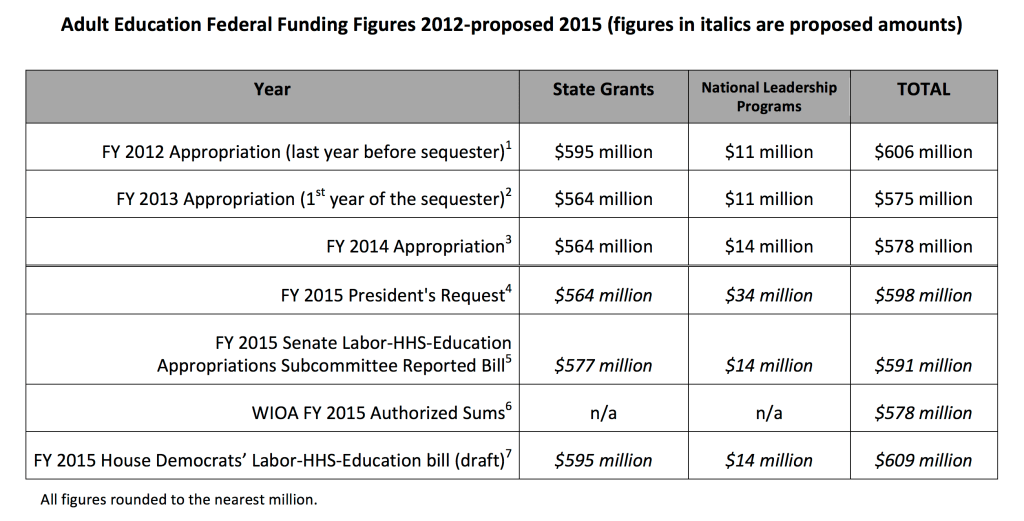
Adult Education Recent Federal Funding

Note that the House Democrats’ proposal is probably the high-water mark for potential adult education funding in FY 2015. It’s also worth noting that there is increasing concern that an omnibus bill will be blocked by Tea Party Republicans upset with President Obama’s imminent executive action on immigration. It’s really unclear to me what is going to happen with the FY 2015 federal budget. If I had to guess, I’d put my money on a short-term Continuing Resolution (CR) that punts the decision into January and the newly elected Congress.


Election Thought of the Day

Thinking about the impact of the elections on adult education policy, I wonder if the results of some of the governer’s races are more significant for adult education (and workforce policy generally), than the shift in power in the Senate. While most education-related legislation languished without much progress during the last Congress, the current crew did manage to successfully dispose of the most important piece of legislation for our field, the Workforce Investment and Opportunity Act (WIOA), passing it by a wide margin this summer. The action is really now at the state level, where governors hold sway over WIOA’s implmentation.

What will party switches in the governor’s offices in Illinois, Pennsylvania, Massachusetts, and Maryland, for example, mean for WIOA implementation in those states?


Bring on the Pork!

Homer Welcomes the Return of Pork Barrel SpendingI tweeted this earlier but in case you are walled out by their subscriber paywall, here’s a fair use except of an interesting article in the Legal Times from yesterday concerning the possible return of Congressional earmarks. An earmark is a legislative provision that allows members to direct approved funds for specific projects, usually to a particular organization or project in their home state or district. Earmarks are popularly portrayed as pork-barrel spending and often cited as a corrupting influence on our politics. The practice became enough of a public relations liability that the House instituted a ban on the practice in 2010, and the Senate soon followed suit. Now some lobbyists (who obviously have a vested interest in this) are going around telling people it might come back:

Former Republican Congressman James Walsh, now at K&L Gates, has predicted that federal earmarks could return to Congress next year. The change could revive the lobbying industry and spark a now-stagnant Congress by giving it more discretionary power after the mid-term elections Tuesday, he said during a webinar sponsored by his firm.

“I think it would make things move better up there,” he said. A highway funding plan, he added, could revive the earmark—a legislative procedure that ended in 2010.

His prediction was among many shared by a K&L Gates panel of former members of Congress and a top lobbyist Monday.

Despite earmarks’ bad reputation, there are some who have argued that an outright ban of the practice was actually a bad idea, claiming it has actually decreased transparency in the appropriations process and shifted the balance of power between the legislative and executive branches too far to the executive. Others argue that the ban removed who a useful tool for lawmakers to have at their disposal as a way to broker deals on legislation.

In the case of adult education, would the return of Congressional  earmarks provide advocates with more leverage over the administration on how money on adult education is spent? I have no idea. I do suspect that without strong, knowledgeable advocacy from the field, Congress could also come up with some really bad ways to earmark adult education funds. But it seems to me the opportunity for leverage is almost always a good thing to have. Right now the administration calls all the shots, and I’m not sure that Congressional language “urging” the Department to “increase the focus on adults with the lowest literacy and numeracy skills” or “work with national adult literacy organizations,” as they did in the FY 2014 omnibus budget bill, is taken that seriously.

The Real Problem With WIOA

I’m still confused over why the Workforce Innovation and Opportunity Act (WIOA) is already considered an abject failure because it didn’t do anything about the predatory lending practiced by institutions covered by an entirely different piece of legislation, but in the meantime, while watching this, I was pleased to see someone mention, even if somewhat obliquely (and then completely ignored by the host), the one clear aspect of WIOA (and its predecessor, the Workforce Investment Act) that really does work to the advantage of those schools that rip people off: the fact that there isn’t nearly enough funding in WIOA to provide quality training to people who are eligible for the program. If people had better options, maybe they wouldn’t be in a position to be taken advantage of by these terrible schools.

I’ve written about the completely inadequate funding levels for adult education in WIOA here. I’m not an expert by any stretch on the job training programs covered in WIOA, but I gather from what little I do know that the funding for these programs is inadequate as well. If people think that it’s the WIOA-funded one-stops that should be counseling people about higher ed student loans, then in their next breath it night be good to talk a little about whether one-stop staff capacity is sufficient—or sufficiently knowledgable—to do this, and if not, what kind of money it might take to  make that happen.

Again, I’m really interested in how workforce investment advocates might do more to stop the higher education scam artists that prey on the unemployed and unskilled, but most of the discussion over the last week or so hasn’t been very clear about the differences between higher eduction and WIOA, how they actually work together, and how they could work together better, given such a restrictive funding environment. Without such clarity, it’s hard to know which policy choices, if any, will make a difference. This is one area where your comments would be much appreciated!