Additional Notes on the FY 2015 Spending Bill

Although not without considerable last-minute drama, Congress did manage to pass a spending bill before leaving town this week. Dubbed the “Consolidated and Further Continuing Appropriations Act of 2015,” the legislation will fund most of the government though the remainder of the fiscal year ending September 30th, 2015. (The exception: The Department of Homeland Security, which was funded only through February, which provides Republicans in the next Congress with some leverage to block President Obama’s executive order on immigration.)

There was never any serious doubt that the small adult education increase was in any jeopardy during the last-minute negotiations, and despite the drama, it would have been hugely surprising if the bill itself failed to pass before Congress adjourned.

As I mentioned in an earlier post, the Act also includes a partial reinstatement of Pell Grant and other federal student aid eligibility for “ability-to-benefit” (ATB) students who lack a high school diploma.

A couple of additional notes on the legislation now that the has been enacted:

First, I’ve updated my earlier table of recent actual and proposed federal funding amounts for adult education under WIA and its successor, WIOA.
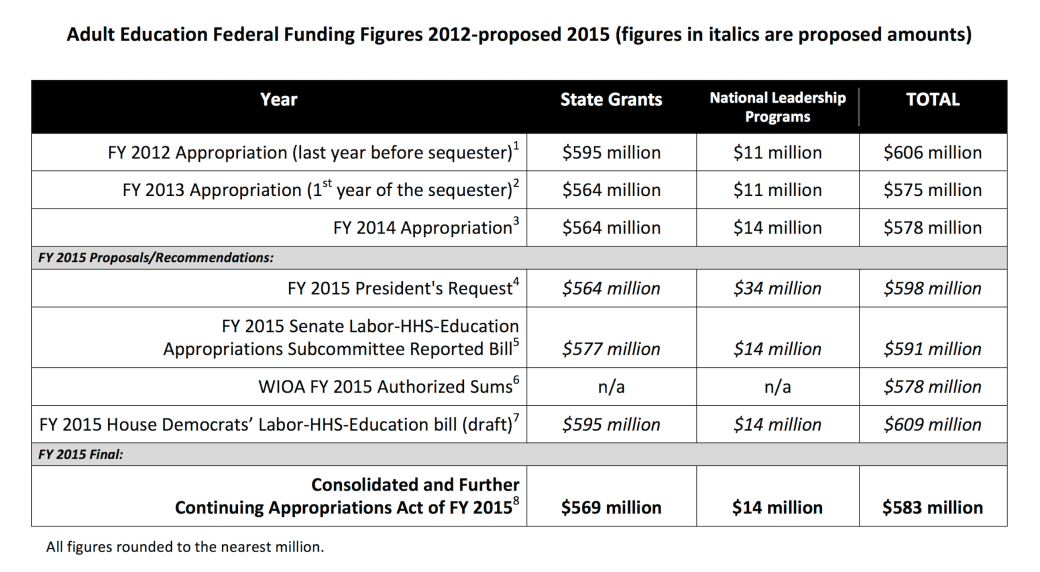
Adult Education Recent Federal Funding - Updated

As you can see above, while any increase in federal funding can be characterized as something of a win right now, the $5 million increase in state grants under WIOA for adult education is far short of where funding for this line item was in FY 2012. A better measure of our success in advocating for more federal funding in recent years, in my opinion, is to look at how we stacked up against other programs—particularly education programs—over the last two years of sequester relief under Ryan -Murray, when there was an opportunity to restore funds lost to the sequester. Some programs have received nearly a full restoration, some have fared worse. I don’t have time to do that analysis myself. But that’s where I suggest looking in order to begin to assess the field’s advocacy efforts during the “sequester era.”

A couple of notes about ATB (and thanks to my colleagues who follow Pell closely for their insights): The reinstatement of ATB eligibility goes into effect immediately. In order to qualify, students have to be enrolled in career pathway programs and prove their ability to benefit from higher education, either by passing an exam or successfully completing six credit hours.

I also dug up the language in the bill that defines an “eligible career pathways program” (it’s on page 376-377). To be considered such a program for purposes of ATB eligibility, it must be a program that:

(A) concurrently enrolls participants in connected adult education and eligible postsecondary programs;

(B) provides counseling and supportive services to identify and attain academic and career goals;

(C) provides structured course sequences that—
(i) are articulated and contextualized; and
(ii) allow students to advance to higher levels of education and employment;

(D) provides opportunities for acceleration to attain recognized postsecondary credentials, including degrees, industry relevant certifications, and certificates of completion of apprenticeship programs;

(E) is organized to meet the needs of adults;

(F) is aligned with the education and skill needs of the regional economy; and

(G) has been developed and implemented in collaboration with partners in business, workforce development, and economic development.

I’m still not entirely sure how students and financial aid folks go about establishing that a program qualifies under those rules, however. It seems to me that some of these elements are open to debate. (How does one demonstrate definitively that a program is “aligned with the education and skill needs of the regional economy,” for example?) But financial aid is not an area of expertise for me. If anyone has a better understanding of this, I’d love to hear from you in the comments.

Also, note that the size of the Pell grant that ATB students will be eligible for varies based on their enrollment date. Those who enroll in a program before July 1st, 2015, will be eligible for the maximum Pell Grant award (which is currently estimated to be going up to $5,830), while those enrolling after that date will be limited to only the maximum discretionary Pell Grant award of $4,860.

One last item that is important to many adult education students and programs: the Act also extended authority and funding for the TANF block grant through September 30th, 2015. TANF has been due for reauthorization since 2010, by the way, and is one of those non-WIOA piece of legislation I advise adult education advocates to follow and weigh in on in the months ahead.

Are We Too Quick to Accept PIAAC Findings at Face Value?

Ralf St. Clair comments on last week’s PIAAC research conference:

At this meeting, lots of findings were discussed, but very little time was spent on methodology. The papers written by presenters were not available in advance (and mostly not at the meeting). One of the problems with PIAAC data is that it is not complete…

In many cases such data gaps are tackled through synthetic data, where the existing data is used to estimate what the missing data should be. One of the problems with this, of course, is that the missing data is essentially assumed to fit with what we have, and unexpected results will never arise.

Without understanding the details of how these types are issues are tackled it is difficult to assess the implications of some of the correlations found, which are often quite weak. Would they exist at all if we had the missing data? Would they run in different directions? What sorts of assumptions are being made throughout the research process that generates the results?

Yet throughout the meeting the findings were accepted at face value and the issues of the data set never fully discussed, even though it was a room full of people who could understand and even work out how to deal with them. As in so much of the activity that surrounds international surveys, the will to believe overwhelms the skepticism we must bring to these exercises. (my emphasis)

I would just add that critical scrutiny is particularly important with PIAAC since it appears that the adult education field (in the U.S. at least, can’t speak for other countries) has decided to embrace PIAAC as our primary foundational data source for policy decisions going forward.

I recommend reading the entire post.

What’s in the FY 2015 Federal Spending Bill for Adult Education

Members of the House and Senate reached an agreement late yesterday on a nearly $1.1 trillion FY 2015 spending bill that will fund most of the federal government through September 30, 2015. The one exception: funding for the Department of Homeland Security is funded only through February. This is supposedly going to give Republicans some leverage in the next Congress to block President Obama’s recent executive order on immigration.

Here is how adult education made out:

Total amount for WIOA Title II adult education is $582,667,000. State grants were funded at $568,955,000. (This is the money that is sub granted to programs for direct services.) The FY 2014 figure for state grants  was $563,955,000, thus this is a $5 million increase. National Leadership funding (basically funding that goes to the U.S. Department of Education to manage the WIOA Title II program and provide assistance, research etc.) was level-funded at $13,712,000 (but note that this line item did get a slight bump up in FY 2014).

There is also some report language on the National Leadership funding:
Career Pathways Report Language

No one is going to complain about an increase—whatever the amount—and in the current fiscal environment, even a relatively small $5 million increase should arguably be viewed as a victory. But as far as I can tell, nearly every adult education or WIOA advocacy group that spoke out about the FY 2015 budget advocated for a larger increase, and with ample justification. A $30 million increase was needed to bring state grant funding back to the pre-sequestration level of $595 million. This was what the House Democrats’ proposed Labor-HHS-Education bill included. The National Coalition for LIteracy advocated for the House Democrats’ proposal, noting that it would not only have restored state adult education grants to the pre-sequester level, it would have also maintained the slight bump up in national leadership programs that was included in the Fiscal Year (FY) 2014 Consolidated Appropriations Act. For those interested, I have a post here that summarizes the different proposals for adult education funding under WIOA that were released over the course of the last year.

For what it’s worth, the total amount for WIOA Title II adult education contained in this bill—$582,667,000—is actually above the funding level authorized under WIOA for FY 2015, which simply carried over the FY 2014 funding level of $577,667,000. But as noted by myself and others, the WIOA authorized amounts are not even close to what is needed to meet the need for adult education in this country.

The new spending bill also includes a provision “reinstating” ability-to-benefit (ATB) financial aid eligibility for students without high school diplomas enrolled in career pathway programs at community colleges. Note that this is in fact a partial reinstatement of ATB, since the older provision didn’t restrict eligibility to those enrolled in career pathway programs. Regardless of whether you think such a restriction is a good or bad idea, I think it’s important to remember that this is not a full restoration of ATB.

The House and Senate are expected to try to quickly pass the bill this week.

Here is the source for all the FY 2015 information above.

Immigration Reality Check

I realize most of the debate over the President’s immigration plan unveiled last week is going to focus on the the issue as to whether the President has the legal authority to unilaterally suspend deportation on the scale that he is proposing. But it’s also important to remember why something needs to be done. We have a huge and growing backlog in immigration cases in this country, and desperately need better guidelines for prosecutors to use in deciding whether to pursue deportation. From an article in the National Law Journal:

There were 421,972 cases pending in the nations 58 immigration courts as of the end of October — an increase of more than 22 percent from around the same time period in 2013, according to data released this week by the Transactional Records Access Clearinghouse.

… [T]he backlog of cases in immigration courts has been on the rise since the 2006 fiscal year, when there were 168,827 pending cases. In June 2011, John Morton, head of U.S. Immigration and Customs Enforcement (ICE) at the time, issued a memorandum explaining that the agency lacked resources to go after every violation; instead, he said, the government should “prioritize its efforts.”

…Philip Wolgin, a senior policy analyst on the Center for American Progress’ immigration policy team, said the Morton memo didn’t work as planned. The language was “vague,” he said, and didn’t have clear enough directives about when prosecutors should stop pursuing low-priority matters.

“…The biggest problem is when ICE is indiscriminate about who it puts into removal proceedings,” [Peter Asaad, an immigration lawyer and managing director of Immigration Solutions Group in Washington] said. “The whole point here is to make it less indiscriminate.”

This is also important to keep in mind when certain members of Congress talk about using the appropriations process to block the President’s order. Congress doesn’t provide enough funding to deal with the immigration case backlog we already have, so any effort by Congress to block the President by starving the agencies responsible for enforcement is only going to make the problem worse.