Study: Poverty Reduces Brainpower Needed for Things Like Education and Job Training

(Updated Below)

New research out of Princeton University suggests that the stress of poverty requires so much mental energy that poor people have significant less brainpower left in the tank to devote to learning:

A person’s cognitive function is diminished by the constant and all-consuming effort of coping with the immediate effects of having little money, such as scrounging to pay bills and cut costs. Thusly, a person is left with fewer “mental resources” to focus on complicated, indirectly related matters such as education, job training and even managing their time. (my emphasis)

Anyone who has experienced financial difficulties knows how stressful and all-consuming worrying about money can be, but this is one of the few studies I’ve seen that links the stress of financial insecurity to cognitive function. The researchers found that subjects consumed with financial insecurity dropped an average of 13 IQ points—the equivalent of losing an entire night’s sleep.

The researchers go on to suggest that services for the poor should be designed to accommodate this cognition loss:

The researchers suggest that services for the poor should accommodate the dominance that poverty has on a persons time and thinking. Such steps would include simpler aid forms and more guidance in receiving assistance, or training and educational programs structured to be more forgiving of unexpected absences, so that a person who has stumbled can more easily try again.

I would take this even further and suggest that this research supports the argument that, overall, we’d see better retention and greater learning gains in adult literacy and adult education among the poor if we alleviated the highly stressful conditions associated with poverty before they enrolled in a program of study or training, instead of just trying to accommodate those stressful conditions as they go along—somewhat analogous to the “housing first” approach to combating homelessness, in which providing stable, permanent housing is viewed as a critical first step before a homeless individual or family can be expected to address the issues that led to homelessness.

Adult education policy is based in large part on the premise that increasing educational opportunity will provide people with the skills they need to lift themselves out of poverty, which in turn is based on the premise (presumably) that a poor person’s lack of education is the primary reason (or at least one of the major reasons) that they are poor to begin with (as opposed to a lack of jobs, a decent wage, child care, health insurance, etc.)

Increasing funding for adult education is a strategy that seems primarily aimed at increasing access to adult education, but if our policy goal is to help people living in poverty  become successful adult learners, this study suggests that removing the highly stressful conditions of poverty for poor individuals before they embark on a course of study is an equally important strategy, instead of relying on adult education to lift them out of poverty after they have achieved some measure of academic success and confidence.

If so, then perhaps advocating for strong anti-poverty measures, such as living wage bills, or against proposals to cut SNAP benefits, needs to become part of the adult education field’s legislative strategy.

h/t Smithsonian SmartNews

UPDATE 9/3/13: The paragraph above that begins “I would take this even further” has been edited a bit so that it would read a little bit better.

Also, it occurred to me this afternoon that this program, which provides low-income single mothers enrolled in college with subsidized housing in residential communities with on-site child care, is a good example of an approach to adult education (in this case, in a community college context), that provides learners with initial and ongoing economic stability (in the form of housing and childcare). Perhaps, in addition to the broad-based antipoverty measures suggested above, policies that encourage the adoption and expansion of program models like this one should also be in the mix.
Dept. of Education Apparently Has Authority to Waive At Least Some Pell Grant Requirements Without Congressional Approval

Politico published an interesting story last week by Libby Nelson on the potential executive actions the administration could take to address some of the President’s higher education proposals. This section, in particular, caught my eye:

The Education Department could also give colleges the flexibility to test new programs by waiving financial aid rules. The department already experiments with new approaches to financial aid. One current experiment allows students who already have a bachelor’s degree to get another Pell Grant — not typically allowed — so they can enroll in a vocational program.

Colleges volunteer to participate in the experiments, and the Education Department has the authority to waive legal requirements. A similar approach could be used, at least on a small scale, to try out additional innovative programs.

Obama singled out a program at Southern New Hampshire University that allows students to earn degrees at their own pace by completing readings and taking tests to show how much they’ve learned. Other experiments could let students use financial aid to pay for tests that let them earn credit for skills picked up outside the classroom. Or they could expand federal financial aid to include high school students earning college credit through dual enrollment programs. (my emphasis)

This section—particularly the last sentence—raises the question as to whether the administration could/would use this authority to provide something resembling “ability to benefit” (ATB) Pell Grant eligibility for certain adults or out-of-school youth without a high-school diploma—perhaps on an “experimental,” college-by-college basis. (ATB was eliminated in a budget deal back in 2012.) There have been proposals in recent months to try to legislatively restore ATB for students enrolled in certain dual enrollment programs—could something similar be done via administrative action?

(Putting aside for now the equity issue raised by restoring ATB eligibility only for students with access to certain approved programs.)

Republican Talking Points on Immigration Reform

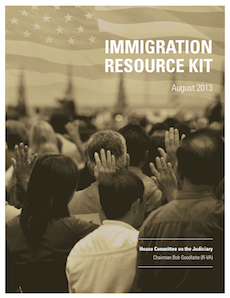
House Republican Immigration Resource KitBefore leaving for August recess, Republican members of the House received this document from the House Judiciary Committee, chaired by Representative Bob Goodlatte (R-VA). According to Rep. Goodlatte, the document was was put together to help members communicate to their constituents “the importance of immigration reform and the House Republican plan to produce solutions that actually fix the problems that plague our immigration system.” The document summarizes the individual immigration bills the House Judiciary has passed this session, as well as a list of concerns about the Senate comprehensive bill. (For those of you involved in adult education or English/Civics instruction, while not mentioned specifically, I think it is safe to say you are probably considered part of the “slush fund” mentioned in “Concern #10.”)

According to some sources, there hasn’t been a lot of activity on either side of the immigration debate during the break, so how I don’t how important these talking points have turned out to be, but I thought the document was interesting to read.

CIRbrief-2013House-SenateBills-Side-by-SideIf you are looking for a less partisan comparison between the Senate comprehensive bill and what the House has produced so far, the Migration Policy Institute has published a helpful side-by-side comparison.

I’m long past my own self-imposed deadline for posting an update on immigration reform  from an adult education perspective—which I’ll try to do this week—but in the meantime I thought I’d pass these documents along.

Interesting New DACA Data to Ponder

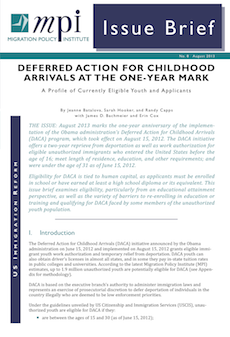
MPI - One Year DACA ReportThe Migration Policy Institute has just published a new policy brief, Deferred Action for Childhood Arrivals at the One-Year Mark: A Profile of  Youth and Applicants, which includes MPI’s most recent estimates on the current and prospective Deferred Action for Childhood Arrivals (DACA) population, and broken down into categories, such as educational attainment, English proficiency, state of residence, country of origin, age, gender, labor force participation, poverty and parental status.

MPI researchers think that about 1.9 million unauthorized immigrants are potentially eligible for the DACA program, with 1.09 million currently meeting the age, education, length of residence, and other criteria. About 392,000 of these individuals are too young to apply now but would become eligible once they reach age 15 if they stay in school or obtain a high school degree or equivalent.

It’s the remaining 423,000 young people who appear to meet everything but the education requirements that are of most interest to adult education advocates. MPI’s brief includes some interesting estimates regarding the educational attainment, English proficiency, state of residence, country of origin, age, gender, labor force participation, income, and parental status for this population. Not surprisingly, these individuals tend to be poorer and less English proficient than those who appear to meet all the DACA requirements. However, more of the individuals in this subset (71%) are in the labor force.