The Sequester Still Festers (But Maybe Not in 2014)

(Updated Below)

This column by Jared Bernstein in the Times neatly summarizes the limited expectations people have for the upcoming budget conference committee meetings, which are focused right now on the hope that the committee might at least be able to do something about the 2014 sequester cuts. A “grand bargain,” or any significant progress towards addressing any of the long-term problems in the economy, appears to be out of the question.

The theory is that there might be a (relatively) easy way to replace the 2014 sequestration cuts with some other cuts (or savings) from (most likely) mandatory programs that wouldn’t kick in until many years later. If this sounds like only a slightly better version of the usual kick-the-can-down-the-road approach, that’s because that’s what it would be: a brief respite from the sequester in return for some new cuts over on the mandatory side of the budget that we don’t have to think about until later, while avoiding dealing with anything else.

Bernstein makes a number of illuminating points in his column, like this one:

[R]eplacement cuts will most likely have to come from the mandatory side of the budget, which includes entitlements. Now, there are definitely entitlement savings — say, from Medicare — in the president’s budget that do not affect beneficiaries, like reducing the amount that Medicare spends on drugs by allowing the program to use its clout to get better bargains from drug companies. And there’s other wasteful spending on this side of the budget, like farm subsidies, that could also contribute. (my emphasis)

This paragraph suggested to me a potential approach to a problem facing many of us who will be advocating for sequester relief for non-defense discretionary (NDD) programs (which means almost all federal education programs, such as adult education) this fall: we may be asked by folks on the Hill to support cuts to entitlements in return for lifting sequester cuts.

This is problematic for a couple of reasons. For one thing, our job is to make the case for the program we are there to represent, not to take a position on cutting other programs. And for many of us who represent NDD programs for low-income people, cutting benefits potentially hurts the people we are there to represent, just in a different way. I don’t have the numbers in front of me, but I think it’s safe to assume that a higher-than-average proportion of adult education students probably receive Medicaid and Social Security benefits, for example. It’s a hollow victory to preserve adult education funding while pushing adult education students who benefit from those programs deeper into poverty. (In his column, Bernstein notes that Social Security benefits alone are keeping 22 million people in this country out of poverty.)

At the same time, just saying no doesn’t seem helpful, since, as Bernstein notes above, there are ways to save on entitlements that don’t necessarily involve cutting benefits. So  perhaps NDD advocates could express a preference for looking at entitlement savings that do not touch the actual benefits that people receive, at least as a second best option if raising revenue is off the table. If I’m in a member’s office talking about federal education programs, I still don’t think I have any business talking a position on farm subsidies, but, as a basic statement of principle, taking the position that “sequester cuts to NDD programs should only be replaced with entitlement savings that do not directly affect beneficiaries” at least provides some guidance to members as to what kind of direction they should be going in if they insist on replacing sequester cuts with some kind of cut from the mandatory side.

I should note that Bernstein and his colleagues at the Center on Budget and Policy Priorities also take the position that while they are open to this kind of trade-off, it should only apply to non-defense sequester cuts. That is, folks who want to replace the sequester for defense programs shouldn’t be looking over at the non-defense side for more cuts. To do so would violate an essential principle embedded in the deal that created the sequester: that budget cuts should come in equal measure between defense and non-defense.

UPDATE 10:20am: Stan Collander, who has been pretty good with predictions of late, has just published a post in which he argues pretty convincingly that even a sequester deal is unlikely.

Muted Celebration

This Wonkblog post makes a good point, and it’s the reason that the proposed deal to end the government shutdown and raise the debt ceiling is merely a cause for relief,  not necessarily celebration:

The mistake Republicans made was thinking that what worked from them in 2011 was simply the hostage taking. What worked for them in 2011 was winning in 2010. What made 2013 impossible was that they’d lost in 2012.

But Republicans should feel good about one thing: This process has been a reminder of how powerful that 2011 deal was and remains for them. Democrats are agreeing to fund the government at a level far beneath what they consider acceptable. Over the weekend, it became clear that Democrats are genuinely worried about sequestration’s 2014 cuts, which trigger on January 15th (the Senate deal is designed so the government funding runs out just as the new cuts trigger — which is to say, its timed to make the next fight a fight over sequestration.)

As Grover Norquist told me, with his characteristic understatement, “Sequester is the big win. It defines the decade.” (my emphasis)

Basically, what we are looking at this morning is a deal to avert disaster and put things back on the less disastrous but still basically terrible path we were on. The agreement (if the House goes along) still leads to diminishing funding for adult education and other federal discretionary programs for many years down the road.

The Wrong Message on PIAAC

(Updated Below)

Americans_are_dumber_than_average_at_math__vocabulary__and_technology_-_Quartz

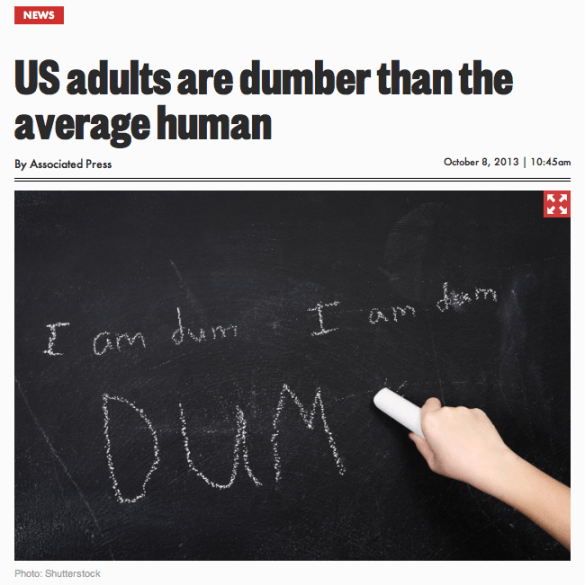
US_adults_are_dumber_than_the_average_human___New_York_Post

The initial of set of PIAAC (Program for the International Assessment of Adult Competencies) survey data released yesterday by OECD received a reasonable amount of attention from major U.S. news outlets, including the New York Times, the Washington Post, and the AP. I’ve nitpicked a little about the coverage, but by in large it’s been decent. (My biggest criticism is the lack of voices from the U.S. adult education field. The study is, after all, primarily concerned with adult literacy and numeracy skills, so one would think that one of our national adult literacy organizations would be good for a quote. Or maybe even an actual adult learner or two.)

But today I came across two stories (pictured above) that are accompanied by some pretty distasteful and misleading headlines and graphics, implying that those Americans OECD believes fall below average in literacy skill are, essentially, dunces. So let’s take a moment to explain why this is not only wrong, but also damaging.

Americans with poor literacy skills are not stupid. Many have struggled with reading and writing due to a disability, (including both physical disabilities and learning disabilities), and were never afforded the proper accommodation they needed to compensate for the disability. Some are refugees or immigrants from other countries with poor education systems or where English is not the native language. Others simply were not afforded the same educational opportunities that other Americans have been fortunate enough to have received. I knew an individual enrolled in an adult literacy program in Washington D.C., for example, who grew up black and poor, with an alcoholic father, in a rural area of a southern state in the days before the Civil Rights movement. He dropped out of school at a very young age to take care of his family and never learned to read much beyond a basic level. Worked as a laborer most of his life—but a bright and articulate guy, who just didn’t have the same kind of opportunities that I had growing up. That’s the kind of story that more often than not is behind your typical adult with below average literacy skills. It infuriates me when people label such individuals as “dumb.”

Moreover, employing such labels makes the problem worse. It’s embarrassing to admit that you have difficulty reading and writing. Many people who have struggled with reading all of their lives really do feel like they are stupid, and that makes it challenging for them to come forward and get the help they need.  I used to operate an  adult literacy hotline in Washington, and we used to get dozens of calls every day. I know what I’m talking about. The stories were often heartbreaking. The callers weren’t stupid people, but people who had struggled for one reason or another—usually it had a lot to do with being poor. Not due to some innate lack of intelligence. (Not that all adult learners are blameless—there are plenty of people enrolled in adult education programs who would own up to being serious f*ck-ups when they were younger—making mistakes that led them to failing, dropping out, or getting kicked out of school—but making a mistake, even a serious one, doesn’t mean you are incapable of learning.)

Labeling people as dumb also perpetuates the idea that policies designed to improve adult skills are doomed to failure—if these adults are just “dumb,” after all, then there really is nothing that can be done for them, right? Low literacy in this country exists largely because we let it happen. As the OECD report(s) make clear, there are policies we can put into place to change this. It’s not a question of whether low-skilled adults can learn, but whether we will provide them with the opportunity.

As the Speaker of the House said the other day about the government shutdown, this isn’t a damn game. Thankfully, most of the media isn’t treating it like one.

UPDATE 10/10/13: The Atlantic picked up the Quartz story above. (Apparently Quartz is a “sister site.”) However, for The Atlantic version, the headline was changed from “Americans Are Dumber Than Average in Math, Vocabulary, and Technology” to “Americans Are Way Behind in Math, Vocabulary, and Technology.” It appears from scanning the comments that they might have originally used the Quartz headline, but I’m not certain. Thankfully, The Atlantic version does not include the picture of the boy in the dunce cap either. Instead they opted for a less offensive—but far more inexplicable—screen shot from the movie Legally Blonde, which makes absolutely no sense at all. (If I remember correctly, the main character in that film is perceived as dumb, but is actually quite intelligent, despite appearances. This is pretty much the opposite of what the study is telling us—that a nation, we are not as skilled as people may believe.)

I also want to say one other thing about the media coverage. More disturbing, really, than the thoughtless headlines above (which, as I mentioned, aren’t typical of the coverage), is the fact that from what I’ve seen, none of the major media outlets reporting on this story have mentioned or seem to even be aware of the fact that there is an adult education system in the United States. My hope was that as a field we could use this opportunity to not just point out the the problem, but to highlight the success stories in adult education that demonstrate that the problem is solvable. Maybe I’ve missed something. If you know of any good examples, let me know in the comments.