Found: A Sequester Cut to Adult Education

For a variety of reasons, which I won’t go into here, it’s been difficult to identify adult education program cuts that are clearly the direct result of sequestration. But they have been happening:

WALTHAM — The City Council on Monday night argued back and forth over funds for an adult literacy program that saw its federal funding cut last year, ultimately sending the request back to committee and asking the School Department to try to come up with the money.

The Power Program, a nonprofit adult literacy organization, has been in existence for 27 years, but had its funding cut last year after there were across-the-board educational cuts on the federal level. (my emphasis)

via Wicked Local Waltham.

Monday Morning Reads

A couple of articles from last week that are worth checking out if you missed them:

Why No Literacy Programs for 30 Million in U.S.?
This Remapping Debate piece by David Noriega reviews the current system of adult basic education in the U.S. and asks various experts (plus me) why there hasn’t been a more aggressive, coordinated investment in adult literacy services from either the federal government or states. Noriega asked members of Congress about federal action to address the issue and the responses aren’t encouraging:

Remapping Debate reached out to 13 members of the House and Senate of both parties, all with high-ranking positions on the relevant committees and subcommittees and many with past action on adult literacy on their records. Besides one who cited a scheduling conflict, only three responded, and of these only one—Rep. John F. Tierney, Democrat of Massachusetts—gave more than an emailed statement.

Tierney, who sponsored the Democratic House bill that would have nearly doubled funding, said the waiting list for adult education programs in his state has remained at close to 20,000 since he came into office in 1997. “The resources clearly are not sufficient,” Tierney said. He added that, while securing those funds is difficult in a House bent on cutting billions in food stamps, this doesn’t mean the money ins’t there. “We understand we have to make some hard decisions on prioritization, but there are plenty of places within our budget—if you include the military as well as the domestic budget—where we can move resources to the places they have to be. And this is a place where it’s obviously appropriate to do that.”

Rep. Phil Roe, Republican of Tennessee and chairman of the Health Education Labor and Pensions subcommittee of the Education and Workforce committee, emailed a statement detailing the intentions of the Republican bill that passed the House. In the statement, Roe characterized the bill as intended to improve adult literacy by cutting down on inefficiencies in the current system rather than by devoting more resources to the problem.

The office of Sen. Tom Harkin, Democrat of Iowa and chairman of the senate’s Health Education Labor and Pensions committee, emailed a brief statement summarizing the bipartisan bill that passed his committee but did not respond to follow-up questions about whether more funding is needed.

Imagine if that question had been about early childhood education.

‘We Cannot Forget People Who Did Not Graduate From High School’
Fawn Johnson, who, among other things, covers the immigration beat for National Journal, wrote this article for The Atlantic on GED classes at La Guardia Community College in New York. The article extolls the results of La Guardia’s “contextualized” approach, as compared to regular GED prep, while glossing over the important fact that the students in the “contextualized curriculum” classes spend more time in class. Without diminishing the benefits of the instructional approach, it’s not really surprising to see better pass rates from students who are able to spend more time in class, whatever the curriculum.

I mention this because it goes back a point I was trying to make with Daniel for his article, which is that I think too much emphasis is sometimes placed on methods and models when the biggest problem is simply a lack of will to get things done. There are plenty of adults who have succeeded without the benefit of whatever is considered the best program model at any given moment. For many people, access to any instruction of some reasonably decent level of quality, in a supportive environment, with the opportunity to really focus a sufficient amount of time on the task at hand, is probably going to be pretty effective. But to create a system across the country that would provide these things for anyone who needs it—particularly low-income adults—is going to require a substantial investment. Not just an investment in instructional resources and teachers, but in the other kinds of supports (child care, housing, jobs with reasonable wages and more paid time off, etc.) that as a country we don’t seem willing to make right now.

Notice Anything Missing in the President’s Speech Today?

Less than two months ago, the results of an international survey (PIAAC) revealed that American adult literacy and numeracy skills lag significantly behind those of adults in most other developed countries. Approximately 36 million U.S. adults were estimated to have low skills. These are adults who lack sufficient skills to succeed in higher education or training, and thus are often stuck in dead-end, low-paying jobs.

A report issued along with the initial results noted that “countries with lower skill levels risk losing in competitiveness as the world economy becomes more dependent on skills.” Less than a month ago, a followup report from the Organization for Economic Cooperation and Development (which administered the survey) called for “concerted action” by the U.S. to address this problem, warning that without such action “the skills of adults will fall further behind other countries.”

Today, the President gave a major address on the economy here in Washington. During the speech, he offered what he called “a road map that I believe should guide us in both our legislative agenda and our administrative efforts,” and listed policy areas “where you should expect my administration to focus all our efforts” over the rest of his term. One of those areas, not surprisingly, included education. In light of those very recent PIAAC findings, you might be curious about what the President had to say specifically about the nation’s 36 million low-skilled adults during this part of his speech:

Step two is making sure we empower more Americans with the skills and education they need to compete in a highly competitive global economy. We know that education is the most important predictor of income today, so we launched a Race to the Top in our schools, we’re supporting states that have raised standards in teaching and learning, we’re pushing for redesigned high schools that graduate more kids with the technical training and apprenticeships, the in-demand high-tech skills that can lead directly to a good job and a middle-class life.

We know it’s harder to find a job today without some higher education, so we’ve helped more students go to college with grants and loans that go farther than before, we’ve made it more practical to repay those loans and today, more students are graduating from college than ever before.

We’re also pursuing an aggressive strategy to promote innovation that reins in tuition costs.

We’ve got to lower costs so that young people are not burdened by enormous debt when they make the right decision to get higher education. And next week, Michelle and I will bring together college presidents and nonprofits to lead a campaign to help more low-income students attend and succeed in college.

But while — applause — while higher education may be the surest path to the middle class, it’s not the only one. We should offer our people the best technical education in the world. That’s why we’ve worked to connect local businesses with community colleges, so that workers, young and old, can earn the new skills that earn them more money.

And I’ve also embraced an idea that I know all of you at the Center for American Progress has championed, and by the way, Republican governors in a couple of states have championed, and that’s making high-quality pre-school available to every child in America. Cheers, applause.

We know that kids in these programs grow up are likelier to get more education, earn higher wages, form more stable families of their own. It starts a virtuous cycle, not a vicious one. And we should invest in that. We should give all of our children that chance.

In other words: nothing. No mention of those 36 million low-skilled adults at all, and nothing in the speech suggested that the President is planning to propose any major new initiatives to address the needs of those adults anytime soon, despite the dire warnings we heard just a few weeks ago about how the failure to act will have such a detrimental effect on our economy.

You can read the full transcript of President Obama’s remarks here.

U.S. Department of Education Response to OECD’s Call to Action

(Updated Below)

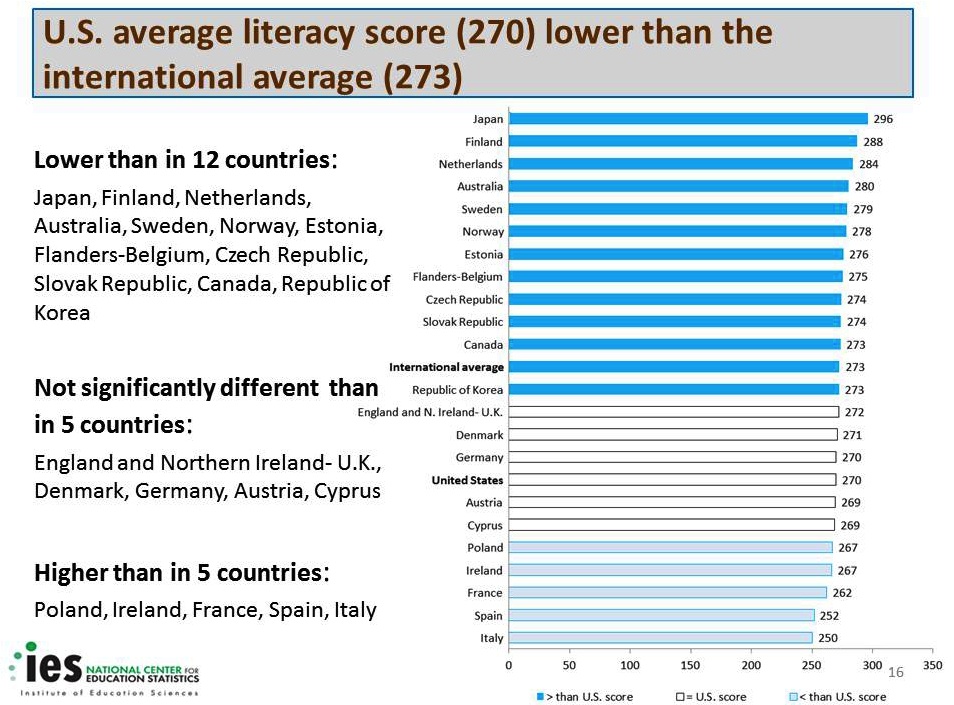
Last week, the Center for American Progress (CAP) and the Organization for Economic Cooperation and Development (OECD) co-hosted an event at CAP that basically served as the coming out party for a special U.S.-focused OECD report on the findings of the international Survey of Adult Skills, a product of the Programme for the International Assessment of Adult Competencies (PIAAC). As I’ve noted in previous posts, the findings  for the U.S. are not encouraging. Here’s a chart from that report showing the relatively poor state of U.S. literacy skills:

OECD Literacy Chart

After the OECD’s main presentation, Assistant Secretary for Vocational and Adult Education (OVAE) Brenda Dann-Messier outlined some specific actions that her office is taking in response to the report. You can view the entire event (including her complete speech) in the video at the end of this post, but I wanted to highlight the action steps, which were as follows:

(1) Her office will be developing a new national plan, to be released at the end of April, aimed at improving “the foundational skills” of low skilled adults.

(2) The plan will be informed in part by a series of five regional “engagement sessions” around the country, beginning with a session here in D.C. on Wednesday. (These “engagement sessions” may sound familiar.) OVAE will be working with the Department of Commerce to ensure that representatives from the workforce development, human resources, business, and labor communities “are actively engaged in these regional sessions.” OVAE also plans to gather “additional input” in each region from adult learners and teachers in local adult education and workforce training programs.

(3) Just like on Jeopardy, there’s a take-home edition: OVAE has put together a toolkit for people who want to host their own engagement sessions or roundtables. Feedback from these sessions will be collected and considered during the planning process. (OVAE also plans to provide opportunities for individuals to submit comments as well.)

(4) OVAE has produced a new set of state fact sheets that profile the low-skilled adult population in each state. (There’s a national profile, too.) This announcement was a bit puzzling to me, as the Assistant Secretary emphasized (correctly) that these profiles are not based on PIAAC but on schooling and educational attainment data from the American Community Survey (ACS). As I mentioned in an earlier post, I think the PIAAC data really drives home the importance of not conflating skills with educational attainment.

(5) The final action step was a puzzler as well, if only due to lack of detail. The Assistant Secretary announced a new “awareness campaign” with an organization called Connect2Compete, in order to, in her words, “create access for the approximately three million low-skilled adults” identified in PIACC “who want to participate in  adult education but can’t due to lack of space or other constraints.”

Through the “Everyone On” campaign, millions of low-income american families can acquire low-cost high-speed internet access and low-cost, high-end devices, such as tablets and laptops. We’re particular exited about the opportunity to work together to not only qualify our students for affordable access and devices, but also to help adult learners connect with everyday services, engage in their communities, apply for jobs, and access high-quality online learning opportunities 24/7, 365 days a year.

This resource sharing effort will help us expand the infrastructure for adult learning in our country so that many more low-skilled adults can access high quality learning anytime, rather than exclusively relying on the WIA infrastructure which has the capacity to serve less than 2 million low-skilled adults per year. (my emphasis)

It’s hard to know what to say about this until further details are revealed. The reference to not “exclusively relying” on WIA (aka the Workforce Investment Act) is curious. It’s also worth noting, for now, that eligibility for many of Connect2Compete’s programs are tied to having children who are eligible for the federal school lunch program. Many adults in need of adult education services, of course, are without children. I’m also curious about how much of this effort is simply increasing awareness of Connect2Compete’s services, or whether there are some specific new resources for adult learners that will be developed. Hopefully, whatever this is, it will leverage and expand the existing efforts to provide online learning opportunities for adults, like this one.

One thing this announcement definitely didn’t include: more funding. That, of course, it is beyond the power of the administration to provide new funds without Congressional approval (although sometimes they can fund new programs by shifting money around or finding savings somewhere). However, that does not mean the administration is prevented from proposing that Congress provide new funding for adult education, which is exactly what the President did for pre-K education in his budget last year. In fact, major new pre-K legislation, based in large part on the President’s request, was rolled out great fanfare on Capitol Hill the very day after the OECD report on adult skills was unveiled at CAP. The House version of the Pre-K bill includes an authorization of $27 billion dollars for pre-K. (Federal support for adult education is well under a billion dollars annually.) This doesn’t mean that Congress will actually ever pass these bills, let alone appropriate those kinds of dollars for pre-K, but the proposal is, at least, on the table.

Make no mistake: the reason adult learners suffer from a “lack of space or other constraints,” is because nothing even remotely close to sufficient funding is being invested in these things. The question for those concerned about adult skills is whether, in the absence of even a modest proposal to increase funding for adult education, the administration is seriously committed to addressing the problem.

Update 11/19/13: I made a small edit above clarifying the ability of the administration to fund new programs. While it’s true that the executive branch can’t appropriate entirely new funding, the administration sometimes had discretion within program categories to allocate or re-allocate funds in order to pay for new programs.