Faith-Based Policymaking in West Virginia

From an article published today in the Charleston Gazette on West Virginia Governor Tomblin’s executive order requiring drug testing for anyone participating in training programs funded under the federal Workforce Investment Act:

Labor union leaders and other worker advocates have questioned the push for workforce-related drug screenings. West Virginia AFL-CIO President Kenny Perdue called on the state’s major industries to provide more information amid concerns that the drug issue has become an excuse to hire out-of-state.

“I do believe that the over-abuse of drugs in this state is not as bad as everybody makes it to be,” Perdue said Tuesday. “I’ve talked to too many people and learned of too many cases that show that it’s not as serious as they say.”

Steve Roberts, president of the West Virginia Chamber of Commerce, said his group has no hard data but that he encounters businesses with this concern in all parts of the state.

“Many employers really do have trouble finding people to hire who are eligible to work, who have the skills the employer requires and who can pass a drug test,” Roberts said Tuesday. “I have to believe that the problem is significant, or I wouldn’t be hearing it every place I go.”
White House Claims House Republican Budget Would Eliminate Training and Employment Services for 3,500 D.C. Residents Over the Next Two Years

The White House Office of Management and Budget has released a couple of charts showing what they believe to be the impact of House Budget Committee Chairman Paul Ryan’s budget plan, released last month.

Basically, they’ve taken the cuts and, using existing allocation formulas, spread them out proportionately across employment and training programs and, for education, across four major educational programs: Pell Grants, work study, special education, and Head Start. Unfortunately, the analysis of education program cuts does not include the District of Columbia, which is strange, since I can imagine more people in the District are impacted by the programs they highlighted than those living, in say, Wyoming.

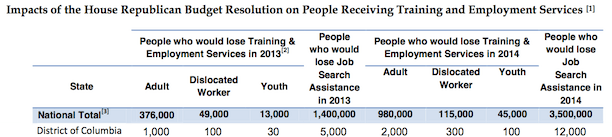
However, they do include D.C. in their analysis of employment and training programs. The projected decrease in participants in these programs was derived by applying the percentage reduction in funding for each state to the national projected reduction in the number of participants served. Here is the breakout nationally, and for the District:

D.C. Chart: Ryan Budget Impact on Job Training

Source: White House

As you can see, they estimate about 1,130 District residents across three categories (adults, dislocated workers, and youth) will lose employment and training services in 2013, and about 2,400 in 2014, for a total of 3,530 over two years. In addition, they estimate 17,000 people will lose access to job search assistance.

Here are links to both charts, which are a bit hard to find on the White House site:

U.S. Chamber of Commerce Claims There Is a “Surplus” of Skilled Workers in U.S.

From an April 2nd NEWS.com.au story on the Australian government’s plan to fill Australian jobs with U.S. workers (which, according to the story, is supported by Australian and U.S. business groups):

“In contrast to the surplus of skilled workers in the US, Australia has intensifying skill shortages and comparatively low unemployment,” said a joint statement from the Australian Industry Group, the Business Council of Australia, the American Chamber of Commerce in Australia (Amcham), and the US Chamber of Commerce. (my emphasis)

Older, Long-Term Unemployed May Lose Education Advantage

Overall, the unemployment rate for workers with a college degree is about half the rate of those who hold just a high school diploma, but that gap appears to narrow for older, long-term unemployed workers. From an article by Arthur Delaney in The Huffington Post yesterday:

[A]dvanced degrees can lose their talismanic power. Once they become unemployed, college-educated workers are just as likely as high school grads to wind up unemployed for an extended period of time. During the year ending last June, 12.4 percent of jobless workers with high school diplomas had been out of work 99 weeks or longer, according to a Congressional Research Service report. Among unemployed Americans with a bachelor’s degree, 11.3 percent had been jobless 99 weeks or longer — a statistically insignificant difference. (my emphasis)

Delaney speculates that one of the reasons for this statistical narrowing is that workers with just a high school education are more likely to leave the labor force, which then reduces the proportion of those workers who count as officially unemployed. Another possibility, he writes, is that that “since a majority of new jobs created during the economic recovery are lower-paying and lower-skilled, they are easier for less-educated workers to learn, while higher-educated workers are simultaneously being more selective about the jobs they’re willing to work.”