For those interested in the immigration reform legislation currently under consideration in the Senate, I co-authored a more detailed followup to my earlier quick take on the bill for the National Coalition for Literacy. Here is the link to that post.
Adult Literacy
What It Takes
(Updated Below)
A small contingent of adult learners attending the National Adult Learner Leadership Institute here in Washington paid a visit this afternoon to the U.S. Department of Education to meet with the Secretary of Education, Arne Duncan, and the Assistant Secretary for Vocational and Adult Education, Brenda Dann Messier. I was fortunate enough to be able to tag along.
Looking over my notes from the discussion, I am struck by how often the discussion turned to (1) what I’d call non-academic issues that nonetheless make adult education a challenge for many adults (especially low-income adults): busy work schedules, raising children, transportation, etc.; and (2) the impact that prior trauma and/or existing disabilities can have on learning, and the need for more resources that are appropriate for these learners.
This isn’t surprising, really—and these issues are well-known by people in the field—but it occurred to me that from a public policy perspective, our efforts to think about and address these issues are a bit underdeveloped. Adult education policy leans a bit more in the direction of what I think of as academic issues (teacher quality, professional development, standards, assessment, etc.) and less on the non-academic issues that can have as much of an impact on adult learner success as anything else. The best instruction in the world can’t do much for a mother who can’t come to class because she can’t find a childcare provider. This is why adult education advocacy can’t begin and end with the number in the line-item for adult education—a cut to housing services or childcare in the state or local budget can have every bit as much of a destructive impact on adult education enrollment and success as a cut to adult education itself.
As for special needs: again, it’s not that adult education policymakers (or programs) ignore these populations, but outside of what are commonly thought of as learning disabilities (such as dyslexia), it’s fair to say that few adult education programs or teachers specialize in serving those with physical/sensory/cognitive disabilities or mental health issues, and I don’t think there is much policy-oriented research available on how best to meet their needs. (This is yet another case where I’d really love to be wrong, so please correct me if I am—but I’ve been in many, many big-picture adult education policy meetings in my life and rarely—if at all—are mental health or disability issues discussed. But these issues come up often, one way or another, when you discuss policy with adult learners.)
Not surprisingly, many of the best programs in adult education do provide or arrange for other support services, including counseling, child care, health and mental health services (including drug and alcohol treatment), service coordination (case management), homelessness and housing services, and other social services. But again I’d say that programs offering a full range of wrap-around services are still pretty rare.
A lot of things have to be in place in order for some adult learners to succeed. If we agree that it makes good public policy sense to provide all adults with limited skills and/or lacking academic credentials with the opportunity to be successful adult learners, we need to look more carefully at what it takes—not only inside the classroom but outside of it—and advocate for policies that support those conditions.
UPDATE 5/10/13: Right after I wrote this post, I learned that World Education is offering an online course this summer for teachers interested in learning more about how chronic stress, trauma, and other adverse life experiences can affect learning. More information here.
UPDATE 5/23/13: The Department of Education has published a blog post about the visit with Secretary Duncan. The post includes a great video of one of the meeting participants, Shamika Hall, talking about her experience going back to school as an adult:
Business Models
Offering fee-based services for those who can afford it, in order to generate income to support free ESL/literacy services for those who can’t, makes a lot of sense—especially contracts with other organizations and businesses for custom-designed services. This isn’t a new idea, but it’s probably something more organizations that provide community-based literacy instruction ought to be looking at. I just can’t see a scenario in the near future in which government funding (federal, state, or local) for adult literacy or ESL is likely to substantially increase, and growth in foundation and charitable giving in general is likely to continue to be pretty flat. At the same time, immigration reform appears to have at least a reasonable chance of passage in the near future, and if it does, that will likely open up even more opportunities for fee-based English language instruction and translation services.
Septima Clark
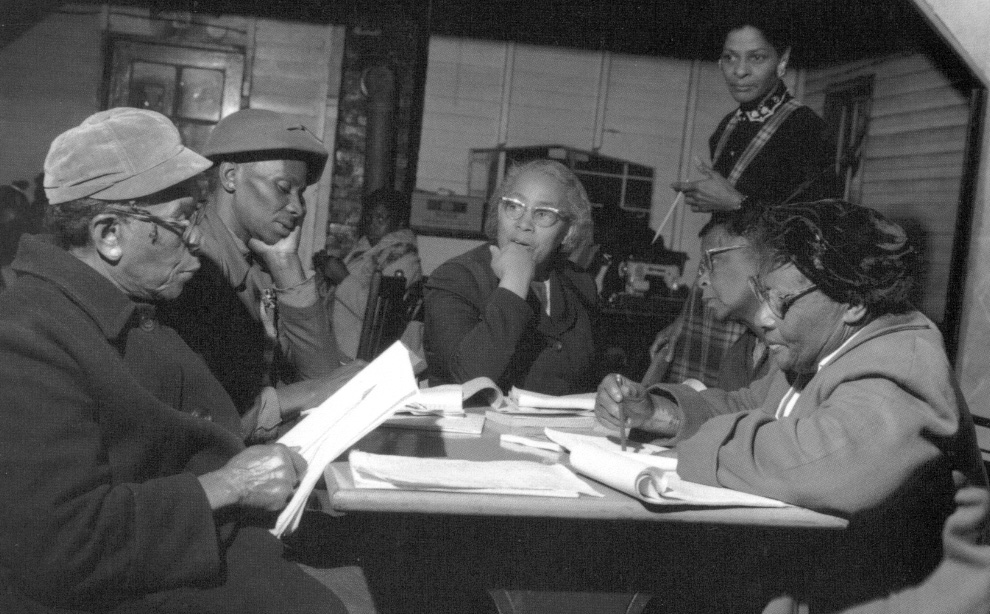
Septima Clark (center). Date/source of photo unknown.
Septima Poinsette Clark was born on this day 115 years ago. Without question one of most important figures in the American Civil Rights movement, the story of her role in advancing adult literacy in the U.S.—and in drawing attention to the connections between education, poverty, and political power—should be mandatory reading for anyone interested or involved in adult literacy or education—especially the “education is the civil rights movement of our time” folks who seem to believe that the relationship between civil rights and education began sometime around the year Teach for America was founded.
Clark is best known for her role in developing the Citizenship Schools of the 1950s and 60s, where thousands of disenfranchised African Americans across the southern U.S. learned to read and write in order to pass the literacy tests required by southern states to register to vote. But while voting was the focus, the schools also emphasized the role of literacy as an instrument of empowerment more broadly.
And unlike today, this was at a time—not that long ago—when teaching reading in such a context was truly dangerous. Classes often had to be taught in back rooms of stores and other hidden places. Teaching people how to read helped countless Black Southerners push for the right to vote, but beyond that, it developed leaders across the country that would help push the civil rights movement long after 1964.
Clark wrote two autobiographies during her lifetime: Echo in My Soul and Ready from Within: Septima Clark & the Civil Rights Movement, A First Person Narrative. A collection of her papers is archived here, although none of it seems to be accessible online. But there is a great online “scrapbook” of images, newspaper clippings, and correspondence related to her life at the Lowcountry Digital Library site.
 Literacy & Policy