Department of Education Releases Fact Sheet on English Literacy Education in the Adult Basic Grant Program

English Literacy Education in the Adult Basic Grant ProgramThe Office of Vocational and Adult Education at the Department of Education recently released a one-page fact sheet on English literacy education in the Adult Education and Family Literacy Act (AEFLA) grant program administered by the Division of Adult Education And Literacy. It includes useful statistics on student enrollment, outcomes, and demographics.

I don’t know this for a fact, but I have to assume this was put together as a resource for folks on the Hill working on immigration reform (English language acquisition is an issue in the pending legislation, since the pathway to citizenship will require undocumented immigrants to demonstrate some level of English proficiency).

Investing in Parents

A couple of weeks ago, in a post about a meeting between a group of adult learners and Secretary of Education Arne Duncan, I mentioned being struck by how often the discussion turned to the non-academic barriers that can make adult education a challenge for many people.

Yesterday the National Journal published a story about the Jeremiah Program in Minneapolis, which provides low-income single mothers enrolled in college with subsidized housing in residential communities with on-site child care, in the belief that a lack of secure housing and child care are the biggest barriers preventing these young women from finishing college. (A pilot program in Austin, Texas is also underway, and there are plans to open a new campus in Fargo, North Dakota, next year)

To qualify for the program, these women have to be enrolled in college, but it’s not difficult to envision how this model could be adapted for adult learners seeking to improve their literacy and/or earn a high-school credential.

Jeremiah’s return on investment numbers also demonstrate, once again, the wisdom of investing in parents (especially mothers) in order to improve school readiness and reduce child poverty:

An independent study from Wilder Research of St. Paul found that every dollar invested in Jeremiah Program families can return up to $7 to society at large, both by reducing the family’s dependence on public assistance and by increasing the economic prospects of both mother and child. Sixty percent of the program’s 2011 graduates were unemployed when they entered the program, and the rest were earning an average of $9.46 per hour. Upon graduation, the women started earning an average wage of $19.35 per hour. Graduates leave with better parenting skills, and their children get the benefit of high-quality early-childhood care. 

Gloria Perez, Jeremiah’s president and CEO, told the National Journal that “everybody seems to acknowledge, across all political lines, that the mother tends to be the primary educator of the child and role model for the child,” but unlike the calls to invest in pre-K education, you don’t hear as much about scaling up programs that invest in parents. And yet the return on investment numbers here are just as powerful as those used to support the case for investing in pre-K.

Senate Workforce Investment Act Reauthorization Proposal May Tie Funding to GDP

Interesting post from Neil Bomberg of the National League of Cities:

Earlier this week and in a meeting with NLC, Sens. Patty Murray (D-WA) and Johnny Isakson’s (R-GA) offices announced the framework for the Senate WIA reauthorization bill. NLC welcomed the good news that the bipartisan measure will likely retain the current state and local governance structures, including a strong role for local elected officials and business leaders with local workforce development areas based on local labor markets or economic regions rather than political boundaries. The Senators’ offices also indicated there will be an effort to move forward with “smart consolidation,” which means taking a measured and evidence-based approach to program elimination and consolidation, and to avoid consolidating programs simply for the sake of consolidation. Finally, the offices indicated an interest in basing workforce development funding on a percentage of the overall gross domestic product (GDP) with expenditures increasing during economic downturns expenditures so that unemployed workers are able to receive the assistance they need. (my emphasis)

That last idea (that I bolded) is new to me. Interesting.

Final Estimated Federal Funding for Adult Education for Fiscal Year 2013

(Updated Below)

On April 30th, the Department of Education released funding tables (by program and by state) for FY 2012 and FY 2013 appropriations, and FY 2014 estimates. As a result, we now know the final estimated total allocation for WIA Title II (or AEFLA) Adult Basic and Literacy Education State Grants for FY 2013: $563,954,515. This includes $70,811,239 for English Literacy and Civics Education State Grants. That’s a cut of about $31 million dollars of federal support for adult literacy in comparison with FY 2012. (But it’s worse than that when you adjust for inflation—see below.)

Fiscal years 2012 and 2013 are based on currently enacted appropriation bills, and the amounts listed for FY 2013 include the effect of the sequester and an across-the-board cut in the final appropriation. FY 14 estimates are based on the president’s proposed budget, and barring a miracle, those estimates are well over what we’ll actually see in the final FY 2014 appropriation.

These tables also include the estimated state allocations. I’ve pulled those out for you here:

State AEFLA Allocation rev05-13-13State Allocations: Adult Basic and Literacy Education State Grants: FY 2012 Appropriations, FY 2013 Appropriations, and FY 2014 estimates
State AEFLA ELCivics Allocation rev05-13-13State Allocations: English Literacy and Civics Education State Grants (Excluded from Adult Basic and Literacy Education State Grants): FY 2012 Appropriations, FY 2013 Appropriations, and FY 2014 estimates

These tables were updated yesterday, but no changes were made to the WIA Title II grants, at least as far as I can tell.

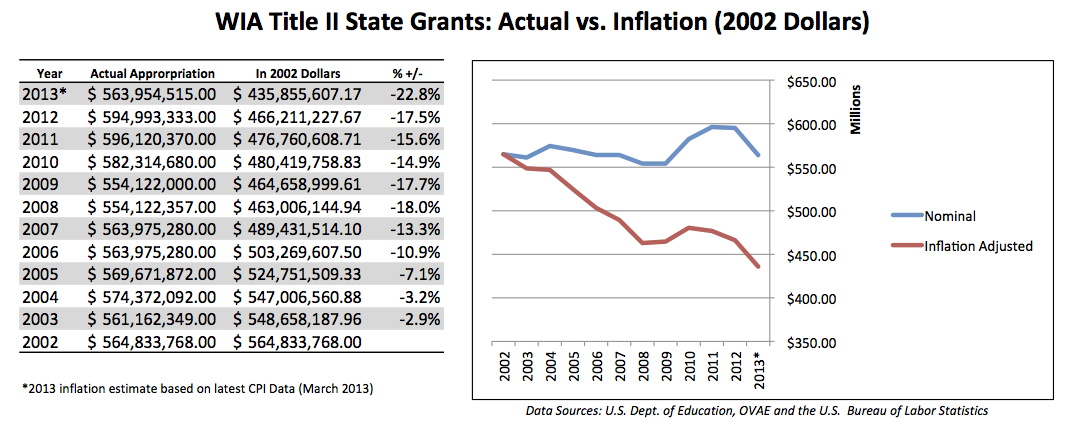
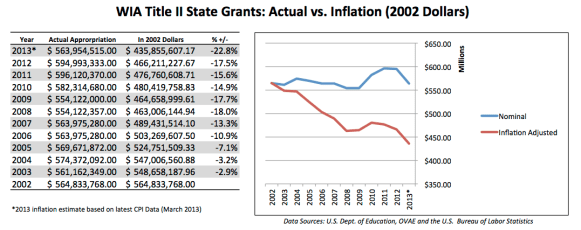
As I mentioned above, federal funding for adult education is even more grim once you adjust for inflation. Based on these figures, I took a stab at estimating the buying power of $563,954,515 in 2002 dollars. I used that figure because the last time I saw this calculated, 2002 was used as the baseline. I plan to follow up at some point with a longer post on calculating the effect of inflation, and the effect of using different baselines (and maybe even different methods, too) but for now this seemed like a good place to start. (For FY 2010, I did not include the one-time adjustment made by the Department of Education to make up for several years of underpayment to some states—that anomaly wasn’t carried over and shouldn’t be interpreted as growth, so I left it out.) (Note: this chart was updated 02/18/14.)
AEFLA Grants to States 2002-13 Graph

Using the most recent CPI (March), I calculate that $563,954,515 equals about $435,855,607 in 2002 dollars. Again, that’s a rough estimate, using the March CPI (for the other years I can use an annual average), but it’s close enough. The main takeaway here is that pre-sequestration the field was receiving somewhat stable, more-or-less flat, funding (that’s the blue line)—even, arguably, with the 2013 cut—but once you adjust for inflation (the red line)  you can see that the field has actually lost about 23% in real dollars in comparison with the appropriation of 2002.

Finally, don’t forget that other federal programs that are vital to adult education programs (Community Development Block Grants, CNCS/AmeriCorps, grants from USCIS, etc.) were also subject to sequestration cuts.

That’s a lot to chew on. Take a look and let me know if you have any comments or corrections.

UPDATE 2/18/14: This table has been updated to reflect the final 2013 CPI numbers.